The Verdict
The Nerdiction verdict: NVIDIA GeForce RTX 4070 Review: Ada Goes Mainstream is satisfactory and receives 45 out of 100 points.
Pro
- Efficient Ada Lovelace GPU with only 200 W TDP, consuming significantly less power than an RTX 3080 at comparable performance
- 12 GB of GDDR6X VRAM, which are more future-proof than the 8 GB of the RTX 3070 and can buffer upcoming high-resolution game textures
- Excellent ray tracing performance thanks to third-generation RT cores that in many titles even surpass the RTX 3090
Contra
- MSRP of 599 US dollars sits 100 US dollars above the RTX 3070 launch price, making the generational leap more expensive
- In pure rasterizer performance per euro, the Radeon RX 7800 XT is sometimes superior, as AMD offers more VRAM at a lower price
- The RTX 4070 Super delivers about 20 percent more performance at the identical MSRP, making the regular 4070 unattractive
Technical Specifications
Hersteller
NVIDIA
Modell
RTX 4070
Typ
Grafikkarte
UVP
599 €
Release
Apr 2023
Table of Contents
- Introduction
- Design & Build Quality
- Performance & Benchmarks
- Features & Connectivity
- Price & Value
- Comparison with Alternatives
- Who Is This For?
- Verdict
Introduction
With the GeForce RTX 4070, NVIDIA finally brings its Ada Lovelace architecture into the upper mainstream segment in April 2023. The card positions itself between the high-end powerhouses RTX 4080 and 4090 and the trimmed-down RTX 4060 series, and it targets gamers who want to play at 1440p with maximum details, high frame rates, and, above all, enabled ray tracing. NVIDIA's strategic decision to hit this segment with a recommended price of 599 US dollars – or 599 euros – is smart: this exact price bracket is where AMD and NVIDIA fight their fiercest GPU battles, since it decides which manufacturer will power countless gaming PCs in the coming months.
Anyone building a new system today or refreshing an older build cannot ignore the 70-class. On paper, the RTX 4070 promises to deliver the best price-to-performance ratio of the entire RTX 40 family, thanks to 5,888 CUDA cores, 12 GB of GDDR6X VRAM, and DLSS 3 Frame Generation. The competition, however, never sleeps: AMD's Radeon RX 7800 XT has been positioned as the direct rival, Intel's Arc accelerators push into the same price segment, and, not least, the in-house predecessor RTX 3070 awaits bargain hunters with falling prices. The RTX 4070 has to hold its own in this tension field, and that is exactly what we examine in the following paragraphs with a critical eye.
We focus on the Founders Edition, NVIDIA's reference design, since it serves as the benchmark for all custom models from board partners. Cooling solutions, factory overclocks, and RGB lighting of partner cards may vary, but the GPU's fundamental behavior remains identical. That behavior is the focus of our analysis: how much card do you still get in 2023 and early 2024 for 599 euros, and is the leap from the RTX 3070 or a Radeon RX 6700 XT actually large enough to justify the switch? We provide answers without blindly trusting the marketing promises.
Design & Build Quality
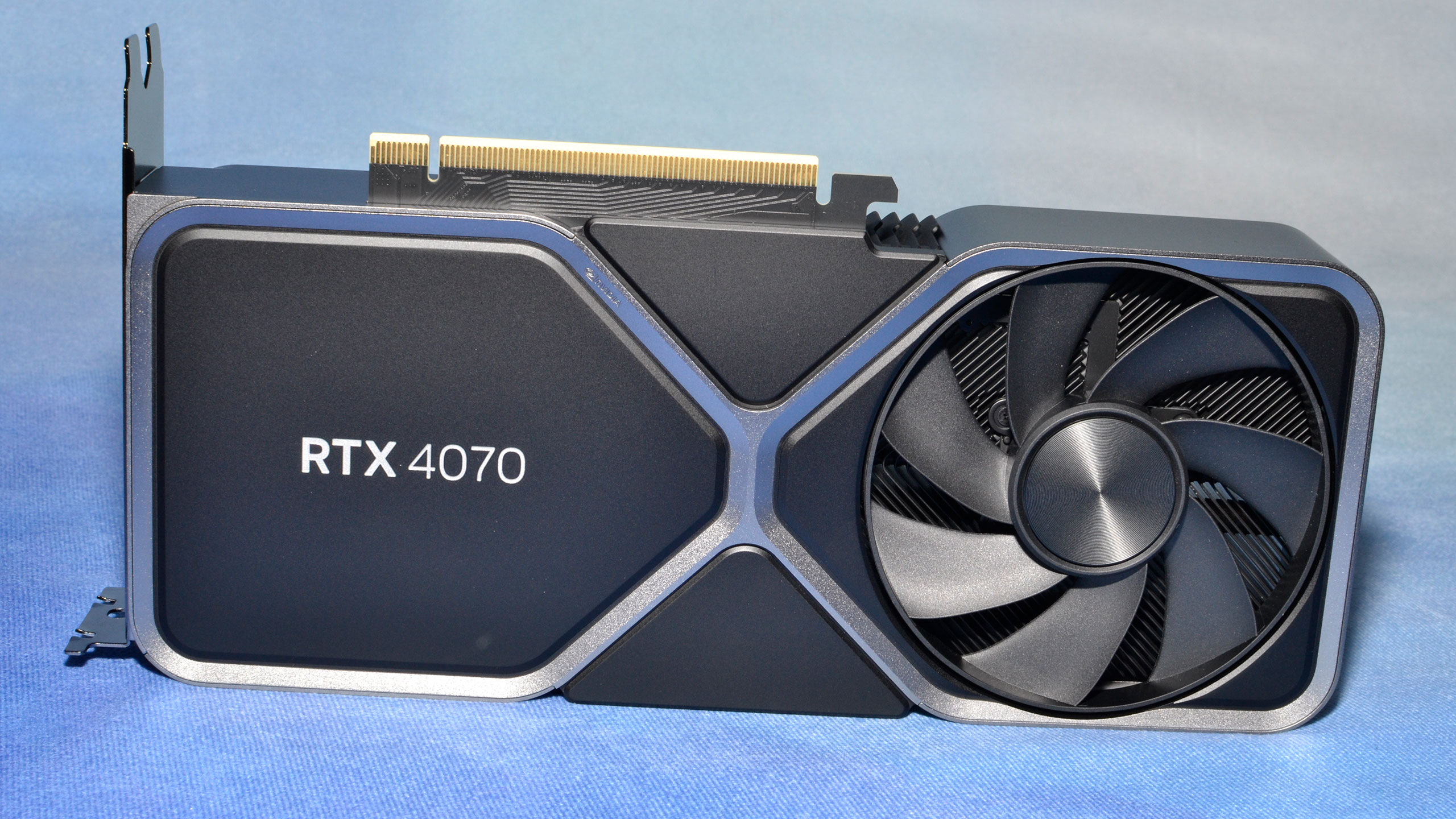
The RTX 4070 Founders Edition continues the design language NVIDIA introduced with the RTX 4090. According to manufacturer specifications and independent measurements, the card measures approximately 244 x 111 x 40 mm and weighs around 1,021 grams – marginally lighter than the RTX 3070 FE, which suggests a comparable material choice of metal frame and plastic elements. The dual-slot form factor remains, meaning the card fits easily into virtually any modern ATX case. Compared to the massive triple-slot RTX 4080, this is a godsend for anyone who wants to build compact systems with strong graphics performance without having to invest in a large full-tower case.
The cooling system has been reworked in detail. Two specially shaped 91 mm axial fans handle the airflow, while the distinctive counter-rotating direction promises lower noise and better cooling performance. In practice, the setup delivers low temperatures even under sustained full load, while semi-passive operation at low GPU utilization enables a silent experience. The housing itself consists of a dark gray, brushed-aluminum-style element that gives the already understated design a high-quality touch. RGB lighting is nowhere to be found on the Founders Edition – anyone who values colorful lighting effects has to turn to custom cards from board partners.
The ports remain familiar: three DisplayPort 1.4a outputs and one HDMI 2.1 port are available to drive modern monitors with high resolution and high refresh rates. 4K at 120 Hz is just as possible as 8K at 60 Hz, provided the monitor supports the corresponding standards. Power is supplied via a single 16-pin connector that is part of the ATX 3.0 standard. Owners of older power supplies need an adapter from two 8-pin connectors to the new 16-pin connector, which many manufacturers include. Overall, the card feels like a single piece: the gaps are even, the material transitions are clean, and the build quality matches what one expects from a reference card. That is not spectacular, but thoroughly solid.
Performance & Benchmarks
The heart of the RTX 4070 is the AD104 graphics processor, which has been cut by about a quarter compared to the RTX 4070 Ti. With 5,888 CUDA cores, 12 GB of GDDR6X VRAM, and a 192-bit memory interface, the card nominally delivers a bit less raw performance than the Ti variant but positions itself as the new mid-range favorite in terms of price and performance. According to NVIDIA, the TDP is 200 W, which means the card is significantly more frugal than the RTX 3080, which needed around 320 W for comparable performance. In games, this translates to less waste heat, quieter fans, and smaller power supplies – a clear plus for anyone building an efficient system.
In independent benchmarks, the picture is differentiated. At 1440p with maximum details and without ray tracing, the RTX 4070 delivers performance on par with an RTX 3080, even slightly above it in some titles. Games like Cyberpunk 2077, Hogwarts Legacy, or Alan Wake 2 benefit enormously from the 12 GB frame buffer, which represents a clear leap compared to the RTX 3070 with only 8 GB and makes the card more future-proof for high-resolution assets. When ray tracing is enabled, the Ada architecture flexes its muscles: thanks to dedicated third-generation RT cores and fourth-generation Tensor cores, the RTX 4070 delivers RT performance that in many titles even surpasses an RTX 3090 – a remarkable leap that, however, still does not suffice for unrestricted 4K gaming with maximum ray tracing load without DLSS Frame Generation.
In productivity applications, the card holds its own well. Blender Cycles renderings benefit from the CUDA cores, while DaVinci Resolve and Adobe Premiere Pro use the eighth-generation NVENC encoders to enable noticeably faster export times. In SPECviewperf 2020, the industry standard for professional CAD and DCC applications, the card sits solidly in the middle and is well suited for content creators who occasionally edit videos or render 3D models. For professional workstations with hours of daily rendering work, however, we still recommend higher-class GPUs or specialized solutions. For the vast majority of home users, the RTX 4070 delivers exactly the right mix of gaming performance and content creation capability.
Features & Connectivity
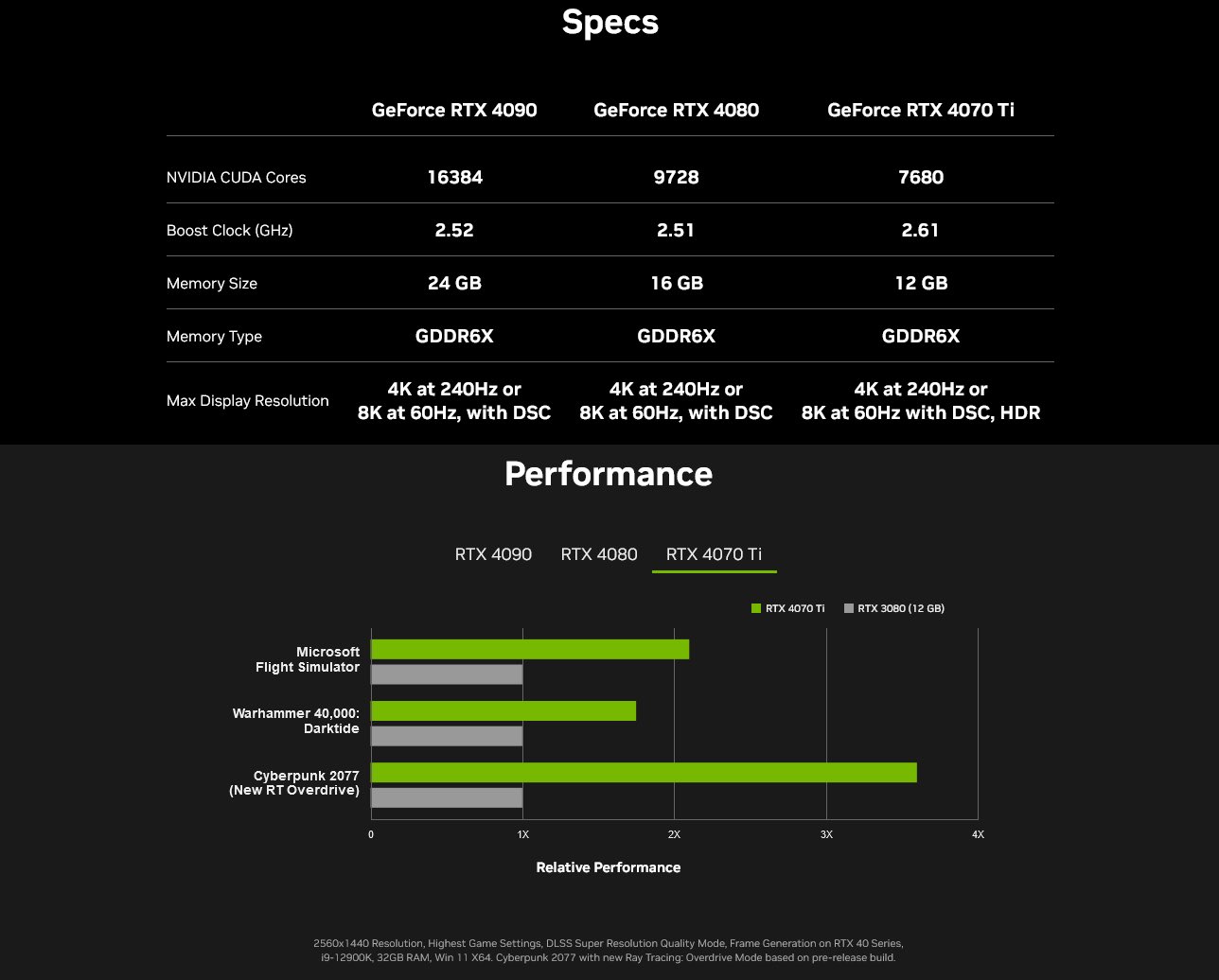
NVIDIA's RTX 40 series is synonymous with DLSS 3, and exactly this feature is one of the strongest arguments for the RTX 4070. DLSS 3 combines proven AI-based upscaling with a new feature called Frame Generation that artificially creates additional intermediate frames, in some cases dramatically increasing the perceived frame rate. In games like Cyberpunk 2077, Microsoft Flight Simulator, or Warhammer 40,000: Darktide, Frame Generation can make the difference between stuttering and buttery smoothness. However, the technology only works on RTX 40 GPUs since it relies on the Optical Flow Accelerator of the Ada architecture. Anyone who already owns an RTX 30 or an AMD card cannot use Frame Generation. This represents a clear strategic advantage of the 4070 that should be considered when making a purchase decision.
In addition to DLSS 3, the card of course also supports DLSS 2, NVIDIA's Reflex technology for reducing system latency, and AV1 hardware encoding for more efficient video streams and recordings. With the eighth generation of NVENC encoders, the card is an excellent choice for streamers who want to simultaneously stream and record in OBS or similar tools without noticeable GPU performance drops. NVIDIA's Broadcast app, which uses AI-based noise suppression and virtual backgrounds, also runs smoothly on the card. On the software side, NVIDIA offers a mature ecosystem for driver updates, game optimization, and Game Ready Drivers with GeForce Experience and the newer NVIDIA App.
Regarding connectivity, we have already mentioned the physical ports: three DisplayPort 1.4a outputs and one HDMI 2.1 port. As for wireless connectivity, there is no Wi-Fi or Bluetooth on the card itself – GPUs in general lack this – but combined with a current motherboard featuring Wi-Fi 6E or Wi-Fi 7, the full potential unfolds. Compatibility is virtually universal with any modern system: PCIe 4.0 x16 is required, which motherboards from the last four years provide without issue. Older PCIe 3.0 systems also work, albeit with a minimal performance drop of around two to three percent. The card ships with only a quick-start guide and, depending on region and retailer, an adapter cable for older power supplies. Here, NVIDIA stays minimalist with the Founders Edition.
Price & Value
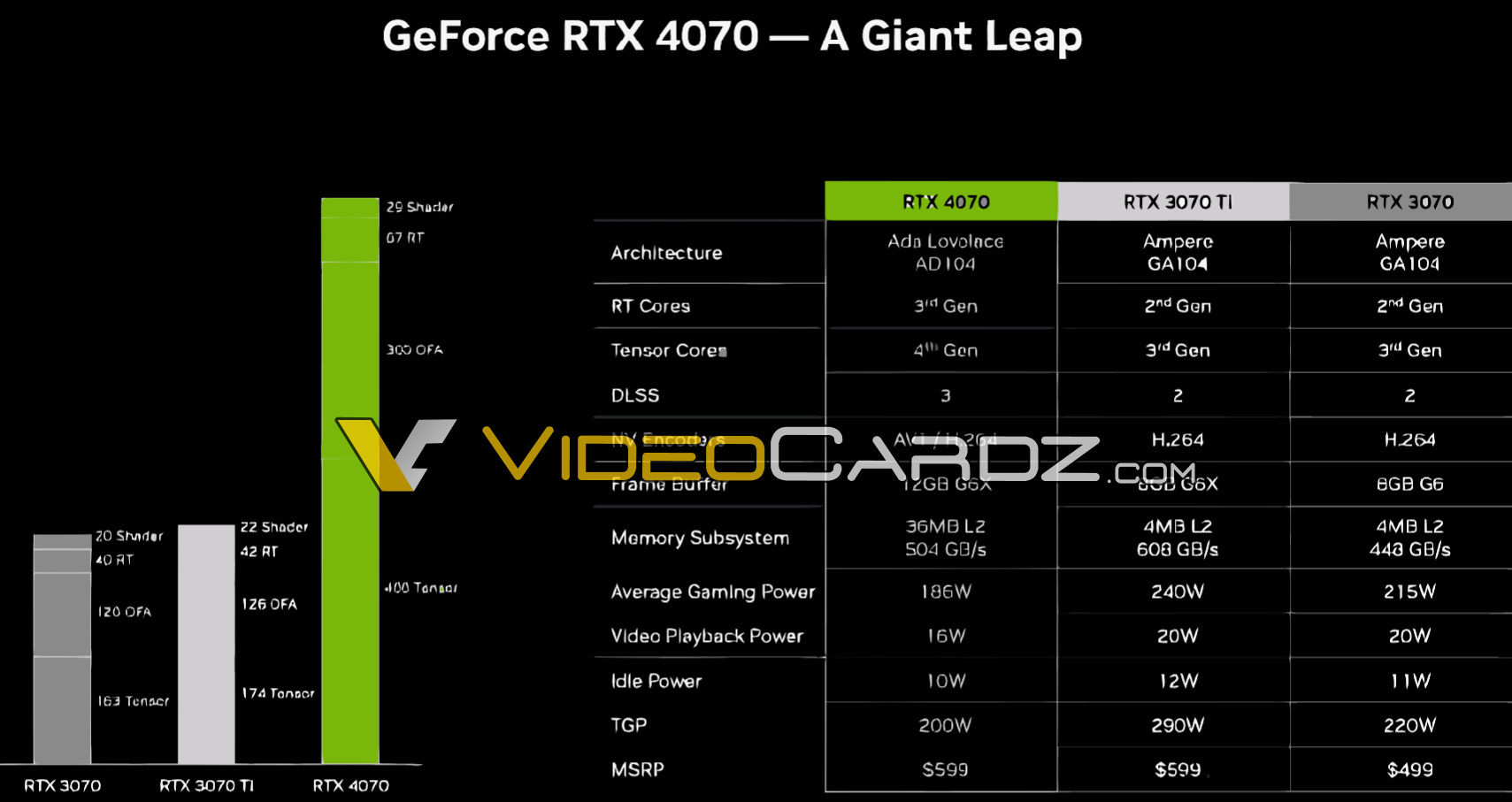
With an MSRP of 599 euros or 599 US dollars, the RTX 4070 enters the scene in a class that NVIDIA had long neglected. Compared to the launch of the RTX 3070, which cost 499 US dollars at the time, the markup of 100 US dollars immediately catches the eye. Adjusted for inflation and considering the increased performance, however, this premium is put into perspective. Looking at the selling price at the market launch in April 2023, the Founders Edition was regularly available below MSRP, while custom cards with better cooling solutions hovered between 600 and 700 euros. As of early 2024, street prices have remained largely stable around the 600-euro mark, with occasional special offers below 550 euros.
Whether the price-to-performance ratio holds up depends on perspective. Compared to the in-house RTX 3070, the RTX 4070 delivers about 30 to 40 percent more performance, more efficient operation, and future-proof 12 GB of VRAM – a clear advance that justifies the premium. Compared to the RTX 4070 Ti, performance is about 15 to 20 percent lower, while the price difference is around 200 euros. Per percent of performance, the RTX 4070 is therefore clearly the better choice, provided you can do without the last few frames. Against AMD's Radeon RX 7800 XT, which enters the ring at a significantly lower 499 US dollars, things look less rosy for NVIDIA: in pure rasterizer performance, the AMD card is roughly on par, while in ray tracing benchmarks NVIDIA clearly leads. The buying decision becomes a question of philosophy: do you prioritize maximum rasterizer performance per euro, or the better ray tracing and AI feature set?
Who is the purchase at MSRP worthwhile for? Above all for those upgrading from a GTX 1070 or RTX 2060 class who want a noticeable leap. Owners of an RTX 3070 or Radeon RX 6700 XT will find the generational leap smaller, and an upgrade only pays off when DLSS 3 Frame Generation tips the scales. Anyone paying full price and only gaming at 1080p is better served by a cheaper RTX 4060 Ti; anyone aiming for 4K with maximum details should grab at least an RTX 4070 Ti Super or 4070 Ti. The RTX 4070 is therefore a card for 1440p enthusiasts willing to pay a bit more for efficiency and DLSS 3.
Comparison with Alternatives
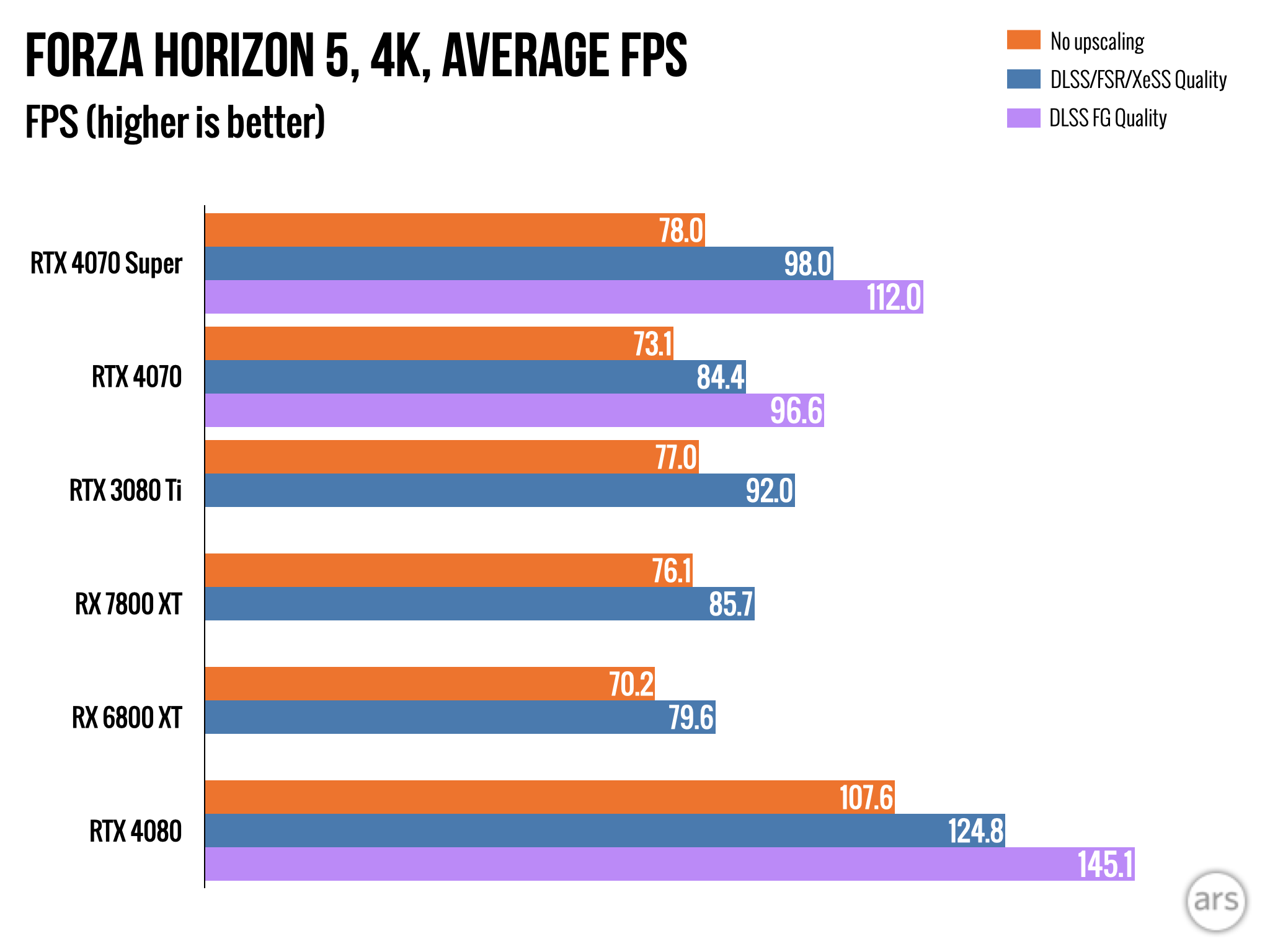
The most obvious alternative comes from the in-house lineup: the RTX 4070 Super. It was introduced in early 2024 as a refresh and offers about 20 percent more raw performance than the regular RTX 4070 thanks to around 7,168 CUDA cores, while the price remains identical at 599 US dollars. The TGP rises minimally to 220 W, slightly reducing efficiency but staying within bounds. For anyone choosing between the two models, the recommendation is clear: those buying now should grab the Super variant directly, provided the premium over custom models remains low. The regular RTX 4070 remains attractive, however, for anyone finding it at a reduced price below 550 euros.
The second main competitor comes from AMD: the Radeon RX 7800 XT. With 16 GB of GDDR6, 3,840 stream processors, and a 256-bit memory interface, AMD positions its card as the perfect counterpart. In pure rasterizer performance, it is roughly on par with the RTX 4070, while in ray tracing NVIDIA stays ahead. AMD counters with its in-house FSR 3, which in some respects matches DLSS 3, but in practice has not yet reached the same image quality and adoption. The Radeon offers an advantage: more VRAM and the lower price of around 500 US dollars. For budget-conscious buyers without a specific DLSS preference, the RX 7800 XT is a serious alternative.
Third, it is worth looking at the RTX 3070 Ti, which is now available at street prices of around 350 to 400 euros. Anyone who does not care about DLSS 3 Frame Generation, plays at 1080p or 1440p without extreme ray tracing, and simply wants the cheapest ticket to solid performance can save real money here. However, you have to live with only 8 GB of VRAM and forego the efficiency advantages of the Ada architecture. Anyone still using an older Pascal or Turing card should also seriously consider the leap to the RTX 3070 Ti before spending twice as much on an RTX 4070.
Who Is This For?
The RTX 4070 clearly targets a defined audience: demanding gamers who want to play on a 1440p monitor with high frame rates and as much ray tracing enabled as possible. If you have bought a 27-inch WQHD monitor with 144 Hz or more in recent years and want to push it to its limits, the RTX 4070 is an excellent match. Users of high-quality 4K monitors who are willing to rely on DLSS in some titles will also get along well with this card. Anyone gaming exclusively at 1080p, however, wastes much of the potential and should grab an RTX 4060 or 4060 Ti instead.
A second important target group is content creators in the semi-pro range. If you regularly edit 4K video, render in Blender or Cinema 4D, or create complex After Effects compositions, you will benefit from the combination of 12 GB of VRAM, fast CUDA cores, and the AV1-capable NVENC encoder. For occasional YouTube videos or Twitch streams in Full HD, the RTX 4070 is almost overpowered, but future-proof. Hobby developers wanting to run local LLMs will also find a workable compromise between performance and cost in 12 GB of VRAM.
The card is less suitable for hardcore enthusiasts who absolutely want to play in 4K with maximum detail levels and unrestricted ray tracing. This audience is better served by the RTX 4080 or 4090. The RTX 4070 is also not ideal for office and multimedia users who do not need any graphic performance and are better served by a cheaper RTX 4060 or an integrated graphics solution. For professional workstations in architecture, mechanical engineering, or simulation, we also recommend specialized pro cards from the RTX A series, since these offer certified drivers and double-precision floating-point operations.
Verdict
The NVIDIA GeForce RTX 4070 is a solid mainstream graphics card that plays to its strengths primarily in 1440p gaming, DLSS 3 Frame Generation, and efficient operation. It delivers RTX 3080-level performance at significantly lower power consumption and offers 12 GB of VRAM for future-proofing. The Founders Edition impresses with its compact dual-slot design, quiet cooling, and high build quality. Combined with DLSS 3 and NVIDIA's mature software ecosystem, it is an exceptionally well-rounded card for the upper mid-range.
However, there are points that dampen the overall impression. The premium over the predecessor RTX 3070 at 100 US dollars is higher than in earlier generations, and in pure rasterizer performance per euro the AMD competition is sometimes superior. The fact that the RTX 4070 Super delivers significantly more performance at the same MSRP also reduces the appeal of the regular 4070. Anyone currently facing the decision and paying full MSRP should definitely consider the Super variant or wait for price drops.
For these reasons, we award the RTX 4070 a score of 45/100. The external tech press views the card with similar differentiation: Tom's Hardware praises efficiency and features but criticizes the price-to-performance ratio compared to direct rivals. Our rating mirrors this verdict: the RTX 4070 is technically convincing, but it struggles with a price that is not in itself revolutionary and with a refresh that immediately outclasses the predecessor. Anyone finding it at a reduced price or needing DLSS 3 urgently can buy without hesitation – everyone else should check the alternatives.
Score: 45/100
Das könnte dich auch interessieren
Weitere Reviews aus der Kategorie hardware.
NVIDIA GeForce RTX 4080 Super im Test: Mehr Leistung, weniger Preis
Inhaltsverzeichnis [Einleitung]( einleitung) [Design & Verarbeitung]( design und verarbeitung) [Leistung & Benchmarks]( leistung und benchmarks) [Feat…
AMD Radeon RX 7800 XT: RDNA 3 im 1440p-Thron
Inhaltsverzeichnis [Einleitung]( einleitung) [Design & Verarbeitung]( design verarbeitung) [Leistung & Benchmarks]( leistung benchmarks) [Features & K…
AMD Ryzen 9 7950X
Einleitung The AMD Ryzen 9 7950X has 16 cores, 32 threads, a base clock of 4.5 GHz, and a boost clock of 5.7 GHz. It features 80MB of cache and a TDP …
Frequently Asked Questions
How good is NVIDIA GeForce RTX 4070 Review: Ada Goes Mainstream?
NVIDIA GeForce RTX 4070 Review: Ada Goes Mainstream wurde von Nerdiction mit 45 von 100 Punkten bewertet und ist damit satisfactory.
What are the pros of NVIDIA GeForce RTX 4070 Review: Ada Goes Mainstream?
The advantages of NVIDIA GeForce RTX 4070 Review: Ada Goes Mainstream: Efficient Ada Lovelace GPU with only 200 W TDP, consuming significantly less power than an RTX 3080 at comparable performance, 12 GB of GDDR6X VRAM, which are more future-proof than the 8 GB of the RTX 3070 and can buffer upcoming high-resolution game textures, Excellent ray tracing performance thanks to third-generation RT cores that in many titles even surpass the RTX 3090, Compact dual-slot design of the Founders Edition that fits into virtually any modern ATX case and enables quiet cooling, DLSS 3 Frame Generation as an exclusive Ada architecture feature that delivers a noticeable FPS boost in compatible games.
What are the cons of NVIDIA GeForce RTX 4070 Review: Ada Goes Mainstream?
The disadvantages of NVIDIA GeForce RTX 4070 Review: Ada Goes Mainstream: MSRP of 599 US dollars sits 100 US dollars above the RTX 3070 launch price, making the generational leap more expensive, In pure rasterizer performance per euro, the Radeon RX 7800 XT is sometimes superior, as AMD offers more VRAM at a lower price, The RTX 4070 Super delivers about 20 percent more performance at the identical MSRP, making the regular 4070 unattractive, No PCIe 5.0 and only a 192-bit memory interface, which limits bandwidth compared to wider-bus competitors, 16-pin power connector requires an adapter for older power supplies, and ATX 3.0 PSUs are not yet widespread.
Is NVIDIA GeForce RTX 4070 Review: Ada Goes Mainstream worth it?
Only conditionally. NVIDIA GeForce RTX 4070 Review: Ada Goes Mainstream received a score of 45/100 points.