The Verdict
The Nerdiction verdict: AMD Radeon RX 7900 XTX Review: RDNA 3 Flagship Tested is excellent and receives 82 out of 100 points.
Pro
- 24 GB of GDDR6 VRAM on a 384-bit bus provide excellent 4K future-proofing.
- Very strong price-to-performance ratio in the high-end tier below the RTX 4080.
- Compact reference design fits into more cases than the RTX 4080/4090 Founders Editions.
Contra
- Hotspot temperatures of up to 110 °C under heavy load.
- Reference cooler is clearly audible under load, with occasional coil whine.
- Ray tracing performance trails NVIDIA's RTX 4000 series significantly.
Technical Specifications
Hersteller
AMD
Modell
RX 7900 XTX
Typ
Grafikkarte
UVP
999 €
Release
Dec 2022
Table of Contents
- Introduction
- Design & Build Quality
- Performance & Benchmarks
- Features & Connectivity
- Price & Value
- Comparison with Alternatives
- Who Is This For?
- Verdict
Introduction
With the Radeon RX 7900 XTX, AMD entered the high-end GPU arena on December 13, 2022, simultaneously ushering in the RDNA 3 generation. After years in which NVIDIA seemed to dominate the top tier almost unchallenged with the RTX 3000 and RTX 4000 series, anticipation was high: could AMD return to the front row with its new flagship, both in performance and in value? The RX 7900 XTX answers that question with an impressive spec sheet – 6,144 stream processors, 24 GB of GDDR6 VRAM, a 2,500 MHz boost clock, and a 355 W total board power. This positions AMD once again as a serious contender in the premium segment, where previously the RTX 4080 and RTX 4090 dominated headlines.
The goal was clear: deliver 4K gaming at high frame rates without the extreme power draw and bulky coolers of the NVIDIA competition. At the same time, AMD wanted to send a strong signal with an aggressive $999 MSRP – undercutting the RTX 4080's $1,199 launch price while staying well below the RTX 4090. This review examines how well AMD delivers on that promise in practice, and where the reference design shines or stumbles.
Design & Build Quality
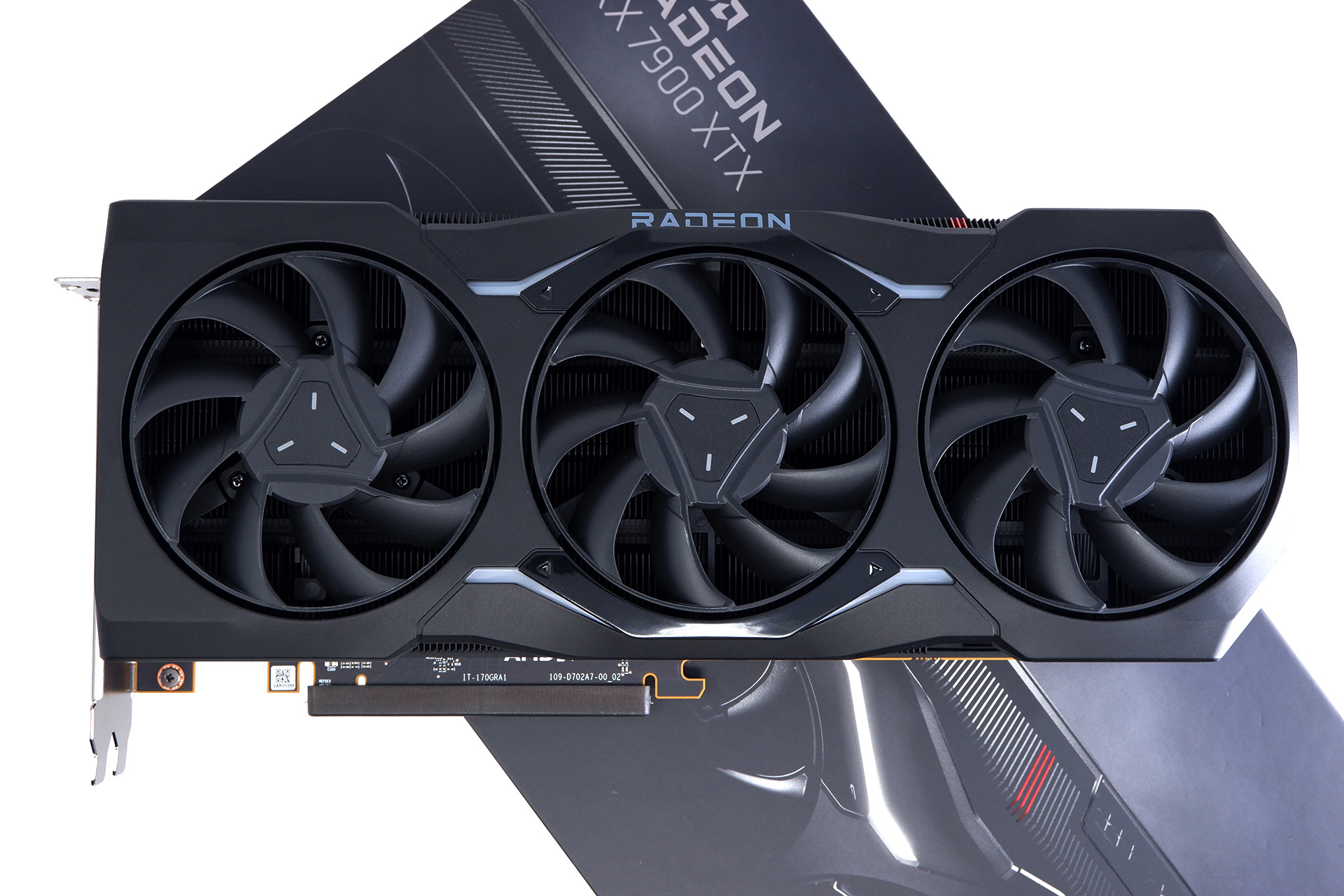
The reference RX 7900 XTX measures 287 × 123 × 51.5 mm, making it noticeably more compact than NVIDIA's RTX 4080 or RTX 4090 Founders Editions. The difference is immediately tangible: the card fits into most mid-tower ATX cases where the NVIDIA competition often pushes the limits of clearance. The heatsink is cooled by three axial fans that, compared to the RX 7900 XT, use a slightly larger diameter to push more air at lower RPM. The exterior follows AMD's typical generation design language: dark plastic and metal finishes, clean lines, and a lit Radeon logo on the side – a feature missing from the XT, giving the XTX a more premium touch.
In hand, the RX 7900 XTX feels solid, even though much of the cooler shroud relies on plastic. The weight is noticeable but not excessive – significantly lighter than many heavy custom designs that stress the PCIe slot. The metal slot bracket and backplate add welcome rigidity. Build quality is typical for a reference card: tidy and functional, without the flair of premium AIB offerings. Compared to the XT, the XTX looks more grown-up and slightly more substantial, which is also reflected in its slightly larger footprint.
Performance & Benchmarks
On paper, the RX 7900 XTX offers an impressive performance base: 6,144 stream processors on the fully enabled Navi 31 GCD, paired with six MCDs (Memory Cache Dies) that host the 24 GB of GDDR6 VRAM across a 384-bit interface. The game clock sits at 2,300 MHz, with boost clocks reaching up to 2,500 MHz, and AMD quotes around 61 TFLOPs of raw compute. These figures represent the upper limit of what AMD has ever offered in a single-GPU graphics card, and reviews confirm a substantial generational leap over RDNA 2.
In games, the XTX proves itself as a capable 4K graphics card. In titles like Cyberpunk 2077, Forza Horizon 5, or Assassin's Creed Valhalla, it delivers frame rates between the RTX 4080 and RTX 4090 – sometimes closer to the 4080, sometimes to the 4090 in well-optimized games. The generous 24 GB VRAM buffer also provides excellent future-proofing for high-resolution texture packs. The second-generation Ray Accelerators noticeably improve ray tracing over RDNA 2, but cannot fully match the level of NVIDIA's RTX 4000 series. In classic rasterization, however, AMD is often on par or ahead – and at a significantly lower price.
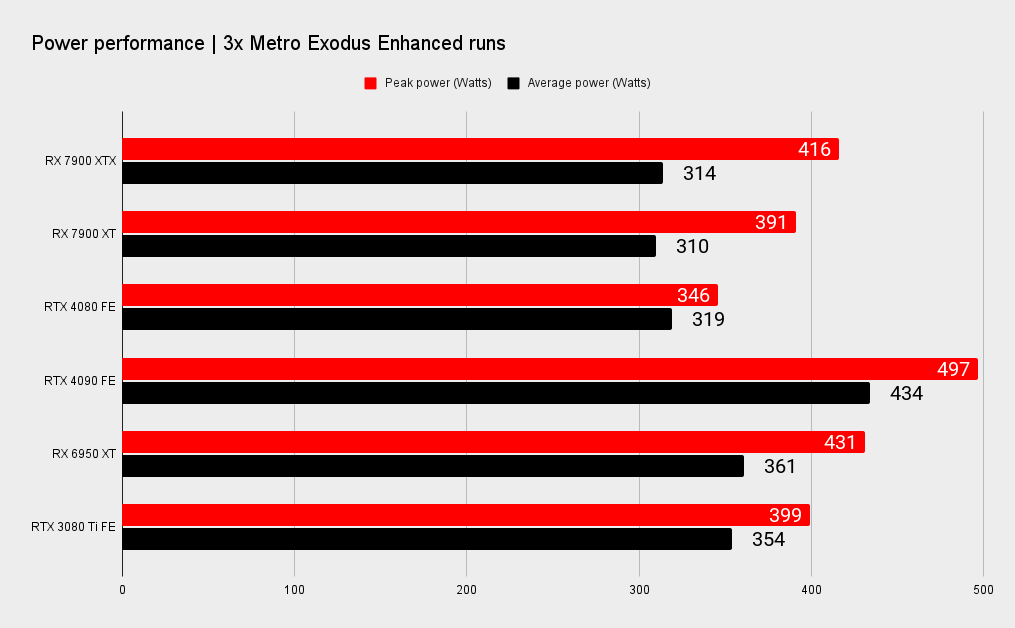
There are downsides, though: under gaming load, the card reaches up to 110 °C junction temperature, running noticeably hotter than competing NVIDIA cards. Combined with audible fan noise and occasional coil whine in high frame-rate games, the reference design clearly reaches its thermal limits. Users seeking a particularly quiet build should look at custom designs with more capable coolers.
Features & Connectivity
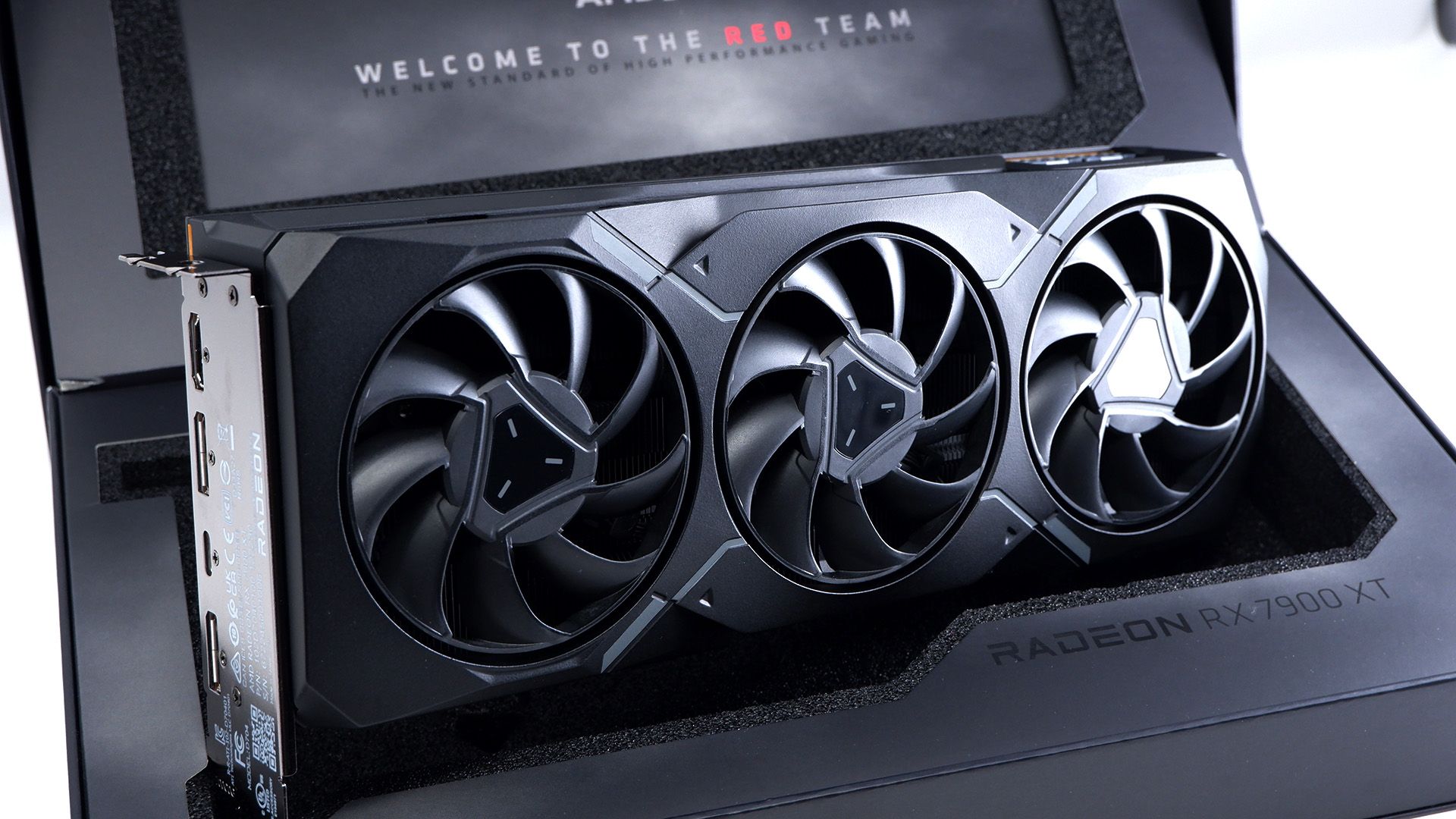
For connectivity, the RX 7900 XTX offers three display outputs – specifically two DisplayPort and one HDMI output, plus a USB Type-C port for modern VR headsets and compatible monitors. The system interface is PCIe 4.0 x16, which is more than sufficient for current platforms. AMD also offers its own upscaling technology, FSR (FidelityFX Super Resolution), which is increasingly supported across games and scales across multiple quality tiers, with FSR 3 adding Frame Generation.
On the software side, the card is managed via AMD's Adrenalin driver suite, providing extensive overclocking, monitoring, and streaming tools. Smart Access Memory (SAM) is supported, delivering a small additional performance boost when paired with Ryzen CPUs. While NVIDIA can counter with DLSS 3 and Frame Generation, AMD's FSR 3 catches up – though the initial library of supported titles is smaller. The box contents are also bare-bones: the card ships without extensive accessories, and power is supplied via two standard 8-pin PCIe connectors – no 12VHPWR adapter needed.
Price & Value
With a $999 MSRP (≈ €999), the RX 7900 XTX positions itself clearly below the RTX 4080's $1,199 launch tag – a nominal price advantage of around €200. That gap translates in practice into a "free" cooler upgrade or extra VRAM. The 24 GB vs. 16 GB VRAM advantage is also a strong argument for AMD, especially for users running high-resolution textures, professional workloads, or VRAM-hungry simulations.
However, this price advantage is partially offset in some areas: in pure ray-tracing performance and AI-accelerated features like DLSS Frame Generation, NVIDIA remains ahead. Gamers who rely heavily on path tracing or frame generation get more performance per dollar from NVIDIA. Conversely, those playing classic rasterizer titles at native resolution get the best price-to-performance ratio in the high-end segment from the RX 7900 XTX.
Comparison with Alternatives
Against the NVIDIA RTX 4080, the RX 7900 XTX delivers comparable to slightly lower rasterization performance, but offers 50% more VRAM and a roughly 17% lower entry price. In heavily ray-traced games the NVIDIA advantage widens, especially in combination with DLSS 3. For classic 4K gaming without heavy RT, the XTX is the more attractive value option.
Against its sibling RX 7900 XT, the XTX is predictably the faster card, benefiting from the fully enabled chip, more CUs, higher clocks, and a wider memory bus. The price premium over the XT is moderate and usually justified by the 4K performance uplift. Gamers playing at 1440p, however, may find the XT offers better value.
Who Is This For?
The RX 7900 XTX is primarily aimed at ambitious 4K gamers seeking maximum rasterization performance at a fair price, who also appreciate the future-proofing of 24 GB VRAM. Content creators working on 3D, video, or simulation workloads also benefit from the large memory buffer. It is less suited for enthusiasts whose focus is on heavy ray tracing and frame generation – NVIDIA remains the first choice in that scenario.
Verdict
The AMD Radeon RX 7900 XTX is an impressive statement: plenty of performance, generous 24 GB of VRAM, a compact build, and an attractive price – qualities that make it the most compelling option in the high-end market for value-oriented 4K gamers. It shows weaknesses in heat, noise, and AI-based upscaling, while the reference cooler reaches its thermal limits. Overall, the XTX is the best pick when classic 4K gaming without a heavy path-tracing focus is the priority, and a quiet build can be achieved through a custom design.
Das könnte dich auch interessieren
Weitere Reviews aus der Kategorie hardware.
Corsair RM850x im Test – 850 W Netzteil mit 80+ Gold und langer Garantie
Inhaltsverzeichnis [Einleitung]( einleitung) [Design & Verarbeitung]( design verarbeitung) [Leistung & Benchmarks]( leistung benchmarks) [Features & K…
LG UltraGear 27GR95QE Test: OLED-Gaming auf 27 Zoll
Inhaltsverzeichnis [Einleitung]( einleitung) [Design & Verarbeitung]( design verarbeitung) [Leistung & Benchmarks]( leistung benchmarks) [Features & K…
PXN CB1 Control Box
Einleitung Button Boxes für Sim Racing Cockpits sind kein neues Konzept, aber ein gutes unter 100 Euro war lange Mangelware. PXN, bekannt für erschwin…
Frequently Asked Questions
How good is AMD Radeon RX 7900 XTX Review: RDNA 3 Flagship Tested?
AMD Radeon RX 7900 XTX Review: RDNA 3 Flagship Tested wurde von Nerdiction mit 82 von 100 Punkten bewertet und ist damit excellent.
What are the pros of AMD Radeon RX 7900 XTX Review: RDNA 3 Flagship Tested?
The advantages of AMD Radeon RX 7900 XTX Review: RDNA 3 Flagship Tested: 24 GB of GDDR6 VRAM on a 384-bit bus provide excellent 4K future-proofing., Very strong price-to-performance ratio in the high-end tier below the RTX 4080., Compact reference design fits into more cases than the RTX 4080/4090 Founders Editions., Strong rasterization performance at 4K, often on par with the RTX 4080., Powered via two 8-pin PCIe connectors, no 12VHPWR adapter required..
What are the cons of AMD Radeon RX 7900 XTX Review: RDNA 3 Flagship Tested?
The disadvantages of AMD Radeon RX 7900 XTX Review: RDNA 3 Flagship Tested: Hotspot temperatures of up to 110 °C under heavy load., Reference cooler is clearly audible under load, with occasional coil whine., Ray tracing performance trails NVIDIA's RTX 4000 series significantly., FSR 3 is supported in far fewer games than NVIDIA's DLSS 3 ecosystem., $999 MSRP is often exceeded by actual street pricing..
Is AMD Radeon RX 7900 XTX Review: RDNA 3 Flagship Tested worth it?
Yes. AMD Radeon RX 7900 XTX Review: RDNA 3 Flagship Tested received a score of 82/100 points and is excellent.