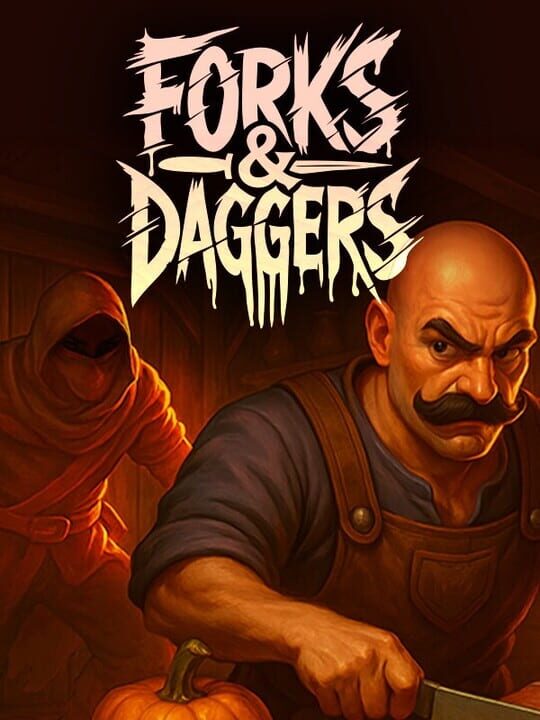
The Verdict
The Nerdiction verdict: Forks & Daggers: Medieval Mayhem Meets Social Deduction is excellent and receives 82 out of 100 points.
Pro
- Unique blend of social deduction and physical chaos
- Lovingly crafted medieval setting with atmospheric immersion
- Excellently scalable for 3-10 players with adapted group dynamics
Contra
- Minor performance drops during maximum chaos moments
- Learning curve steeper than expected for social deduction newcomers
- Voice chat quality could be better with larger groups
Forks & Daggers Review
Table of Contents
- Introduction
- Gameplay and Mechanics
- Atmosphere and Setting
- Multiplayer Experience
- Technical Implementation
- Long-term Motivation
- Conclusion
Introduction
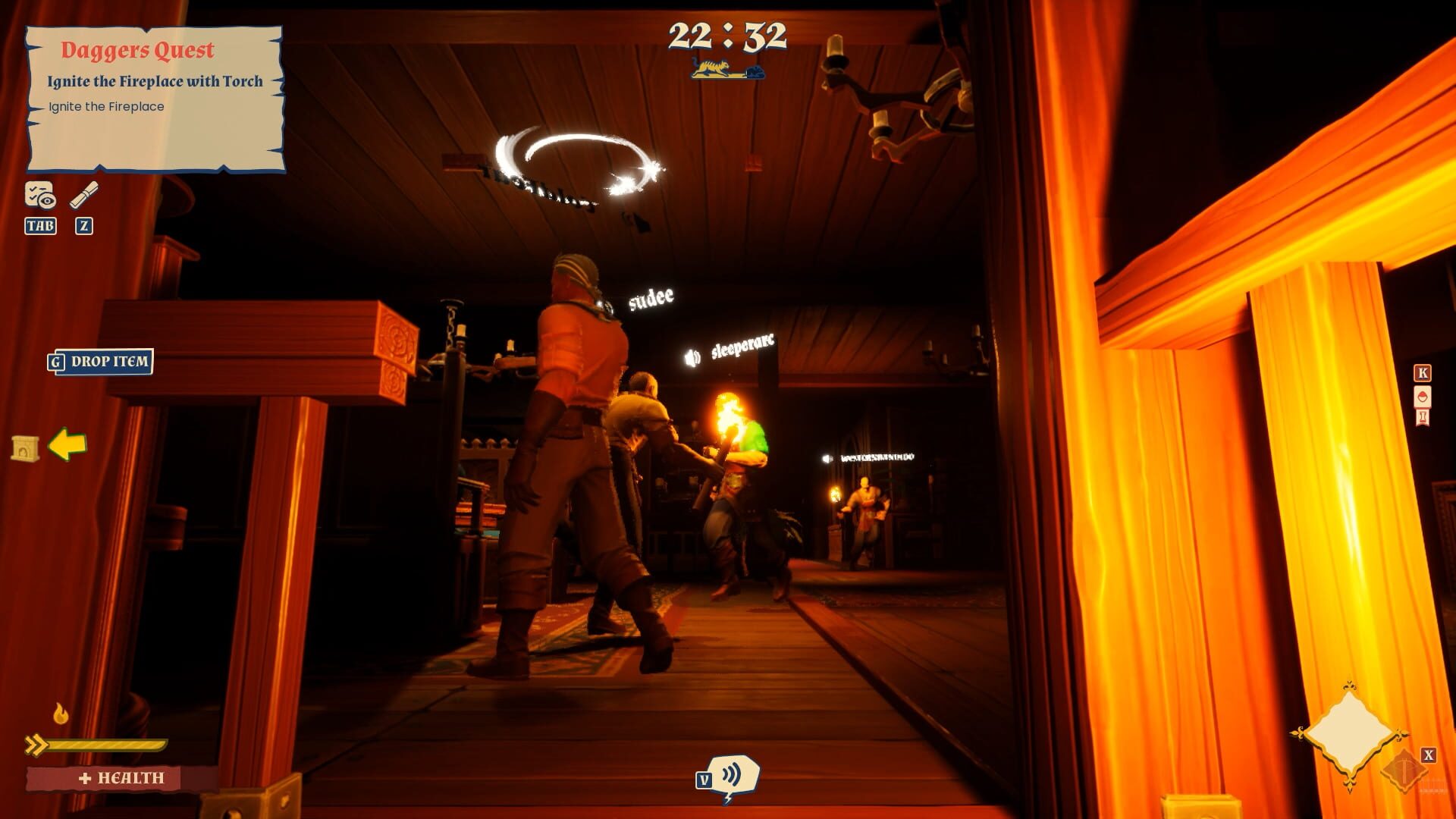
Medieval banquets have always been treacherous affairs – just ask the Borgias and other notorious noble houses. Forks & Daggers takes this historical paranoia and transforms it into a chaotic social deduction game that throws up to 10 players into a manor filled with intrigue, betrayal, and flying kitchen utensils.
Rather than opting for subtle manipulation, the developers have fully embraced physical chaos: here, players don't just lie and deceive, but also hurl everything that isn't nailed down. The result is a unique hybrid of social deduction and party brawler that's already generating buzz ahead of its January 21, 2026 release.
Gameplay and Mechanics
The heart of Forks & Daggers lies in its dual gameplay approach. While classic social deduction games like Among Us or Werewolf primarily rely on discussion and voting, Forks & Daggers adds a physical component that revolutionizes the genre.
Players take on the roles of guests at a medieval banquet, with one or more traitors lurking among them. What's special: the entire manor becomes a weapon. Forks, knives, candlesticks, and even furniture can be picked up and thrown. This mechanic transforms every round into a chaotic spectacle where players must demonstrate both their social and reflexive skills.
The transformation mechanic is particularly cleverly implemented: traitors can transform into daggers to sneak undetected through the manor and eliminate their targets. This shape-shifting adds an additional layer of paranoia – every object lying around could potentially be a disguised traitor.
Atmosphere and Setting
The medieval setting is implemented with great attention to detail. The manor shines in an authentic yet not overly grim medieval ambiance. The developers have skillfully found a middle ground between historical accuracy and playful accessibility.
The soundscape deserves special mention: the clinking of metal, creaking of old wooden floors, and muffled calls of players create an atmosphere that's both tension-filled and humorous. The medieval instrumentation in the background enhances immersion without becoming intrusive.
Visually, the game opts for a stylized yet detailed approach. Character models are expressive enough to convey emotions but not so realistic that the violence becomes disturbing. This balance is crucial for the party game character.
Multiplayer Experience
With support for 3-10 players, Forks & Daggers offers impressive scalability. Smaller groups lead to more intense, focused experiences, while larger rounds devolve into glorious chaos. Each group size offers its own strategic challenges.
The communication mechanics are well thought out: players can communicate through both voice chat and emotes/gestures. Particularly clever is the implementation of "whisper mode" – players in close proximity can have private conversations, enabling additional layers of conspiracy.
The game particularly shines in local multiplayer sessions. The shared physical presence significantly amplifies social dynamics and leads to unforgettable moments of triumph and betrayal.
Technical Implementation
Technically, Forks & Daggers presents itself as solid but not revolutionary work. The engine handles the chaos of up to 10 players and countless physical objects without major issues. Minor frame drops are noticeable in particularly chaotic moments but don't substantially impact the gaming experience.
The network implementation deserves praise: even with poor connections, the game remains playable, with intelligent lag compensation ensuring throws and movements are fairly registered.
The user interface is intuitive and quickly learnable even for casual players. Tutorials are kept brief and get newcomers into the game quickly without overwhelming them.
Long-term Motivation
As a party game, Forks & Daggers lives or dies by its long-term motivation. The developers have implemented a clever progression system here: players can unlock various character skins, manor variants, and even new throwable objects.
Particularly successful are the weekly events and seasonal modes. These regularly bring new mechanics and objectives into the game and prevent routine from setting in.
Community features are strongly developed: a robust friend system, clans, and even simple tournament modes ensure players keep returning.
Conclusion
Forks & Daggers achieves a remarkable balancing act: it takes the proven social deduction formula and enriches it with physical chaos without diluting the genre's core. The result is a unique party game experience that delights both casual players and genre veterans.
The medieval theme is lovingly implemented without becoming kitschy, and the balance between strategy and chaos is nearly perfectly calibrated. Minor technical weaknesses and a certain learning curve for newcomers barely tarnish the positive overall impression.
For fans of social deduction games and anyone looking for a fresh party game, Forks & Daggers is a clear recommendation. While it doesn't redefine the genre, it expands it with a welcome physical component that will provide countless memorable moments.
System Requirements
Minimum
Recommended
Das könnte dich auch interessieren
Weitere Reviews aus der Kategorie game.
Order Automatica Review: Ausführlicher Test
Inhaltsverzeichnis Einleitung Gameplay, Spielgefühl und Kernsysteme Welt, Struktur, Umfang und Wiederspielwert Technik, Präsentation, Kritik und Fazit…

Space Show Edition 17
Einleitung The year is 2085, the year of the 17th Space Show. It's the most watched reality show in the solar system. 13 million contestants compete a…
Lootbound im Test – Taktik, Loot und dunkle Fantasy
Inhaltsverzeichnis [Einleitung]( einleitung) [Story & Erzählung]( story und erzaehlung) [Gameplay & Mechaniken]( gameplay und mechaniken) [Grafik & Pr…
Frequently Asked Questions
How good is Forks & Daggers: Medieval Mayhem Meets Social Deduction?
Forks & Daggers: Medieval Mayhem Meets Social Deduction wurde von Nerdiction mit 82 von 100 Punkten bewertet und ist damit excellent.
What are the pros of Forks & Daggers: Medieval Mayhem Meets Social Deduction?
The advantages of Forks & Daggers: Medieval Mayhem Meets Social Deduction: Unique blend of social deduction and physical chaos, Lovingly crafted medieval setting with atmospheric immersion, Excellently scalable for 3-10 players with adapted group dynamics, Innovative transformation mechanics heighten paranoia levels, Strong community features and regular content updates.
What are the cons of Forks & Daggers: Medieval Mayhem Meets Social Deduction?
The disadvantages of Forks & Daggers: Medieval Mayhem Meets Social Deduction: Minor performance drops during maximum chaos moments, Learning curve steeper than expected for social deduction newcomers, Voice chat quality could be better with larger groups, Limited manor variants at launch, Balance between different traitor abilities not yet perfect.
Is Forks & Daggers: Medieval Mayhem Meets Social Deduction worth it?
Yes. Forks & Daggers: Medieval Mayhem Meets Social Deduction received a score of 82/100 points and is excellent.
Diskussion
Interessant, dass die Balance der Verräter-Fähigkeiten noch nicht stimmt. Welche Fähigkeiten sind denn besonders stark/schwach? Überlege mir das Spiel zu holen, bin aber bei asymmetrischen Spielen immer vorsichtig.
82 Punkte sind definitiv gerechtfertigt! Hab gestern Abend mit 8 Freunden gespielt und wir waren bis 3 Uhr morgens dabei. Die Transformations-Mechanik ist wirklich genial - niemand weiß, wem man trauen kann. Die Performance-Probleme bei viel Chaos sind mir auch aufgefallen, aber ehrlich gesagt war das Spiel so spannend, dass es kaum gestört hat.
Kann die Kritik zum Voice-Chat nur bestätigen. Bei unserer 10er-Gruppe war es teilweise schwer zu verstehen, wer gerade spricht. Das mittelalterliche Setting ist aber wirklich atmosphärisch gelungen - die Entwickler haben sich richtig Mühe gegeben. Für Social-Deduction-Neulinge würde ich empfehlen, erstmal mit kleineren Gruppen anzufangen.
Kann die 82 Punkte absolut nachvollziehen! Die Transformations-Mechanik ist wirklich innovativ - endlich mal was Neues im Social Deduction Genre. Haben gestern zu acht gespielt und die Paranoia war perfekt dosiert. Nur die Performance-Einbrüche bei vollem Chaos nerven etwas, aber das sollte patchbar sein.
Finde die Bewertung etwas zu positiv. Ja, das Setting ist schön, aber die Balance-Probleme bei den Verräter-Fähigkeiten machen das Spiel oft unfair. Manche Rollen sind einfach zu stark. Würde eher 75 Punkte geben, bis das gefixt ist.
Die steile Lernkurve kann ich bestätigen - meine Freunde waren nach der ersten Runde ziemlich überfordert. Aber wenn man erstmal drin ist, macht es echt Spaß! Das mittelalterliche Setting ist wirklich atmosphärisch gelungen.
Stimme bei den Voice-Chat-Problemen zu. Bei 10 Leuten wird es wirklich chaotisch und die Qualität leidet. Hoffentlich bessern die Entwickler das bald nach, denn das Spiel hat definitiv Potenzial für größere Gruppen.
Solid bewertete Review! Die Community-Features sind wirklich stark und die regelmäßigen Updates zeigen, dass die Devs am Ball bleiben. Für ein Launch-Titel ist das schon sehr ordentlich. Bin gespannt auf mehr Manor-Varianten.
Nur begrenzte Manor-Varianten zum Launch? Das ist schon etwas enttäuschend für den Preis. Hoffe, dass da schnell Nachschub kommt, sonst wird es schnell repetitiv. Ansonsten aber gute Analyse der Stärken und Schwächen.
82 Punkte sind fair. Das physische Chaos kombiniert mit Social Deduction funktioniert überraschend gut. Hatte Bedenken, dass es zu hektisch wird, aber die Balance stimmt meistens. Performance könnte besser sein, aber spielbar ist es definitiv.
Kann man das Spiel auch gut zu dritt spielen oder braucht man wirklich mehr Leute? Die Review erwähnt 3-10 Spieler, aber Social Deduction funktioniert doch erst ab einer gewissen Gruppengröße richtig, oder?
Die Transformations-Mechanik klingt interessant, aber wie funktioniert das genau? Können sich Spieler mitten im Spiel in andere Charaktere verwandeln? Das würde die Paranoia definitiv erhöhen. Mehr Details wären hilfreich gewesen.
Gute Review, deckt sich mit meinen Erfahrungen. Das mittelalterliche Setting ist wirklich liebevoll gemacht und die Skalierung funktioniert tatsächlich gut. Performance-Issues sind nervig, aber nicht spielbrechend. Freue mich auf die kommenden Updates.