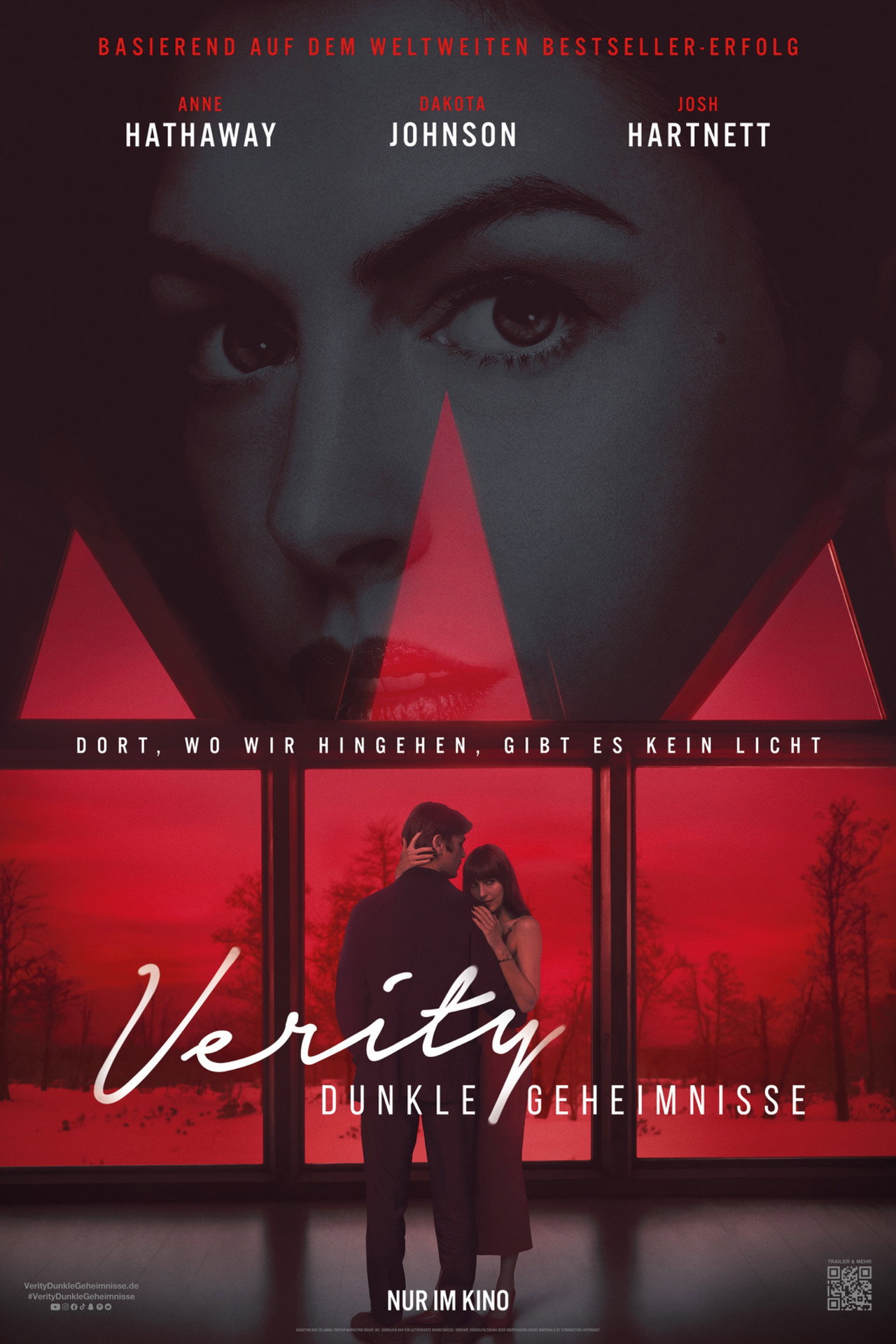
The Verdict
The Nerdiction verdict: Verity - Dark Secrets: A Psychological Thriller of Blurred Realities and Intense Performances is satisfactory and receives 65 out of 100 points.
Pro
- Strong, nuanced lead performances by Anne Hathaway and Dakota Johnson.
- Subtle, intelligent direction by Michael Showalter with a distinct visual style.
- Compelling examination of themes like identity, power, and narrative control.
Contra
- Pacing falters in the second half, leading to a sluggish impression.
- Some twists feel predictable, especially to seasoned thriller fans.
- Emotional presentation occasionally veers into melodrama without sufficient depth.
Videos & Trailers
Loading video…
Details
September 30, 2026
1h 58m
6.4
/ 10(128 votes)144.8
Genres
Production Companies
Production Countries
Spoken Languages
Cast
Table of Contents
- Introduction
- Plot & Narrative
- Acting & Characters
- Direction & Cinematography
- Music & Sound Design
- Visual Effects & Technical Craft
- Themes & Message
- Comparison with Similar Films
- Who Is This Film For?
- Verdict
Introduction
“Verity – Dark Secrets” is a gripping psychological thriller adapted from the bestselling novel by Colleen Hoover and directed by Michael Showalter, slated for its theatrical premiere on October 1, 2026. The film promises a blend of literary intrigue, emotional tension, and psychological complexity — a combination that should resonate with both genre enthusiasts and connoisseurs of introspective character studies. With Dakota Johnson portraying the isolated writer Lowen Ashleigh and Anne Hathaway playing the iconic author Verity Crawford, the project unites two of contemporary cinema’s most compelling actresses, whose contrasting approaches to life beautifully mirror the central conflict of the story: the pursuit of truth in a world where deception is routine.
The initial impression remains ambivalent. While the marketing campaign leans towards a traditional shock-driven narrative, the opening scenes already introduce a subtler form of unease — not through overt violence but through an increasingly opaque emotional dynamic. The atmosphere within the Crawford household feels charged from the outset, as if something fundamental were already out of balance. The camera captures every slight facial twitch, each barely perceptible tremor, hinting at deeper unrest beneath the surface. It is a setting that simultaneously highlights solitude and connection — and soon becomes the core thesis of the film itself.
Plot & Narrative
The narrative structure of “Verity – Dark Secrets” follows a carefully constructed model that gradually draws viewers into a realm of mistrust and seduction. When Lowen Ashleigh, a financially struggling novelist with a history of failed projects, gets the chance to complete Verity Crawford’s memoirs, she enters what appears to be a cohesive family home that is soon revealed to be profoundly fractured. The house itself functions as a dual symbol — simultaneously sanctuary and prison, creative haven and site of repression.
The pacing remains deliberately measured throughout much of the film, a conscious choice that allows minute details to emerge — a closed cabinet, a faded photograph, an unanswered letter — which later serve as crucial clues. During this phase, the perspective centers largely on Lowen’s observant nature, whose analytical instincts constantly probe beneath surface behaviors. The dialogue stays restrained, amplifying the weight of silence and leaving ample space for viewer speculation.
One pivotal turning point occurs when Lowen gains access to Verity’s private journals. These documents, allegedly written directly by Verity, contain contradictory statements regarding the true nature of her misfortune and Jeremy’s actual involvement in the tragedy. Whether these writings reflect authenticity or are part of a larger scheme drives the plot forward and creates a persistent uncertainty that places the audience firmly in Lowen’s position.
The final act escalates into unsettling territory where logic and madness increasingly overlap. Avoiding explicit spoilers, the closing sequences reveal that truth rarely offers clarity — and sometimes demands a price greater than any reward. The storytelling deliberately employs ambiguity as a narrative engine, culminating in an ending that feels both satisfying and provocative.
Acting & Characters
Among the standout strengths of “Verity – Dark Secrets” is undoubtedly the layered performances delivered by its lead actors. Dakota Johnson brings Lowen Ashleigh to life with her characteristic blend of vulnerability and resolve. Her talent lies in channeling emotion without exaggerating it, making her believable as a figure oscillating between analytical detachment and intimate engagement. Johnson’s nuanced delivery in scenes where she attempts to decode emotional barriers significantly contributes to the overall tension of the film.
Anne Hathaway, meanwhile, embodies Verity Crawford as far more than a mere victim archetype. Beneath her polished exterior hides a strength that rarely fully surfaces. Hathaway uses micro-expressions and body language to continuously suggest that behind every statement might lie a hidden motive. Particularly powerful is her scene involving a glass of wine late at night, during which she seeks solace while asserting dominance.
Josh Hartnett portrays Jeremy Crawford as the seemingly calm husband whose silence can be just as threatening as loud declarations. His method of controlling emotions adds another layer of distrust to the overall composition. The chemistry among the principal cast develops not through grand gestures but via quiet, almost imperceptible cues — glances, pauses, tonal inflections — that keep viewers in a heightened state of awareness.
Supporting players like Brady Wagner and Ismael Cruz Cordova provide contextual variety within the social fabric of the film. While Wagner maintains a relatively neutral presence, Cordova injects an energetic vitality as Corey, whose helpful aura carries implicit danger. Collectively, the ensemble resists simple moral judgments, creating characters rich enough to defy easy categorization.
Direction & Cinematography
Michael Showalter, known for his work across comedy and drama genres, brings an unexpected sensitivity to this psychological thriller. His directorial touch is defined by a meticulous attention to spatial relationships and movement, infusing each frame with added layers of meaning. Notably effective is his ability to align the viewer’s gaze with Lowen’s point of view without entirely dismissing Verity’s parallel narrative.
The staging incorporates architectural features — corridors, doors, windows — as visual guides that shape the flow of the story. Each chamber is uniquely designed, emphasizing personalization of spaces while simultaneously fostering an atmosphere of anonymity that deepens the viewer’s uncertainty. Lighting alternates between natural daylight and shadow play, marking transitions between revelation and concealment.
The editing rhythm is intentionally restrained, allowing audiences to absorb emotions alongside the characters rather than pushing them toward artificial urgency. Several sequences linger beyond comfort, heightening tension and reinforcing emotional intimacy. Showalter sidesteps clichéd shortcuts in favor of subtle yet impactful staging choices.
Music & Sound Design
The score of “Verity – Dark Secrets” blends harmonious and discordant tones to echo the fluctuating emotional states of its characters. Much of the music operates quietly in the background, yet even in moments of minimal presence, it cultivates a deep ambiance that blurs boundaries between tranquility and disturbance. Particularly evocative is the use of solitary piano notes that slowly accumulate before abruptly cutting off — a sonic metaphor for torn sentiments.
Sound design prioritizes ambient environmental cues — creaking floorboards, dripping water, the soft hum of air filtration systems — to render the space alive while implying latent threats. During conflict sequences, a low-frequency drone takes precedence, directing focus to subtle details and placing the listener in an alert frame of mind.
Another key technique involves strategic deployment of silence. Not merely as negative space, but as an active narrative component. Silence functions here as a tool to either fill emptiness or signal an unseen menace. This interplay of volume and quiet crafts an auditory landscape that physically carries the viewer through the experience.
Visual Effects & Technical Craft
Visually, the film showcases a coherent aesthetic that avoids spectacle in favor of functional image-making. The color palette remains muted — grays, warm whites, soft beiges — lending the entire visual tone an aura of control and order that subtly fractures upon closer inspection.
Production design reflects the sophistication of the 1970s era, steering clear of nostalgic kitsch. Furniture, textiles, and artwork were selected with precision to project an image of an intellectually ambitious family — one now exposed for its true self. Notably impressive is the design of Verity’s writing room, which resembles both a sanctuary of the soul and a confining cell.
Technically, the film excels with smooth camera movements and crisp clarity. Combining natural illumination with controlled lighting creates visuals that feel grounded yet surreal. Close-ups render skin textures with remarkable fidelity, enhancing emotional proximity and viewer empathy.
Themes & Message
“Verity – Dark Secrets” explores multiple intersecting ideas: silence, power, identity, and the cost of truth. Most fundamentally, it questions how far someone would go to protect themselves — and how distant they may remain from genuine security. Lowen’s role as a ghostwriter embodies the archetype of the observer who looks inward but remains unseen.
Another significant theme revolves around relational dynamics, especially within contexts shaped by emotional dependency and societal pressure. The film asks: Who controls the narratives we tell ourselves about our lives? Is it the author — or someone else?
Its message stays ambiguous yet profound. There are no simple answers, no clear heroes or villains. Instead, the film thrives in an aesthetic of ambivalence, prompting reflection long after the credits roll.
Comparison with Similar Films
The film aligns itself along a trajectory similar to works like “Gone Girl” or “The Girl on the Train,” both of which intertwine themes of trauma, identity, and media perception. As with Gillian Flynn or Paula Hawkins, the focus rests heavily on a character concealing another reality behind a flawless facade.
However, unlike comparable productions, “Verity” appears less driven by plot mechanics and more centered on internal psychological terrain. Relative to films like “Shutter Island” or “Black Swan,” it highlights subtler indicators of mental instability, cultivating a distinct kind of suspense.
Even among other adaptations of Colleen Hoover novels such as “It Ends With Us,” “Verity – Dark Secrets” carries a darker undertone. Whereas Hoover’s novels often emphasize love and relationships, this adaptation delves into the shadowier aspects of human connections.
Who Is This Film For?
The target demographic includes audiences who value layered characters, subtle suspense building, and literary references. Fans of Colleen Hoover will likely find it captivating, as will those drawn to psychological thrillers infused with feminist undertones.
For theatergoers, the combination of visual elegance and emotional density proves especially engaging. On the big screen, the nuances of editing and musical pacing gain full impact.
On streaming platforms, the film suits cozy home cinema settings where viewers can absorb finer details. Nevertheless, its lack of explosive energy might disappoint certain expectant viewers.
Verdict
“Verity – Dark Secrets” demonstrates just how much potential lies in a solid concept — provided it’s executed thoughtfully. Featuring standout performances from Anne Hathaway and Dakota Johnson, coupled with intelligent direction and a richly textured soundtrack, the film succeeds as both a contemplative piece and an engaging thriller.
Its shortcomings stem mainly from pacing issues and occasional overdramatic emotional styling. Still, overall, it stands as a compelling exploration of the boundaries between fact and fiction — and a tribute to the transformative power of storytelling.
Given all factors, we assign the film a rating of 65 out of 100 points — slightly above average but far from cinematic legend status. Still, it merits viewing for anyone appreciating nuance and depth.
Pros:
- Strong, nuanced lead performances by Anne Hathaway and Dakota Johnson.
- Subtle, intelligent direction by Michael Showalter with a distinct visual style.
- Compelling examination of themes like identity, power, and narrative control.
- Excellent sound design that meaningfully enhances mood.
- Elegant cinematography with cool color schemes and precise camera work.
Cons:
- Pacing falters in the second half, leading to a sluggish impression.
- Some twists feel predictable, especially to seasoned thriller fans.
- Emotional presentation occasionally veers into melodrama without sufficient depth.
- Supporting roles are thinly written and lack memorability.
- Ending raises more questions than it resolves, risking viewer frustration.
Das könnte dich auch interessieren
Weitere Reviews aus der Kategorie movie.
Die Frau ohne Vergangenheit – Eine tiefgründige Thriller-Rezension 2026
Inhaltsverzeichnis [Einleitung]( einleitung) | [Handlung & Erzählung]( handlung und erzaehlung) | [Schauspiel & Charaktere]( schauspiel und charaktere…
The Runner – ein intensiver Thriller mit Gal Gadot
Inhaltsverzeichnis [Einleitung]( einleitung) [Handlung & Erzählung]( handlung und erzaehlung) [Schauspiel & Charaktere]( schauspiel und charaktere) [R…
Der Kinderflüsterer – Netflix-Thriller mit De Niro im Serienkiller-Schatten
Inhaltsverzeichnis [Einleitung]( einleitung) [Handlung & Erzählung]( handlung erzaehlung) [Schauspiel & Charaktere]( schauspiel charaktere) [Regie & I…
Frequently Asked Questions
How good is Verity - Dark Secrets: A Psychological Thriller of Blurred Realities and Intense Performances?
Verity - Dark Secrets: A Psychological Thriller of Blurred Realities and Intense Performances wurde von Nerdiction mit 65 von 100 Punkten bewertet und ist damit satisfactory.
What are the pros of Verity - Dark Secrets: A Psychological Thriller of Blurred Realities and Intense Performances?
The advantages of Verity - Dark Secrets: A Psychological Thriller of Blurred Realities and Intense Performances: Strong, nuanced lead performances by Anne Hathaway and Dakota Johnson., Subtle, intelligent direction by Michael Showalter with a distinct visual style., Compelling examination of themes like identity, power, and narrative control., Excellent sound design that meaningfully enhances mood., Elegant cinematography with cool color schemes and precise camera work..
What are the cons of Verity - Dark Secrets: A Psychological Thriller of Blurred Realities and Intense Performances?
The disadvantages of Verity - Dark Secrets: A Psychological Thriller of Blurred Realities and Intense Performances: Pacing falters in the second half, leading to a sluggish impression., Some twists feel predictable, especially to seasoned thriller fans., Emotional presentation occasionally veers into melodrama without sufficient depth., Supporting roles are thinly written and lack memorability., Ending raises more questions than it resolves, risking viewer frustration..
Is Verity - Dark Secrets: A Psychological Thriller of Blurred Realities and Intense Performances worth it?
Only conditionally. Verity - Dark Secrets: A Psychological Thriller of Blurred Realities and Intense Performances received a score of 65/100 points.