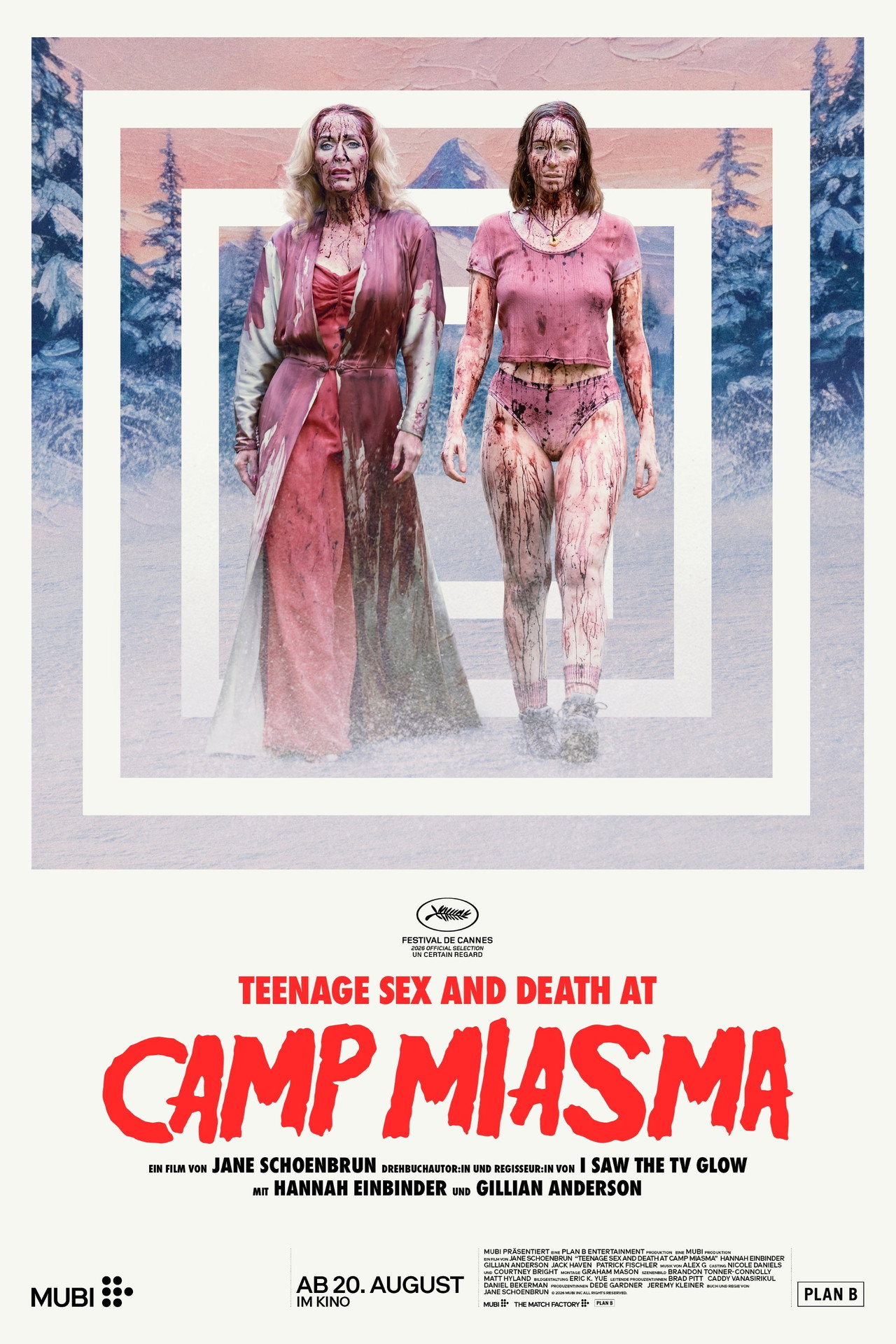
The Verdict
The Nerdiction verdict: Teenage Sex and Death at Camp Miasma: A Wildly Brilliant Slasher Comedy is good and receives 72 out of 100 points.
Pro
- A revolutionary blend of horror, comedy, and romance that rethinks the genre.
- An outstanding performance by Hannah Einbinder, combining intelligence with emotional openness.
- Gillian Anderson’s performance is a masterclass in reflection and gravitas.
Contra
- The genre-blending may be confusing for some audiences.
- The violent scenes, although thoughtfully crafted, are not suitable for sensitive viewers.
- The narrative complexity requires a willingness to engage intellectually.
Videos & Trailers
Loading video…
Loading video…
Details
August 6, 2026
1h 46m
6.7
/ 10(63 votes)25.7
Genres
Production Companies
Production Countries
Spoken Languages
Cast
Table of Contents
- Introduction
- Plot & Narrative
- Acting & Characters
- Direction & Cinematography
- Music & Sound Design
- Visual Effects & Technical Craft
- Themes & Message
- Comparison with Similar Films
- Who Is This Film For?
- Verdict
Introduction
Jane Schoenbrun’s “Teenage Sex and Death at Camp Miasma” is not a typical slasher film – it is a deliberate, witty, and deeply thoughtful homage to the genre that simultaneously reinvents it. Released on August 6, 2026, in select theaters, the film playfully deconstructs the formulas of classic splatter cinema through a blend of comedy, horror, and romance. With a runtime of 106 minutes, it is short enough not to overextend, yet long enough to fully explore its thematic depth.
The protagonist is a young, ambitious director who inherits the iconic slasher franchise Camp Miasma after years of lackluster sequels and dwindling fanbases – a role perfectly embodied by Hannah Einbinder. Joining her is Gillian Anderson as the reclusive star of the original films and a cast of supporting characters who contribute not just to the terror, but also to the charm.
Audiences can expect a genre-bending experience that celebrates the tropes of the slasher genre while subtly deconstructing them. And exactly this balance lies confidently in Schoenbrun’s blood – supported by a stellar cast and direction that is both precise and daring.
Plot & Narrative
The narrative of Teenage Sex and Death at Camp Miasma follows a clear but surprisingly elegant arc: the rise and fall of a young director trying to revive a faded franchise – and in doing so, unwittingly entering a world of sex, violence, and self-discovery. The story begins with the handing over of the directing reins to the young filmmaker, who draws upon her childhood memories of the original Camp Miasma to reinterpret the work.
The pacing remains consistently high without ever losing control. Schoenbrun manages to balance the tension between comedy and horror so that even the most brutal scenes retain a near-philosophical lightness. The plot twists are subtly placed – they feel less like sudden strokes of fate and more like natural consequences of the characters themselves. The dialogue is sharp, often cynical, but never shallow.
Particularly noteworthy is how the narrative blurs the lines between reality and fiction. Without spoiling the ending, it can be said that the film contains a series of twists that not only redefine the audience’s understanding of the story but also fundamentally alter the relationships between the characters. The narrative remains always at the service of emotion – not action.
The storyline, as described in the provided sources, is a tribute to the slasher genre, but also a critical engagement with its own history. The characters navigate a space defined by desire, fear, and delusions – a space that is both captivating and unsettlingly familiar.
Acting & Characters
The performances in Teenage Sex and Death at Camp Miasma are among the film’s strongest assets – and not just on the level of leading roles. Hannah Einbinder, known for her ability to convey complex emotions in seemingly simple moments, delivers a performance that is simultaneously intelligent, tenacious, and emotionally open. Her portrayal of the young director feels authentic – it reflects the uncertainty of an artist trying to find her place in a world that has fascinated her since childhood.
Gillian Anderson, playing the reclusive star of the original films, brings such depth and gravitas to her role that she exudes a presence that is almost overwhelming, even in the briefest of scenes. Her chemistry with Einbinder is not only credible – it is alive, dangerous, and emotionally resonant. Together, they craft a relationship that is defined by both affection and power struggles.
The supporting cast – including Arthur Conti as Alex, Eva Victor as DJ Ella Giastic, and Zach Cherry as Will – supports the leads with a mix of irony, empathy, and unrestrained energy. Even Sarah Sherman in the role of the agent and Patrick Fischler as Rudolph bring unexpected depth to their roles, strengthening the film and giving it an unmistakable edge.
Especially remarkable is how the characters do not serve as mere props in the slasher setting – they are living, contradictory individuals with their own motivations, fears, and desires. This makes the violence that occurs in the film not only more engaging but also morally complex.
Direction & Cinematography
Jane Schoenbrun, who directs as well as writes the screenplay, delivers a deeply felt yet never sentimental direction. Her visual style combines the forms of the slasher genre with a modern, almost cinematic sensitivity. Camera movements are precise, often absurdly funny, but never over-the-top. She opts for tight shots to capture the characters’ emotions and wide shots to emphasize the isolation and menace of the camp setting.
The editing is rhythmic and energetic – it supports the fast-paced action without sacrificing tension. Schoenbrun knows when to slow down and when to accelerate, resulting in a narrative that flows like a river – sometimes calm and deep, sometimes wild and relentless.
The visual language is highly intentional. Colors, light, and shadow are used not merely as aesthetic elements but as expressive tools for the characters’ inner states. The use of red in violent scenes is not naive – it is symbolic and emotionally charged. The composition of scenes is often so bold that it makes the viewer feel almost like a participant in the game.
Overall, the direction is a masterclass in balance – between humor and horror, between nostalgia and innovation, between what was and what could be.
Music & Sound Design
The music in Teenage Sex and Death at Camp Miasma is a subtle but powerful component of the film. The score, often drawing on synthesizer-based tones, echoes the soundtracks of the 1980s – but without falling into retro kitsch. Instead, it feels contemporary and emotionally enriched, underscoring the tension of the slasher genre in a way that is both eerie and liberating.
Sound effects are just as precise as the music. The sound design uses the environment of the camp to create an atmosphere of threat – from the creaking of branches to the echoing effects in empty rooms. There are no superfluous effects – every sound serves the narrative.
Particularly impressive is how the music is woven into character development. The themes associated with specific characters evolve throughout the film – they reflect not only emotions but also change itself. The soundscape is dense but never overloaded.
Overall, the sound design is a masterpiece of support – it makes the film more palpable without ever becoming dominant. It is the invisible hand guiding the viewer.
Visual Effects & Technical Craft
The visual effects in Teenage Sex and Death at Camp Miasma are deliberately restrained – they serve emotion over spectacle. The violent scenes that occur in the film are not realistic, but extremely convincing – they combine practical effects with purposeful animation that honors the style of the original without descending into morbid mythology.
The production design is a tribute to the classic slasher universe – from the wooden buildings of the camp to the weathered beds. Every detail is carefully chosen to enhance the atmosphere of the place. The props – from costumes to weapons – feel authentic without veering into kitsch.
The color grading is highly intentional – the use of warm tones in intimate scenes and cool, detached colors in violent scenes creates an emotional landscape that guides the viewer. The lighting is often so bold that it acts almost like another character in the film.
Overall, the technical execution is a testament to the power of modest means – it is not grand, but it is perfectly tailored to the needs of the story.
Themes & Message
The film explores a variety of themes – from sexuality and self-discovery to power, identity, and the nature of cinema itself. The themes are not driven by overt messages – they emerge from the experiences of the characters and their interaction with the world. The film is an exploration of the boundaries between reality and fiction, between what we see and what we feel.
A central theme is the idea of direction as an act of self-revelation. The young director who inherits the franchise is not just a character in the film – she is a metaphor for the artist trying to find her place in a world that has fascinated her since childhood. The film is both a love letter to the power of cinema and a critical engagement with its own history.
The film is also an exploration of longing – for love, for understanding, for a place in the world. This longing is not hollow – it is alive and dangerous. And it is precisely this aliveness that makes the film something special.
Comparison with Similar Films
Teenage Sex and Death at Camp Miasma enters into direct dialogue with films like Scream, The Cabin in the Woods, and Jennifer’s Body – but it is not simply a tribute. It is an evolution. Where those films were often caught in irony and self-reflection, Schoenbrun is stronger in emotion. The film is both a love letter to the genre and a critical engagement with it.*
The comparison with Scream is particularly relevant – both films play with the audience’s knowledge of the genre. But where Scream was often trapped in wit and humor, Teenage Sex and Death is deeper. The film is not less clever – it is wiser.
The comparison with The Cabin in the Woods is equally relevant – both films are tributes to the genre that are also critical. But where The Cabin in the Woods was often caught in absurd comedy, Schoenbrun is stronger in emotion. The film is not less absurd – it is deeper.
The comparison with Jennifer’s Body may be the most direct – both films are surprises about the nature of sexuality and violence. But where Jennifer’s Body was often caught in farce, Schoenbrun is stronger in reflection. The film is not less sexy – it is wiser.
Overall, the film is an evolution of the genre – not a revolution, but a sensitive, emotional development.
Who Is This Film For?
For slasher fans, this film is a must – not just for the tribute, but for the way it rethinks the genre. For lovers of comedy, horror, and romance, it is a welcome surprise – a film that blends all three genres in a way that is both entertaining and emotionally resonant.
The film is not for everyone – it is too clever, too emotional, and too sensitive for an audience seeking simple, surface-level entertainment. But for an audience looking for something that both entertains and provokes thought, it is a welcome surprise.
The film is available in select theaters – an experience worth indulging if you have the luxury. For streaming audiences, it is also a welcome addition – a film that works well for a cozy night at home without sacrificing depth.
The price-to-performance ratio is excellent – for a film that packs so much emotion and intelligence into such a short runtime, it is a real treasure.
Verdict
Jane Schoenbrun’s Teenage Sex and Death at Camp Miasma is a milestone in the slasher genre – a film that not only entertains but also provokes thought. With a stellar cast, sharp direction, and emotionally deep storytelling, it is a testament to the power of cinema that can be both fun and meaningful.
The film is proof that the genre is far from exhausted – it just needs someone willing to reinvent it. And Jane Schoenbrun is exactly that person.
Score: 72/100
Jane Schoenbrun at the premiere of Teenage Sex and Death at Camp Miasma. The direction is a blend of respectful homage and revolutionary curiosity.
Hannah Einbinder and Gillian Anderson in one of the film’s central scenes. Their chemistry is one of the film’s greatest strengths.
A young, ambitious director inheriting the slasher franchise Camp Miasma – a setup that leaves so much room for surprises.
The Camp Miasma itself – a place that is both terrifying and familiar. The production design is a tribute to the genre.
Pros:
- A revolutionary blend of horror, comedy, and romance that rethinks the genre.
- An outstanding performance by Hannah Einbinder, combining intelligence with emotional openness.
- Gillian Anderson’s performance is a masterclass in reflection and gravitas.
- Jane Schoenbrun’s direction is precise, emotionally deep, and visually intentional.
- The sound design and music support the film’s emotions without overwhelming them.
Cons:
- The genre-blending may be confusing for some audiences.
- The violent scenes, although thoughtfully crafted, are not suitable for sensitive viewers.
- The narrative complexity requires a willingness to engage intellectually.
- The 106-minute runtime sometimes feels short, especially in emotional moments.
- Limited theatrical availability may be a barrier for some viewers.
Das könnte dich auch interessieren
Weitere Reviews aus der Kategorie movie.
Die theoretische Unwahrscheinlichkeit von Liebe – Review
Inhaltsverzeichnis [Einleitung]( einleitung) [Handlung & Erzählung]( handlung und erzaehlung) [Schauspiel & Charaktere]( schauspiel und charaktere) [R…

Matchbox: Der Film – Spielzeug-Abenteuer zwischen Action, Humor und zähem Ensemble
Inhaltsverzeichnis [Einleitung]( einleitung) [Handlung & Erzählung]( handlung und erzaehlung) [Schauspiel & Charaktere]( schauspiel und charaktere) [R…
Tyler Perry's Doing Life – Eine tiefgehende Analyse
Inhaltsverzeichnis [Einleitung]( einleitung) [Handlung & Erzählung]( handlung und erzaehlung) [Schauspiel & Charaktere]( schauspiel und charaktere) [R…
Frequently Asked Questions
How good is Teenage Sex and Death at Camp Miasma: A Wildly Brilliant Slasher Comedy?
Teenage Sex and Death at Camp Miasma: A Wildly Brilliant Slasher Comedy wurde von Nerdiction mit 72 von 100 Punkten bewertet und ist damit good.
What are the pros of Teenage Sex and Death at Camp Miasma: A Wildly Brilliant Slasher Comedy?
The advantages of Teenage Sex and Death at Camp Miasma: A Wildly Brilliant Slasher Comedy: A revolutionary blend of horror, comedy, and romance that rethinks the genre., An outstanding performance by Hannah Einbinder, combining intelligence with emotional openness., Gillian Anderson’s performance is a masterclass in reflection and gravitas., Jane Schoenbrun’s direction is precise, emotionally deep, and visually intentional., The sound design and music support the film’s emotions without overwhelming them..
What are the cons of Teenage Sex and Death at Camp Miasma: A Wildly Brilliant Slasher Comedy?
The disadvantages of Teenage Sex and Death at Camp Miasma: A Wildly Brilliant Slasher Comedy: The genre-blending may be confusing for some audiences., The violent scenes, although thoughtfully crafted, are not suitable for sensitive viewers., The narrative complexity requires a willingness to engage intellectually., The 106-minute runtime sometimes feels short, especially in emotional moments., Limited theatrical availability may be a barrier for some viewers..
Is Teenage Sex and Death at Camp Miasma: A Wildly Brilliant Slasher Comedy worth it?
Yes. Teenage Sex and Death at Camp Miasma: A Wildly Brilliant Slasher Comedy received a score of 72/100 points and is good.