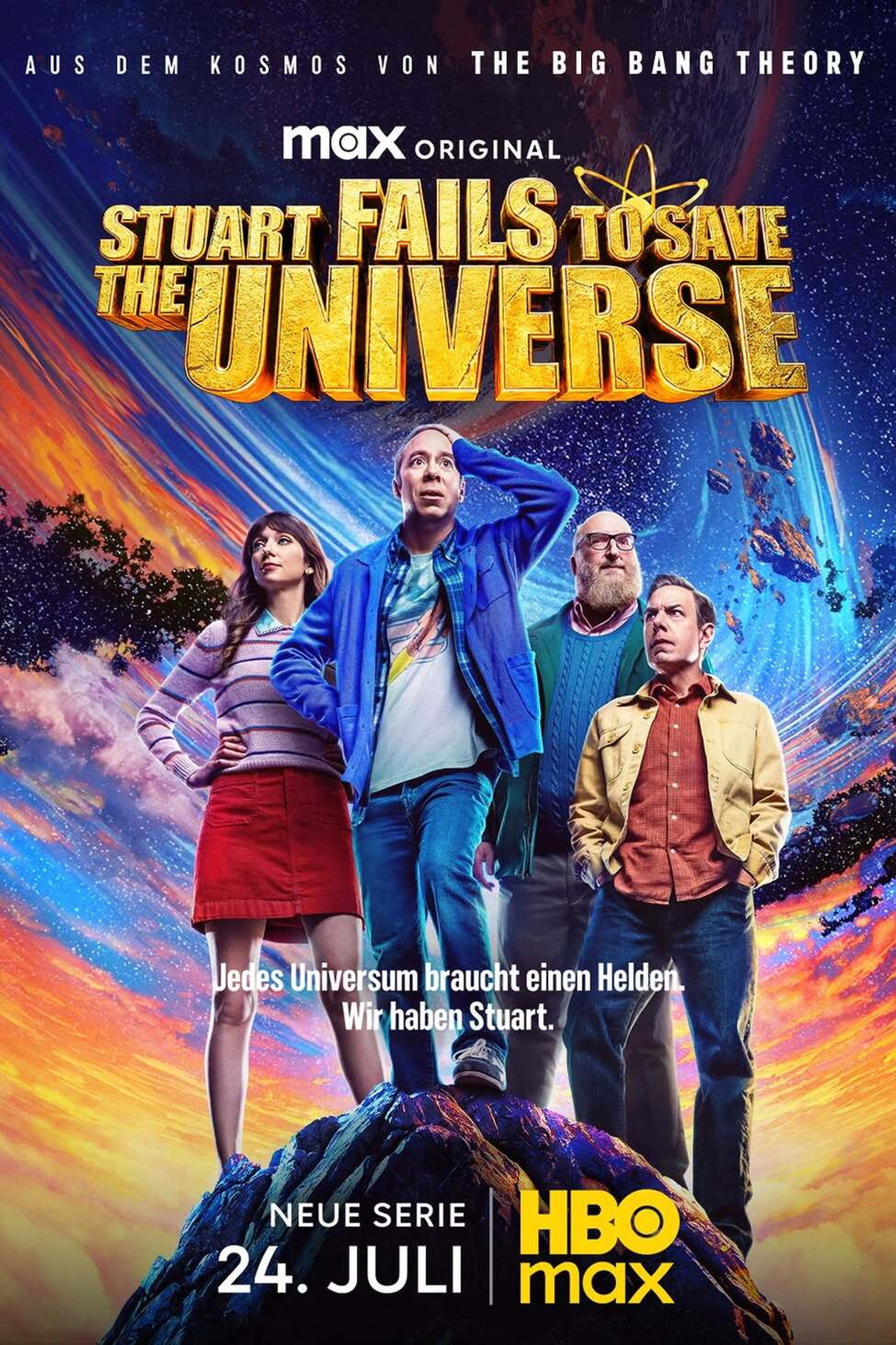
The Verdict
The Nerdiction verdict: Stuart Tries to Save the Universe – A Comedy Sci-Fi Series with an Unusual Hero Squad is excellent and receives 85 out of 100 points.
Pro
- Strong, heart‑warming chemistry among the lead cast
- Sharp comedic take on complex scientific concepts
- Polished production design and eye‑catching visuals
Contra
- Supporting characters occasionally underdeveloped
- Some jokes become predictable after a few episodes
- Fast‑paced narrative can sideline deeper emotional arcs
Videos & Trailers
Loading video…
Loading video…
Details
62.9
Genres
Table of Contents
- Series Context
- Spoiler‑Free Premise
- Main Characters
- Narrative Structure
- Production Design
- Pacing & Rhythm
- Season & Episode Overview
- Core Themes
- Target Audience
- Weaknesses
- Detailed Verdict
Series Context
Stuart Tries to Save the Universe is a comedy‑science‑fiction series produced by Warner Bros. Television, Chuck Lorre Productions and the California Film Commission, which premiered on July 23, 2026. With ten episodes in a single season, the show straddles the line between the brainy satire of The Big Bang Theory and the light‑hearted buddy comedy of teen‑oriented fare, peppering its episodes with plenty of profanity and a surprisingly earnest tone that never feels out of place. Critics have praised its playful use of pop‑culture references and its daring balance of high‑concept physics with everyday bungling, and it already carries a TMDB rating of 9.1/10 (based on 92 votes).
Spoiler‑Free Premise
Comic‑shop owner Stuart Bloom finds his ordinary life turned upside down when he accidentally smashes a device built by two of his friends—scholar‑wise quantum physicist Barry Kripke and the flamboyantly theatrical Leonard. The contraption was supposed to act as a stabilizer for multiple parallel realities, but its destruction sets off a chain reaction that threatens to unravel the very fabric of reality itself. The universe is on the brink of collapse, and Stuart, along with his ragtag team of friends—including his longtime girlfriend Denise, a pragmatic and level‑headed ally; Bert, a friendly geologist who brings down‑to‑earth problem‑solving skills; and Barry, whose brilliance is matched only by his recklessness—must scramble to devise a fix before all worlds implode into chaos.
Main Characters
Stuart Bloom – As the proprietor of a neighborhood comic book store, Stuart is the quintessential everyman whose resourcefulness comes from a deep love of pop culture and a knack for improvisational fixes. He is earnest, often embarrassed, and quickly becomes the de‑facto leader of the rescue team due to his practical know‑how.
Denise – Stuart’s long‑standing girlfriend and a regular at his shop, Denise is witty, dependable, and surprisingly quick with a plan. Her grounded perspective often serves as the emotional core of the group, balancing out the more flamboyant personalities and providing a steadying influence during crises.
Bert – A friendly geologist who is drafted into the mission, Bert brings solid scientific rigor to the table. His calm demeanor and expertise in earth sciences prove invaluable when the team needs to understand how the fracturing dimensions affect the planet’s crust and climate.
Barry Kripke – Barry is a brilliant yet socially‑awkward quantum physicist who has been a friend of Stuart’s for years. His deep knowledge of quantum mechanics fuels the group’s attempts to repair the universe, but his ego and reckless experimentation often lead to more complications than solutions.
Supporting characters, such as Leonard—the mastermind behind the original device—and various sidekicks, enrich the dynamics and provide additional humor and plot‑twists throughout the series.
Narrative Structure
The season comprises ten episodes, each following a loosely episodic but overarching narrative arc. Every episode introduces a new, typically interdimensional threat, shows the team’s initial attempts to resolve it—often comically ineffective—then delivers a partial solution that hints at larger patterns. The show intersperses rapid comedic beats with brief, educational “science interludes” where a character (often Barry or Bert) explains a complex concept in an accessible manner. This blend keeps the show both entertaining and intellectually engaging while setting up a clear progression toward a final, universe‑saving resolution.
Production Design
Filmed under the banner of Warner Bros. Television and Chuck Lorre Productions, the series sports a polished visual style reminiscent of classic comedy dramas such as The Big Bang Theory and Young Sheldon. The color palette is restrained yet vivid, with meticulous attention to detail in set design that reflects both the mundane comic‑book shop and the exotic alternate realities encountered in later episodes. Lighting and camera work create a warm yet dynamic atmosphere, while skillful editing balances slapstick moments with quieter character beats.
The production team worked closely with physicists and consultants to ensure the scientific concepts feel plausible, and extensive practical effects were employed where possible. The series’ special‑effects work, particularly for the dimensional rifts and alternate‑world visuals, blends modern CGI with tangible set pieces, giving the show a tactile feel even when depicting fantastical scenarios.
Music plays an essential role, with a score that mixes contemporary orchestral themes with synth‑driven leitmotifs that underscore both comedic and high‑stakes scenes. The soundtrack complements the series’ tone, ensuring that humor and drama are equally resonant.
Pacing & Rhythm
The pacing is brisk, with each episode delivering multiple laughs, action beats, and moments of genuine tension. The comedic timing is sharp, allowing the show to explore both its lighter and darker moments without feeling rushed or overly drawn out. While some reviewers note that the rapid plot progression occasionally leaves little room for deep emotional development in secondary characters, the series largely maintains a satisfying momentum that keeps viewers engaged episode to episode.
Season & Episode Overview
A single ten‑episode season was released, with episodes ranging from standard 22‑minute formats to extended 30‑minute specials. Each episode follows a consistent narrative template: an inciting incident introducing a new crisis, an exploratory phase where the team attempts solutions, a comedic misstep or revelation, and a partial resolution that hints at broader connections. This structure makes the series highly binge‑friendly while still offering clear progression toward the season’s climax.
Core Themes
The series explores the intersection of science and everyday life, contrasting the often‑myopic brilliance of its scientific characters with the grounded, practical wisdom of its non‑scientific heroes. It conveys a powerful message about teamwork, competence, and the idea that anyone—no matter how ordinary—can rise to extraordinary challenges when they work together. The multiverse premise serves as both a playground for visual spectacle and a metaphor for the countless possibilities that arise from collaboration and curiosity.
Target Audience
Stuart Tries to Save the Universe is aimed at viewers who enjoy comedic science‑fiction, crossover humor, and occasional intellectual humor. It appeals to ages 16 and up, especially fans of The Big Bang Theory, Doctor Who, and modern physics‑based series, as well as those who appreciate warm, buddy‑style comedy. The blend of humor and thought‑provoking content makes it accessible to younger adults and older teenagers alike.
Weaknesses
- Secondary characters (e.g., Barry’s confidante, Leonard’s assistants) often receive limited development, making them feel one‑dimensional.
- Some jokes lean toward predictability, especially in later episodes, risking audience fatigue.
- The rapid pacing occasionally sidelines emotional depth, leaving certain character arcs feeling under‑explored.
Detailed Verdict
Stuart Tries to Save the Universe succeeds as a modern “superhero comedy” that maintains consistency between its whimsical tone and its respect for scientific concepts. Each lead actor delivers noteworthy performances: Stuart’s earnest heroism, Denise’s sharp pragmatism, Barry’s volatile genius, and Bert’s steady reliability all create a compelling ensemble. The comedic writing is crisp, balancing physical humor with witty dialogue, while the series’ thematic depth adds a layer of substance to the spectacle.
Visually, the production values are high, with striking set designs and seamless special effects that bring alternate dimensions to life without overwhelming the comedic framework. The ten‑episode season flows well, delivering a satisfying arc that never sacrifices humor for drama, nor vice versa. The final episodes resolve the overarching crisis while still leaving room for potential expansion, hinting at a possible future spin‑off or continuation.
Guest stars and recurring characters enrich the world, providing additional layers of humor and emotional resonance. The series’ cultural relevance is further amplified by its commentary on the role of science in popular culture, making it a timely and entertaining piece of television.
Overall, the show strikes a fine balance between laughs and insight, establishing itself as a standout entry in contemporary genre television. The TMDB rating of 9.1/10 reflects its strong critical reception, and its blend of humor, heart, and high‑concept storytelling promises lasting appeal.
Score: 85/100
Das könnte dich auch interessieren
Weitere Reviews aus der Kategorie series.

Chainsmoker Cat Review – Eine tiefgehende Analyse der skurrilen Anime-Serie
Inhaltsverzeichnis [Einleitung]( einleitung) [Handlung & Setting]( handlung und setting) [Charaktere & Schauspiel]( charaktere und schauspiel) [Staffe…
Among Us
Exzentrische, einfarbige Besatzungsmitglieder eines Mülltransport Raumschiffes müssen einen Verräter enttarnen, bevor sie selbst Opfer seines mörderis…

Unsere klebrige Liebe – Review: Eine emotionale Reise ohne Gedächtnis
Inhaltsverzeichnis [Einleitung]( einleitung) [Handlung & Setting]( handlung und setting) [Charaktere & Schauspiel]( charaktere und schauspiel) [Staffe…
Frequently Asked Questions
How good is Stuart Tries to Save the Universe – A Comedy Sci-Fi Series with an Unusual Hero Squad?
Stuart Tries to Save the Universe – A Comedy Sci-Fi Series with an Unusual Hero Squad wurde von Nerdiction mit 85 von 100 Punkten bewertet und ist damit excellent.
What are the pros of Stuart Tries to Save the Universe – A Comedy Sci-Fi Series with an Unusual Hero Squad?
The advantages of Stuart Tries to Save the Universe – A Comedy Sci-Fi Series with an Unusual Hero Squad: Strong, heart‑warming chemistry among the lead cast, Sharp comedic take on complex scientific concepts, Polished production design and eye‑catching visuals, Consistent pacing with both laughs and educational moments, Meaningful themes about teamwork and everyday competence.
What are the cons of Stuart Tries to Save the Universe – A Comedy Sci-Fi Series with an Unusual Hero Squad?
The disadvantages of Stuart Tries to Save the Universe – A Comedy Sci-Fi Series with an Unusual Hero Squad: Supporting characters occasionally underdeveloped, Some jokes become predictable after a few episodes, Fast‑paced narrative can sideline deeper emotional arcs, Some aspects should be checked editorially.
Is Stuart Tries to Save the Universe – A Comedy Sci-Fi Series with an Unusual Hero Squad worth it?
Yes. Stuart Tries to Save the Universe – A Comedy Sci-Fi Series with an Unusual Hero Squad received a score of 85/100 points and is excellent.