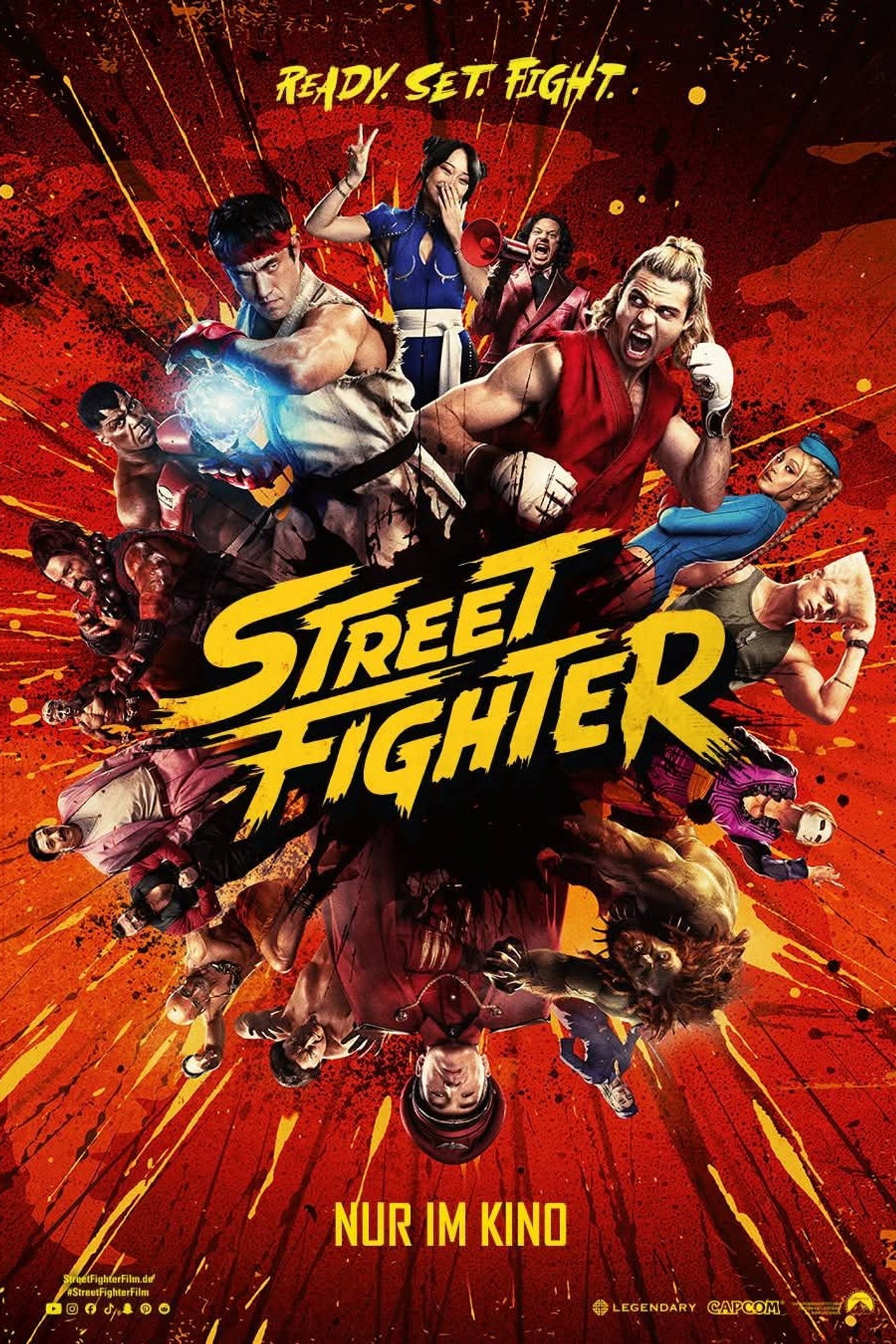
The Verdict
The Nerdiction verdict: Street Fighter (2026) Review: Between Arcade Nostalgia and Cinematic Reboot is satisfactory and receives 62 out of 100 points.
Pro
- Die exzellente Kampfchoreografie und das kinetische Kameragespür von Sakurai machen jeden Fight zum visuellen Highlight.
- Die Bruder-Dynamik zwischen Andrew Kojis stoischem Ryu und Noah Centineos charismatischem Ken trägt den emotionalen Kern des Films.
- Die animierten Flashback-Sequenzen bieten eine stilistisch mutige und gelungene Abwechslung zum Live-Action-Geschehen.
Contra
- Das überladene Fighter-Roster führt dazu, dass Fan-Favoriten wie Guile, Cammy oder Zangief auf reine Cameos ohne Bogen reduziert werden.
- Die Exposition lastet schwer auf der Mitte des Films und bremst das Tempo zugunsten einer generischen Verschwörungshandlung.
- David Dastmalchian als M. Bison wird trotz starker Präsenz durch das Drehbuch in seiner Bedrohlichkeit beschnitten.
Videos & Trailers
Loading video…
Loading video…
Details
October 13, 2026
2h 0m
6.3
/ 10(103 votes)225.4
Genres
Production Companies
Production Countries
Spoken Languages
Cast
Table of Contents
- Introduction
- Plot & Narrative
- Acting & Characters
- Direction & Cinematography
- Music & Sound Design
- Visual Effects & Technical Craft
- Themes & Message
- Comparison with Similar Films
- Who Is This Film For?
- Verdict
Introduction
With "Street Fighter," Legendary Pictures, in collaboration with Capcom, attempts the second major live-action adaptation of the iconic fighting game franchise. The shadow of the legendarily poor 1994 film starring Jean-Claude Van Damme looms heavily over any reboot attempt, but the signs in 2026 are different: Kitao Sakurai ("Bad Trip," "The Eric Andre Show"), known for his guerrilla-style, energetic directorial signature, sits in the director's chair, and the screenplay comes from genre veterans like Gary Dauberman ("Annabelle," "It") and T.J. Fixman. The theatrical release on October 13, 2026, marks the attempt to finally bring the brand to where it has belonged since "Street Fighter II": serious action cinema. Fan expectations were a mixture of cautious hope and traumatic wariness – could a film that positions Ryu and Ken as estranged adoptive brothers in the 90s finally strike the balance between respectful adaptation and its own cinematic life? The first impression after the credits roll is that of a film that does not deny its origins but is bold enough to forge its own narrative paths, even if it stumbles along the way.
Plot & Narrative
The plot is set in 1993, a deliberate choice that gives the film an analog, rough patina and makes the modern surveillance and technology aesthetic of the Shadaloo organization all the more threatening. At the center are Ryu (Andrew Koji) and Ken Masters (Noah Centineo), once inseparable adoptive brothers under the tutelage of a shared master who warned them to protect each other from themselves. Their paths have diverged: Ryu seeks perfection as a wandering fighter, Ken enjoys the privileged life as heir to the Masters fortune, yet the longing for the World Warrior Tournament still connects them. The catalyst is Chun-Li (Callina Liang), who recruits the two for the tournament as an Interpol agent, behind which lies a deadly conspiracy led by M. Bison (David Dastmalchian). The narrative structure follows the classic tournament arc but breaks it up in the first half with a "road movie" approach that brings the characters together before the main event. The pacing is uneven: the first act takes its time establishing the fractured brother dynamic, while the second act staggers under the weight of exposition and the introduction of the huge ensemble (Guile, Cammy, Dhalsim, Zangief). Turning points are driven less by subtle character decisions than by external plot mechanics (tournament rules, Bison's manipulation). The dialogue is functional, sometimes clichéd, but avoids cringe-worthy one-liners in favor of a surprisingly serious baseline tone. The ending delivers a satisfying, albeit somewhat overloaded, showdown that leaves room for a potential franchise without feeling like a mere teaser.
Acting & Characters
The heart of the film undoubtedly beats in the chemistry between Andrew Koji and Noah Centineo. Koji portrays Ryu with a physical presence and stoic intensity that honors the "wanderer" archetype without lapsing into caricature; his martial arts are authentic, his inner conflict palpable. Centineo, meanwhile, surprises: he plays Ken not merely as arrogant, but as a deeply insecure man who uses his mask of charm and wealth to fill the void of the missing brother. Their scenes together – whether arguing or in rare moments of reconciliation – are the emotional anchors of the film. Callina Liang as Chun-Li brings the necessary determination and professional hardness but remains trapped in a script that uses her primarily as a plot device (recruiter, explainer) rather than giving her an arc of her own. David Dastmalchian as M. Bison is a fascinating miscast on paper that turns out to be a stroke of genius: he plays the dictator not as a roaring muscle mountain, but as a quiet, intellectual threat, a CEO of evil. Unfortunately, the script gives him too little room to fully unfold this interpretation. The extended ensemble – Cody Rhodes as Guile, Mel Jarnson as Cammy, Vidyut Jammwal as Dhalsim, Olivier Richters as Zangief – suffers from the "Avengers syndrome": everyone gets their moment, their signature move, but no one gets an arc. Rhodes convinces through physical authority, Jammwal through impressive agility, yet they remain splashes of color in a picture that wants to use too many colors at once.
Direction & Cinematography
Kitao Sakurai proves he can do more than hidden-camera comedy. His direction is characterized by a raw, kinetic energy reminiscent of the best 90s Hong Kong action films, but shot with modern technical precision. The camera stays close to the bodies, uses long takes during fight scenes to let the choreography breathe, and does not cut in the ADHD rhythm of modern blockbusters. A standout stylistic device is the animated flashback sequences visualizing the origin of Ryu and Ken and the mythology surrounding their master. These sequences, reminiscent of classic anime aesthetics (think "Street Fighter II: The Animated Movie"), artfully break the live-action look and deliver emotional context that would have felt wooden in dialogue. The color palette is deliberately muted, grainy, almost documentary in the street scenes of Hong Kong and Thailand, but explodes into saturated neon colors in the tournament arenas – a visual reference to the arcade cabinets. Sakurai stages violence as painful and consequential (PG-13, but on the border), bones break audibly, sweat and blood are real. This groundedness contrasts with the absurdity of "Hadokens" or "Sonic Booms," anchoring the film in its own fascinating reality.
Music & Sound Design
The auditory level is a love letter to the source material. The score, a blend of driving synthwave, orchestral epicness, and traditional Japanese instruments, weaves the iconic leitmotifs (Guile's Theme, Ryu's Theme) subtly into the fabric of the music, rather than placing them blatantly as needle drops. The sound design is the secret star of the fight scenes: every punch, every kick, every block has weight, texture. The "thwack" of a connected Hadoken, the electric sizzle of a Sonic Boom, the deep rumble of Zangief's Siberian Express – they are not just effects, but narrative tools that visualize the superpower before the VFX shows it. The licensed 90s tracks (hip-hop, grunge, early electronica) anchor the 1993 setting authentically, without feeling like a "Guardians of the Galaxy" mixtape. In quiet moments, the music recedes, leaving room for breathing and ambient noise – a sign of maturity in sound mixing rarely heard in video game adaptations.
Visual Effects & Technical Craft
Here, the budget from Legendary and Capcom shows most clearly. The visual effects pursue a "practical first" approach: wire work, stunt work, and pyrotechnics form the base, CGI is only used for the supernatural elements (Hadoken, Yoga Flame, Psycho Power). The result is a tactile physicality that CGI-heavy competitors like "Mortal Kombat" (2021) often lack. The Hadokens don't feel like composited energy balls added in post, but like physical projectiles displacing air and kicking up dust. The production design reconstructs early 90s Asia with meticulous detail: neon signs in Kowloon, humid dojos in Thailand, sterile Shadaloo labs. The costumes master the balancing act between spandex-comic look and tactical realism surprisingly well – Ryu's white Gi fits, Ken's red hair is a statement, Bison's uniform is militaristic-elegant. The technical execution (editing, color grading) supports the genre mix: fast cuts in tournament mode, slow, almost meditative shots in character dramas. Only the final battle suffers from slight "VFX fatigue" when too many particle effects fill the screen simultaneously, momentarily disorienting the viewer.
Themes & Message
Beneath the surface of the brawls, the film negotiates surprisingly mature themes. The central motif is brotherly love as both a toxic and healing force: "Protect each other from yourselves," the master warned. Ryu and Ken are two sides of the same coin – discipline vs. chaos, duty vs. freedom. The film asks: Can one change one's nature, or does the fight define us? M. Bison embodies perverted control: he doesn't want to defeat the fighters, but to monetize, weaponize, and press their violence into a system (Shadaloo as a military-industrial complex). Chun-Li represents institutional justice that hits its limits when the system is corrupt. The "demons of the past" are not just metaphorical (Ryu's Satsui no Hado is hinted at) but manifest in the fear of one's own potential for destruction. The film gains societal relevance through the 1993 setting: post-Cold War chaos, rising globalization, the body as the last capital. Emotional depth arises not through grand speeches, but through looks, silence, the shared cigarette after training. It is a film about men who don't know how to talk about feelings, so they fight about them – a classic, but effectively staged action cinema trope.
Comparison with Similar Films
Comparison with the 1994 Van Damme film is almost forbidden; this reboot is superior in every discipline – acting, choreography, respect for the lore. A closer comparison lies with "Mortal Kombat" (2021): both are R-rated-adjacent (here hard PG-13) reboots of iconic fighters. Where "Mortal Kombat" relies on gore and fatalities, "Street Fighter" relies on martial arts precision and character drama. "Shang-Chi" (2021) is the benchmark for superhero martial arts in MCU style; Sakurai's film is rougher, less "Marvel-quippy," more "John Wick" meets "Enter the Dragon." Compared to the "Tekken" films (2009, 2014), "Street Fighter" wins hands down due to budget, directorial talent, and casting quality. An interesting parallel is "The Raid" (2011) in the final tower-conquest structure, only here the floors are replaced by tournament rounds. What makes "Street Fighter" unique is its refusal of pure spectacle in favor of the brother relationship – a unique selling point in the video game adaptation genre, reminiscent more of dramas like "Warrior" (2011) than pure arcade adaptations.
Who Is This Film For?
Target audience number one is the fighting game community and long-time "Street Fighter" fans: they will appreciate the love for detail (frame data references, stage transitions, win poses) and chuckle at the in-jokes (Zangief's "Quick Spin," Dhalsim's Yoga Teleport). Action cinema lovers who prefer hard, choreographed close-quarters combat over CGI storms get their money's worth – the fight scenes are the strongest argument for the big screen (or a good home theater setup). Nostalgia hunters of the 90s aesthetic (fashion, tech, music, film grain) find an authentic time capsule look. However, anyone expecting a deep, twist-heavy conspiracy thriller plot will be disappointed by the formulaic nature of the B-plot. Fans of specific side characters (Guile, Cammy, Rose) should also manage expectations: they are guest stars, not co-leads. Value proposition: In theaters, the surround sound and screen size are worth it for the fights; on streaming (likely Paramount+/Prime Video), the film loses none of its narrative quality but gains pausability for the Easter egg hunt.
Verdict
"Street Fighter" (2026) is no knockout, but a solid, respectful, and occasionally brilliant decision victory for video game adaptations. Kitao Sakurai delivers the best live-action implementation of the brand because he understands that "Street Fighter" is at its core not about fireballs, but about people using their fists to answer questions they cannot ask. The strengths – the Koji/Centineo dynamic, the kinetic direction, the animated flashbacks, the sound design – do not fully outweigh the weaknesses – the overloaded ensemble, the exposition-heavy middle, the underutilized Bison – but they make the film an experience that should be seen. It fails not for lack of courage, but under the weight of trying to serve too many expectations (fan service, franchise building, character study) simultaneously. With a score of 62/100, the film positions itself slightly below the critical average (63/100), which is fair: it is better than the sum of its parts, but not quite the masterpiece the brand deserved. Clear recommendation for action fans and gamers; for everyone else, a solid "Rent/Stream".
Das könnte dich auch interessieren
Weitere Reviews aus der Kategorie movie.
Mutiny: Ein konventionelles Action-Thriller-Duell mit Jason Statham
Inhaltsverzeichnis [Einleitung]( einleitung) [Handlung & Erzählung]( handlung und erzaehlung) [Schauspiel & Charaktere]( schauspiel und charaktere) [R…
Masterplan (2026) – Ein glanzvoller, aber hohler Heist-Thriller
Inhaltsverzeichnis [Einleitung]( einleitung) [Handlung & Erzählung]( handlung und erzaehlung) [Schauspiel & Charaktere]( schauspiel und charaktere) [R…
Mayday
Einleitung Auf dem Höhepunkt des Kalten Krieges gerät US Navy Pilot Lieutenant Troy „Assassin“ Kelly während einer streng geheimen Mission über russis…
Frequently Asked Questions
How good is Street Fighter (2026) Review: Between Arcade Nostalgia and Cinematic Reboot?
Street Fighter (2026) Review: Between Arcade Nostalgia and Cinematic Reboot wurde von Nerdiction mit 62 von 100 Punkten bewertet und ist damit satisfactory.
What are the pros of Street Fighter (2026) Review: Between Arcade Nostalgia and Cinematic Reboot?
The advantages of Street Fighter (2026) Review: Between Arcade Nostalgia and Cinematic Reboot: Die exzellente Kampfchoreografie und das kinetische Kameragespür von Sakurai machen jeden Fight zum visuellen Highlight., Die Bruder-Dynamik zwischen Andrew Kojis stoischem Ryu und Noah Centineos charismatischem Ken trägt den emotionalen Kern des Films., Die animierten Flashback-Sequenzen bieten eine stilistisch mutige und gelungene Abwechslung zum Live-Action-Geschehen., Die detailverliebte 90er-Jahre-Ästhetik (Produktionsdesign, Kostüme, Filmkorn) schafft eine immersive Atmosphäre., Der Soundtrack und das Sounddesign übersetzen die ikonischen Audio-Cues der Spiele (Hadouken, Stages) meisterhaft ins Kino..
What are the cons of Street Fighter (2026) Review: Between Arcade Nostalgia and Cinematic Reboot?
The disadvantages of Street Fighter (2026) Review: Between Arcade Nostalgia and Cinematic Reboot: Das überladene Fighter-Roster führt dazu, dass Fan-Favoriten wie Guile, Cammy oder Zangief auf reine Cameos ohne Bogen reduziert werden., Die Exposition lastet schwer auf der Mitte des Films und bremst das Tempo zugunsten einer generischen Verschwörungshandlung., David Dastmalchian als M. Bison wird trotz starker Präsenz durch das Drehbuch in seiner Bedrohlichkeit beschnitten., Die Dialoge schwanken zwischen funktional und klischeehaft, wodurch emotionale Schlüsselmomente an Wucht verlieren., Das Finale verliert sich in zu vielen gleichzeitigen Schauplätzen, wodurch der finale Showdown an Fokus einbüßt..
Is Street Fighter (2026) Review: Between Arcade Nostalgia and Cinematic Reboot worth it?
Only conditionally. Street Fighter (2026) Review: Between Arcade Nostalgia and Cinematic Reboot received a score of 62/100 points.