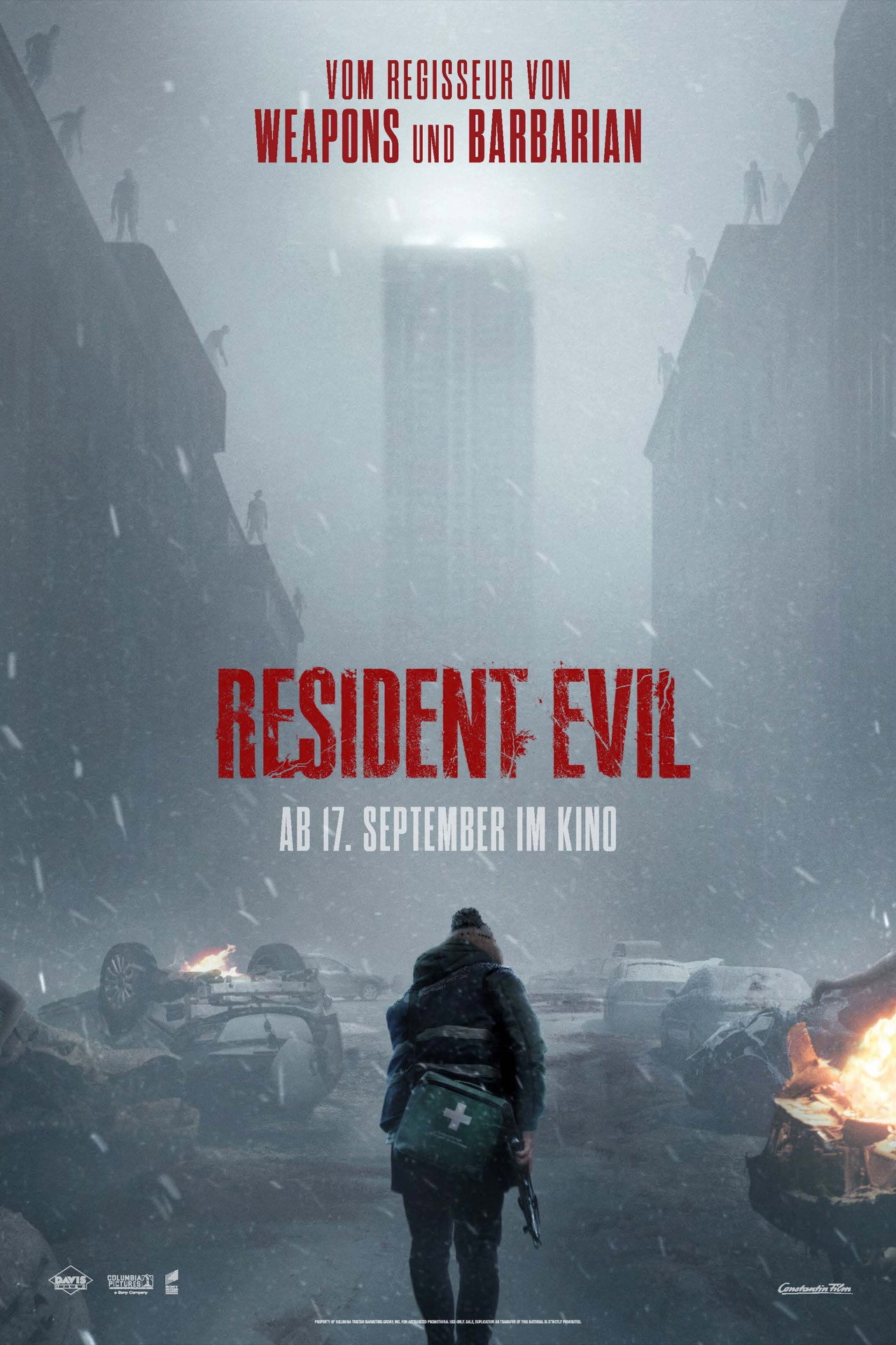
The Verdict
The Nerdiction verdict: Resident Evil (2026): A Surprisingly Engaging Reboot of the Cult Horror Classic is good and receives 77 out of 100 points.
Pro
- Austin Abrams delivers a charming, convincing lead performance
- The blend of horror and humor is expertly balanced
- Zach Cregger's direction injects fresh ideas into the genre
Contra
- Short runtime leaves some themes underdeveloped
- Certain supporting characters feel underwritten
- Linear story may seem predictable to some viewers
Videos & Trailers
Loading video…
Details
September 16, 2026
1h 35m
7.3
/ 10(359 votes)584.5
Genres
Production Companies
Production Countries
Spoken Languages
Cast
Table of Contents
- Introduction
- Plot & Narrative
- Acting & Characters
- Direction & Cinematography
- Music & Sound Design
- Visual Effects & Technical Craft
- Themes & Message
- Comparison with Similar Films
- Who Is This Film For?
- Verdict
Introduction
With Resident Evil (2026), director Zach Cregger — known for their iconic works such as Barbarian and Weapons — ushers in a new era of survival horror cinema. The film, which marks the eighth installment in the long-running series, represents not only a fresh start but a bold departure from familiar formulas. With a runtime of just 95 minutes, it's packed with tension, dark humor, and a touch of surreal dread. The first impression? An intense, relentless plunge into a seemingly innocent world — enriched by an unexpectedly charming protagonist who guides us through a night of terror and, ultimately, human resilience.
Medical courier Bryan, portrayed by Austin Abrams, begins his day with what seems like a routine job: transporting a biomedical package through the snowy night to Raccoon City. But what starts as a regular workday quickly transforms into a living nightmare with no escape. Blending survival action with psychological depth, the film draws viewers into an atmosphere where fear and humor coalesce.
Cregger brings not only their signature aesthetic but also a sharp balance between action and emotion. The film appeals to both hardcore fans of the game franchise and newcomers seeking a compelling story. With an international cast and relentless energy, it sets new benchmarks for the genre.
Plot & Narrative
The narrative kicks off with Bryan, a courier caught in the midst of a personal crisis. Rather than returning home to await the arrival of his pregnant girlfriend, he accepts one final overtime gig. Yet this seemingly mundane assignment soon opens doors to an eerie and dangerous reality. In a snow-covered, icy night deep in the woods of Raccoon City, Bryan finds himself caught in a cascade of perils he can barely comprehend.
Cregger and their screenwriting team — Shay Hatten and Zach Cregger themselves — construct a tension curve that echoes iconic moments from horror cinema history. The plot follows a linear but intensely paced structure. Every scene is a step deeper into a reality growing more surreal. Plot twists are precisely timed and often arrive unexpectedly, keeping the audience on the edge of their seats.
The dialogue, often sharp and witty, plays a key role in character development. Bryan himself becomes a mirror of a generation searching for direction amidst chaos and despair. The narrative stays tightly focused on the central conflict — one ordinary man against a world teeming with hidden threats. The climax is epic and leaves little room for lingering questions.
A notable feature is how the film subverts audience expectations without disappointing. The story remains connected to its core conflict, making every moment count. The simplicity of the premise allows for rich, layered storytelling.
Acting & Characters
Austin Abrams' performance as Bryan stands out as one of the strongest in the entire film. Their ability to convey emotions that are both vulnerable and resolutely strong makes them indispensable to the narrative. Bryan’s evolution from a seemingly passive courier to a true fighter is convincing and feels organic.
Paul Walter Hauser as Paul brings a blend of wit and depth to his role. His chemistry with Abrams is one of the film’s highlights. Between the two, there's a dance of respect, trust, and mutual support — a dynamic that gives the film real momentum.
Kali Reis as Maxine is a defining presence, bringing both strength and complexity to the script. Their performance is impressive both physically and emotionally. Zach Cherry as Carl adds a light yet essential tone — his humor never feels dismissive, but rather deeply human.
Supporting roles played by Johnno Wilson and Shaun W. Loeser round out the cast with authenticity. Each character carries a backstory that extends beyond the screen — a testament to thoughtful character construction.
Cregger themselves appears briefly as the voice of the intercom, a small but effective role that reinforces the film’s style: simple, yet powerful.
Direction & Cinematography
Cregger's direction is a symphony of control and chaos. Their ability to strike a perfect balance between suspense and levity is remarkable. The camera follows Bryan through each scene with a mix of intimacy and detached observation, constantly repositioning the viewer’s perspective.
The staging is clear and purposeful. Cregger employs light and shadow to create moods that are often hypnotic. Action sequences are choreographed like dances — every movement has intent, every camera angle a purpose.
Editing supports the mounting tension with quick, precise cuts that propel the story forward. At the same time, it remains subtle enough to preserve the emotional depth of the characters.
Particularly impressive is how Cregger interweaves the various layers of reality — psychological, physical, and emotional. Every scene is a masterclass in visual and narrative coordination.
Music & Sound Design
The musical score is a fusion of industrial textures and orchestral arrangements. These sounds craft an atmosphere that is both threatening and gripping. In quieter moments, the music enhances emotional resonance; in action scenes, it amplifies tension.
Sound design is meticulous and significantly contributes to the overall experience. From the wind rustling through trees to the mechanical hums of the mutated creatures — every sound is carefully placed. Notably, the use of silence often conveys more than loud effects.
The combination of music and sound creates an immersive experience that frequently pulls the audience into the story. Its emotional impact lingers long after the credits roll.
Visual Effects & Technical Craft
The visual effects are stunning in their detail and iconic aesthetic. The mutants appearing in this film are both realistic and terrifying — a fusion of physical menace and psychological unease.
Production design is another strength. From snowy landscapes to intricately designed interiors — each location is crafted to reinforce authenticity. Costumes and props ground the film in believable reality.
Technically, the film is polished and modern. Cregger and their team utilize cutting-edge technology to achieve seamless integration of effects and live-action footage. The visual language is consistent and bold, supported by a vibrant color palette that contrasts and harmonizes throughout.
Themes & Message
Resident Evil explores several themes including isolation, survival instinct, and the search for meaning amidst chaos. Bryan’s journey is not merely physical but deeply emotional — a metaphor for internal struggles we all recognize.
The message is clear: even in our darkest moments, we are not alone. Community, trust, and courage are the keys to survival. The film also emphasizes responsibility — Bryan carries not just the package, but the weight of his choices.
Its societal relevance is palpable. In a world often shaped by uncertainty and fear, Resident Evil offers reflection on how we navigate these feelings. Emotional depth is among the film’s greatest strengths.
Comparison with Similar Films
Compared to other horror films like The Descent or The Hills Have Eyes, Resident Evil distinguishes itself through its blend of survival action and emotional nuance. While those films rely heavily on raw fear, our film introduces layers of humor and humanity.
In contrast to earlier Resident Evil entries, this version leans more into psychological aspects. It’s less an action blockbuster and more an introspective horror that provokes thought.
Cregger’s style echoes directors like Jordan Peele, who similarly merge humor with horror. The film is unique — a blend of classic survival thriller and modern, thoughtful cinema.
Who Is This Film For?
Resident Evil is perfect for fans of survival horror and intelligent cinema. The mix of suspense, humor, and emotional depth attracts a wide audience.
The film works well both in theaters and on streaming platforms. Its short runtime and immersive atmosphere make it ideal for any evening’s entertainment.
For newcomers to the series, it serves as an excellent entry point, while veterans appreciate the fresh perspective. A must-watch for anyone who enjoys smart, thrilling films.
Verdict
Resident Evil (2026) is a milestone in survival horror cinema. With a stellar performance from Austin Abrams paired with Zach Cregger’s inventive direction, the film crafts an atmosphere that is both gripping and emotionally resonant.
The blend of survival action, dark humor, and human resilience makes it essential viewing. The film raises the bar for the genre and proves that horror can inspire hope.
Score: 77/100
Pros:
- Austin Abrams delivers a charming, convincing lead performance
- The blend of horror and humor is expertly balanced
- Zach Cregger's direction injects fresh ideas into the genre
- Action sequences are intense and choreographed
- Emotional depth gives the film a distinctive edge
Cons:
- Short runtime leaves some themes underdeveloped
- Certain supporting characters feel underwritten
- Linear story may seem predictable to some viewers
- Visual effects are impressive, but not groundbreaking
- Climax is tense, but not as epic as expected
Resident Evil is a must for anyone who values intelligent, suspenseful filmmaking with a dash of humor. A triumph that expands the boundaries of the genre.
Das könnte dich auch interessieren
Weitere Reviews aus der Kategorie movie.

Das Ende der Sterne – Ridley Scotts stille Apokalypse im Test
Inhaltsverzeichnis [Einleitung]( einleitung) [Handlung & Erzählung]( handlung und erzaehlung) [Schauspiel & Charaktere]( schauspiel und charaktere) [R…
The Last House – Eine klaustrophobische Parabel über Isolation und Überleben
Inhaltsverzeichnis Einordnung im Genre Handlung ohne Spoiler Themen und symbolische Ebene Inszenierung und Regie Kamera, Look und Produktionsdesign Sc…

Coyote vs. ACME – Das Gerichtsurteil der Looney Tunes
Inhaltsverzeichnis [Einleitung]( einleitung) | [Handlung & Erzählung]( handlung und erzaehlung) | [Schauspiel & Charaktere]( schauspiel und charaktere…
Frequently Asked Questions
How good is Resident Evil (2026): A Surprisingly Engaging Reboot of the Cult Horror Classic?
Resident Evil (2026): A Surprisingly Engaging Reboot of the Cult Horror Classic wurde von Nerdiction mit 77 von 100 Punkten bewertet und ist damit good.
What are the pros of Resident Evil (2026): A Surprisingly Engaging Reboot of the Cult Horror Classic?
The advantages of Resident Evil (2026): A Surprisingly Engaging Reboot of the Cult Horror Classic: Austin Abrams delivers a charming, convincing lead performance, The blend of horror and humor is expertly balanced, Zach Cregger's direction injects fresh ideas into the genre, Action sequences are intense and choreographed, Emotional depth gives the film a distinctive edge.
What are the cons of Resident Evil (2026): A Surprisingly Engaging Reboot of the Cult Horror Classic?
The disadvantages of Resident Evil (2026): A Surprisingly Engaging Reboot of the Cult Horror Classic: Short runtime leaves some themes underdeveloped, Certain supporting characters feel underwritten, Linear story may seem predictable to some viewers, Visual effects are impressive, but not groundbreaking, Climax is tense, but not as epic as expected.
Is Resident Evil (2026): A Surprisingly Engaging Reboot of the Cult Horror Classic worth it?
Yes. Resident Evil (2026): A Surprisingly Engaging Reboot of the Cult Horror Classic received a score of 77/100 points and is good.