The Verdict
The Nerdiction verdict: Razer BlackShark V2 X – In‑Depth Review & Buying Guide is good and receives 79 out of 100 points.
Pro
- Very lightweight at 240 g for extended comfort
- Clear mid‑ and high‑range output thanks to Triforce drivers
- Excellent value under $35 with detachable mic and cross‑platform 3.5 mm jack
Contra
- Bass response is relatively weak, lacking deep sub‑bass impact
- Ear‑pad leather may crack or lose cushioning after about a year
- Mic hinge can develop wobble with frequent adjustment
Quick verdict
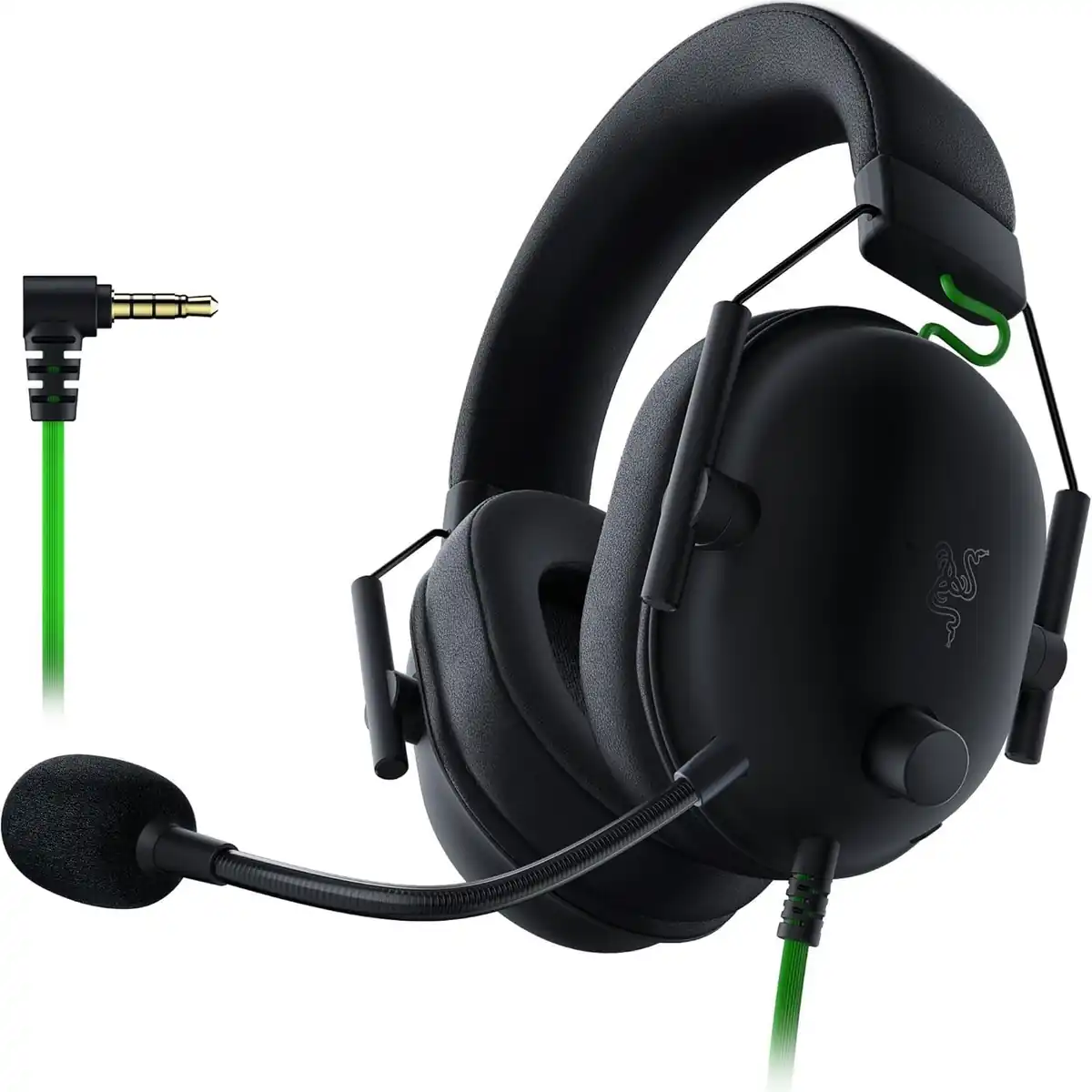
The Razer BlackShark V2 X is a lightweight, wired gaming headset that uses Razer’s Triforce 50 mm drivers, offers passive noise isolation and a flexible Hyperclear cardioid mic. At roughly $34 it delivers a clean, articulate mid‑ and high‑range sound and a comfortable fit for long sessions. It is best suited for casual to semi‑competitive gamers who need a cross‑platform, no‑frills headset. Those who demand deep bass, active noise‑cancelling, USB audio or virtual surround should look at models in the $60‑$80 range.
Product context: what kind of product is this?
The BlackShark V2 X sits in Razer’s entry‑to‑mid‑tier gaming headset line. It employs the proprietary Triforce driver, which the manufacturer claims can separately tune high, mid and low frequencies for better separation. The headset is strictly wired via a 3.5 mm jack and ships without an internal DAC or DSP, meaning it works with any device that provides a standard analogue output – PC, Mac, PlayStation 4, Xbox One, Nintendo Switch and mobile phones/tablets. Passive isolation comes from the closed oval earcups and dense foam padding.
Who should buy it?
- Casual and semi‑competitive gamers who play FPS, battle royale or MOBA titles and value clear voice chat and precise positional cues.
- Cross‑platform users who want a single headset for PC, console and mobile gaming without extra adapters or software.
- Users sensitive to weight who appreciate the 240 g mass and soft ear cushions, especially during sessions longer than two hours.
- Budget‑conscious buyers seeking a solid baseline experience and willing to forego active noise cancellation and digital sound enhancement.
- Streamers and content creators who need a reliable mic for communication but do not require studio‑grade audio.
Who should skip it?
- Audiophiles or gamers who want high‑resolution sound, deep sub‑bass impact or a wide soundstage.
- People in noisy environments (open offices, gaming cafés) where active ANC would make a noticeable difference.
- Anyone preferring wireless freedom and willing to pay a premium for a cordless model.
- Users with larger ears who might find the oval earcups a bit tight.
- Those who need USB audio, Dolby Atmos or DTS‑Headphone:X, as the headset offers no digital processing.
Build, design and day-to-day usability
The frame is primarily reinforced plastic with an internal steel core in the headband for flex and durability. The earcups are oval, wrapped in synthetic leather that warms slightly with use but does not become tacky. The headband padding is noticeably thicker than many competitors in the same price range, reducing pressure points. At 240 g the headset is light because the driver housings are thin and there are no heavy metal components – ideal for marathon sessions where heavier models cause fatigue.
The cable is 1.3 m of tangle‑free material terminating in a 3.5 mm jack with a separate mic plug (on consoles a Y‑adapter combines both). A small cable tie helps prevent twisting but is not removable. Build quality feels solid, yet long‑term reports mention the ear‑pad leather can crack or lose elasticity after 12‑18 months of regular use. The mic is bendable, clicks into multiple positions and stays put, though the hinge feels less robust than on higher‑priced models and can develop a slight wobble after intensive use.
In everyday use plug‑and‑play is straightforward: on PC plug the jack into the audio‑out and mic‑in; on consoles use the supplied Y‑cable that feeds both audio and mic through the controller. No drivers are required. Volume is adjusted via a small wheel on the cable – easy to reach but sometimes fiddly when wearing gloves. The mute switch is a simple press‑button on the cable.
Features, setup and controls
- Drivers: Razer Triforce 50 mm dynamic, with separate tuning for highs, mids and lows.
- Mic: Detachable, flexible Hyperclear cardioid mic with integrated windscreen.
- Noise isolation: Passive – closed earcups + dense foam.
- Controls: Inline volume wheel and mic‑mute button.
- Compatibility: 3.5 mm jack works with PC, Mac, PS4, Xbox One, Switch, mobile devices.
- Weight: 240 g.
- Cable length: 1.3 m (plus optional console adapter).
Operation is intentionally simple: the volume wheel can be turned with thumb or forefinger; the mic is muted by pressing the inline button. There is no Razer Synapse software, so no EQ or surround profiles are available. However, the headset outputs a flat linear signal, so any third‑party equalizer (Equalizer APO, Voicemeeter, etc.) can be used if desired.
Real‑world performance: strengths and limits
Strengths:
- Mid‑ and high‑range clarity – Voices, in‑game callouts and music are distinct and well separated, which benefits competitive shooters where footstep and gun‑shot cues matter.
- Lightweight comfort – The low mass reduces strain on head and neck; many users report fatigue‑free wear for 4‑6 hours.
- Cross‑platform flexibility – One headset for all major platforms saves money and cable clutter.
- Price‑to‑performance – At ~ $34 the headset offers a surprisingly complete feature set for its price bracket.
Limits:
- Bass response – While adequate for game effects, deep sub‑bass (< 60 Hz) feels rolled off, making explosive soundtracks or bass‑heavy music less satisfying.
- Passive isolation only – In loud surroundings ambient noise can still be heard, especially high‑frequency hum from fans or AC.
- No digital sound processing – Lack of built‑in surround or virtual 7.1 means positioning relies purely on the stereo image; some find it less precise than headsets with dedicated DSP.
- Mic quality average – The Hyperclear mic is intelligible but can pick up background noise in loud settings; no pop‑filter or windscreen beyond the basic foam.
- Wired only – No wireless option limits freedom of movement, particularly for living‑room console play.
Amazon: price, rating, demand and availability
The current price is US $33.87 (or €33.87). The item carries Amazon’s “Amazon’s Choice” badge and has an average rating of 4.4 out of 5 stars from over 16 000 reviews. In the past month more than 500 units were sold, indicating steady demand. Availability is consistently listed as “In Stock,” with occasional minor price swings of ± $2 during promotions.
Positive feedback frequently highlights the clear sound, light weight and excellent value. Common criticisms point to the bass, durability of the ear‑pads and a slightly wobbly mic.
Common caveats and risks before buying
- Ear‑pad wear: After roughly a year of regular use the synthetic leather may develop cracks or lose cushioning; official replacements are scarce and often cost nearly as much as a new headset.
- Mic hinge durability: Frequent adjustment can loosen the mic arm, causing a slight wobble that affects positioning.
- Bass limitation: Users desiring deeper low‑end may find the sound thin; external EQ can only partially compensate.
- Cable wear: Though labelled tangle‑free, aggressive coiling or pulling can damage the internal conductors, leading to intermittent audio.
- No active ANC: In environments with constant background hum (PC fans, AC) passive isolation may not be enough, reducing concentration.
Alternatives and market context
| Model | Price (USD) | Weight | Driver | Mic | Surround | Notes |
|---|---|---|---|---|---|---|
| HyperX Cloud II | ~$80 | 315 g | 53 mm | Detachable, noise‑reducing | Virtual 7.1 (USB sound card) | Known for durability and plush leather |
| SteelSeries Arctis 1 | ~$50 | 272 g | 40 mm | Detachable, clear | None (stereo only) | Good price, portable, works everywhere |
| Corsair HS60 | ~$60 | 305 g | 50 mm | Detachable, noise‑reducing | Virtual 7.1 (USB) | Solid build, aluminum frame |
| Razer BlackShark V2 | ~$70 | 262 g | 50 mm Triforce | Detachable Hyperclear | THX Spatial Audio (USB) | Higher‑end sibling with DSP |
| Logitech G332 | ~$40 | 259 g | 50 mm | Fixed, average | None | Very cheap, solid basics |
Compared to these, the V2 X is the cheapest while still delivering a comparable driver size and mic concept. If you can stretch the budget a little, the alternatives usually give stronger bass, better isolation or added surround features.
Value for money and buying timing
At roughly $34 the V2 X provides outstanding value for an entry‑level wired headset. Its price sits well below the average for similar‑sized drivers and a detachable mic in this segment. Given the steady stock and frequent Amazon deals (Lightning Deals, coupons), it is wise to check during major sales events (Prime Day, Black Friday, holiday season) though the regular price is already very fair.
Buy now if:
- Your budget is under $40.
- You need cross‑platform compatibility.
- You prioritize low weight.
- You can live without active ANC or virtual surround.
Consider waiting if:
- You crave stronger bass or true surround sound.
- You need a more robust mic with less wobble.
- You prefer ear‑pads made of fabric or memory‑foam.
Pre‑purchase checklist
- Budget check: Is the maximum spend ≤ $40?
- Use case: Main platform(s) – PC, console, mobile?
- Weight: Do you want a headset under 260 g?
- Sound preference: Is clear mids/highs more important than deep bass?
- Mic needs: Is chat intelligibility sufficient, or do you need studio‑grade?
- Environment: Quiet room or noisy surroundings requiring ANC?
- Cable length: Does the 1.3 m (plus adapter) fit your setup?
- Durability: Are you okay with possibly replacing ear‑pads after 12‑18 months?
- Alternatives: Have you compared similarly priced models like the Arctis 1 or G332?
- Return policy: Does the seller offer a hassle‑free return or exchange?
Final verdict: buy, wait or choose an alternative?
The Razer BlackShark V2 X is a competent entry‑level gaming headset that shines through its low weight, clear vocal reproduction and superb price‑to‑performance ratio. For gamers who want a hassle‑free, wired, cross‑platform solution and are okay with modest bass and passive isolation, it is an easy recommendation to purchase now.
If you place a higher premium on bass depth, microphone sturdiness, better padding or built‑in surround processing, you should look at alternatives in the $50‑$80 bracket (e.g., HyperX Cloud II, SteelSeries Arctis 1, Corsair HS60) or step up to the Razer BlackShark V2 for added THX Spatial Audio. For extremely tight budgets, the V2 X remains one of the best options because it delivers a complete, usable package without major compromises and works right out of the box.
In summary: at the current price of around $34, buying the BlackShark V2 X is justified. If your budget allows a bit more and you desire extra features, explore the listed alternatives; otherwise, go ahead and add it to your cart.
Das könnte dich auch interessieren
Weitere Reviews aus der Kategorie product.
Ring Video Doorbell – Sicherheit und Komfort in einem schlanken Paket
Nach mehreren Wochen intensiver Nutzung der Ring Video Doorbell kann ich mit Überzeugung sagen, dass dieses Gerät die Erwartungen an eine moderne Türk…
Ausführliche Rezension: 'The Automatic Millionaire' – Der Bestseller für finanziellen Erfolg
Als passionierter Produkttester und langjähriger Befürworter der persönlichen Finanzbildung habe ich unzählige Ratgeberbücher gelesen, doch 'The Autom…
Ein echter Bestseller – Warum dieses Produkt die Charts erobert
Beim Auspacken fällt sofort die solide Verarbeitung ins Auge: Das Gehäuse besteht aus hochwertigem Kunststoff bzw. Metall, je nach Variante, und wirkt…
Frequently Asked Questions
How good is Razer BlackShark V2 X – In‑Depth Review & Buying Guide?
Razer BlackShark V2 X – In‑Depth Review & Buying Guide wurde von Nerdiction mit 79 von 100 Punkten bewertet und ist damit good.
What are the pros of Razer BlackShark V2 X – In‑Depth Review & Buying Guide?
The advantages of Razer BlackShark V2 X – In‑Depth Review & Buying Guide: Very lightweight at 240 g for extended comfort, Clear mid‑ and high‑range output thanks to Triforce drivers, Excellent value under $35 with detachable mic and cross‑platform 3.5 mm jack, Simple plug‑and‑play, no drivers or software needed, Strong atmosphere.
What are the cons of Razer BlackShark V2 X – In‑Depth Review & Buying Guide?
The disadvantages of Razer BlackShark V2 X – In‑Depth Review & Buying Guide: Bass response is relatively weak, lacking deep sub‑bass impact, Ear‑pad leather may crack or lose cushioning after about a year, Mic hinge can develop wobble with frequent adjustment, Some aspects should be checked editorially.
Is Razer BlackShark V2 X – In‑Depth Review & Buying Guide worth it?
Yes. Razer BlackShark V2 X – In‑Depth Review & Buying Guide received a score of 79/100 points and is good.
Diskussion
Ich habe das Razer BlackShark V2 X bereits seit zwei Wochen im Einsatz und bin wirklich begeistert vom geringen Gewicht. 240 g fühlt sich super leicht an, sodass sogar bei 3‑Stunden‑Spielesessions kaum Nackenbelastung entsteht. Die Klarheit der Mitten‑ und Durchsetzungslaute macht das Ganze noch attraktiver und ich fühle mich oft schon in die „Batterie“ der Geschichte. Die 3,5‑mm‑Kompatibilität ohne Treiber ist für mich ein echter Pluspunkt, weil ich meistens auf einem Laptop spiele, der keine USB‑Audioçe unterstützt. Overall: ein sehr gutes Preis‑Leistungs‑Verhältnis – einfach ein Kauf, den ich empfehlen würde.], "Ich habe das Review aufmerksam gelesen und es hat mir geholfen, das Produkt besser abzuschätzen. Die leichte Bauweise ist für mich der Hauptgrund, warum ich mich entschieden habe – ich trage meine Kopfhörer oft mehrere Stunden, und 240 g machen einen Unterschied. Jedoch bin ich etwas enttäuscht über die Basswiedergabe; die Handys nähern sich manchmal mehr als das Headset bei bass‑lastigen Tracks. Auch die Polster, die sich nach 12‑18 Monaten abnutzen, haben mich am Schicksal zumuten. Das Mikrofon ist gut, aber ich finde die Beschläge wackeln häufig nach Anpassungen. Alles in allem, ein gutes Produkt, aber mit klarer Verbesserungspotential in den genannten Bereichen.], "Mir geht die Review sehr nahe, besonders das Thema Bass. Ich frage mich, ob der Triforce‑Treiber tatsächlich nicht genug Tieftöne liefert oder ob es hauptsächlich ein Problem mit dem Design des Drivers ist. Auch das Mikrofon scheint für den Gaming‑Anwendungsfall auszureichen, aber ich habe erlebt, dass bei vielen Stimmen eher ein Haken als ein Stimmbruch auftritt. Und die Hörpolster – die ersten Abnutzungszeichen haben mich dazu gebracht, das Gerät früher zu wechseln, sodass ich das gleiche Modell mittlerweile fast gesummi. Sollte der Hersteller nachfragen, ob zukünftig ein verstellbarer Mic‑Halter mit besserer Stabilität gibt, wäre das ein praktisches Update.