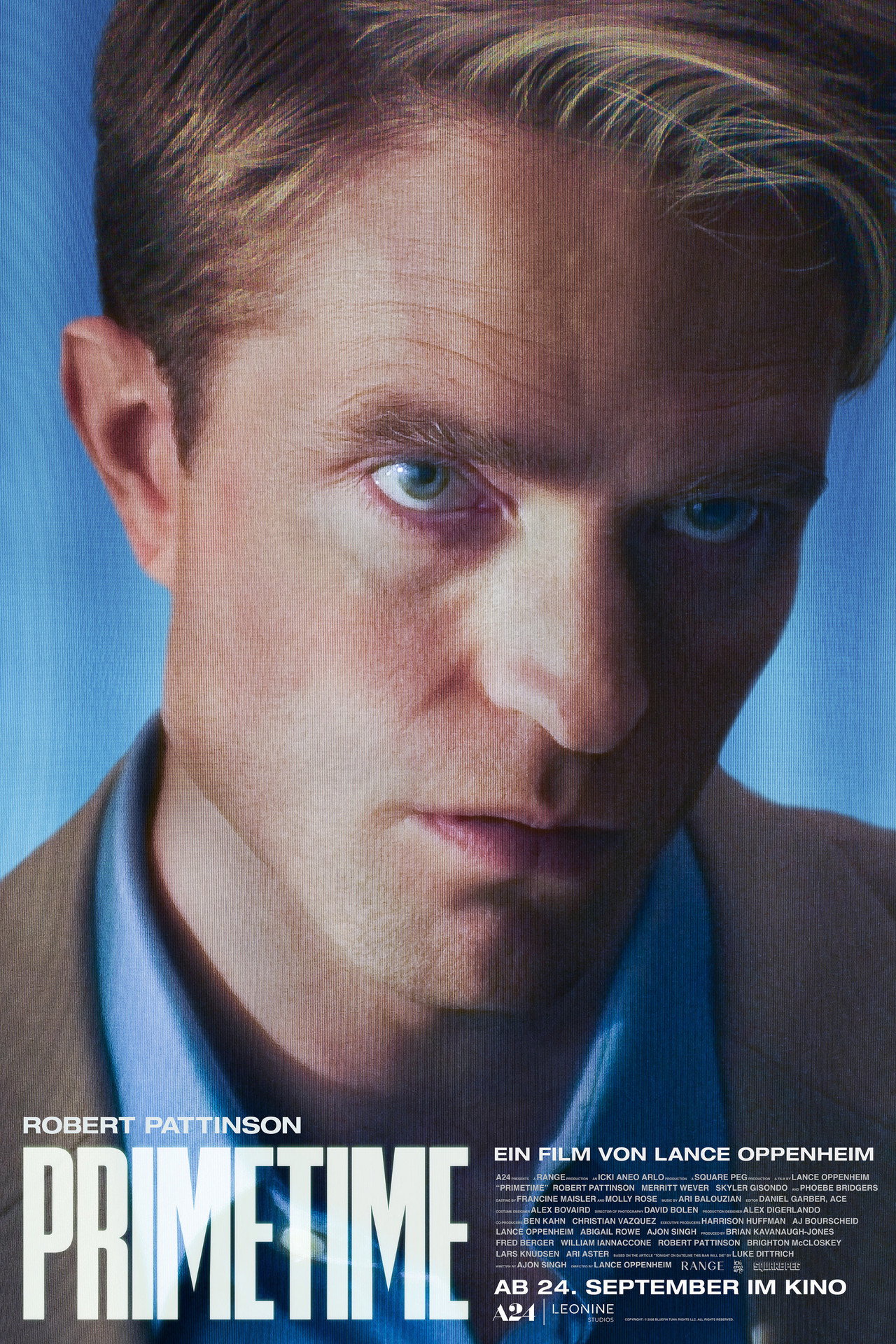
The Verdict
The Nerdiction verdict: Primetime – A Media‑Critical Analysis by Lance Oppenheim is satisfactory and receives 68 out of 100 points.
Pro
- Robert Pattinson’s nuanced performance as Chris Hansen, showing both distance and vulnerability.
- Detailed production design that authentically recreates early‑2000s TV studio aesthetics.
- Lance Oppenheim’s restrained direction, using static framing to generate subtle tension.
Contra
- The somewhat predictable tempo can lead to mild lulls in certain scenes.
- Some narrative motifs are repeated, creating a feeling of redundancy.
- The restrained staging may disappoint viewers expecting more explosive thriller elements.
Videos & Trailers
Loading video…
Details
September 23, 2026
1h 51m
7.0
/ 10(75 votes)91.7
Genres
Production Companies
Production Countries
Spoken Languages
Cast
Table of Contents
- Introduction
- Plot & Narrative
- Acting & Characters
- Direction & Cinematography
- Music & Sound Design
- Visual Effects & Technical Craft
- Themes & Message
- Comparison with Similar Films
- Who Is This Film For?
- Verdict
Introduction
Primetime opens with a sober atmosphere that recalls the early 2000s and immediately puts the central theme of media manipulation into focus. Within the first minutes the film raises questions about responsibility and sensationalism without giving away the plot. Director Lance Oppenheim employs a restrained visual style that piques curiosity. The cast, led by Robert Pattinson, draws instant attention because of his reputation for portraying complex figures. Overall the first impression is both intriguing and leaves room for interpretation.
Plot & Narrative
Set in 2006, the story follows Chris Hansen as he attempts to launch a new television format that goes beyond merely exposing crimes. The narrative is linear but enriched by carefully placed flashbacks that illuminate the protagonist’s motives without spoiling the ending. Pace shifts between calm observational stretches and sudden tense confrontations, creating a steady flow of engagement. Dialogue is kept matter‑of‑fact, yet subtle hints add an undercurrent of tension. Turning points arise organically, prompting Hansen to reassess his own limits.
Acting & Characters
Robert Pattinson delivers a nuanced portrayal of Chris Hansen, oscillating between professional distance and personal turmoil. Skyler Gisondo as Dan Plumb injects youthful energy that contrasts with Hansen’s seasoned demeanor. Merritt Wever gives Andie Bender an empathetic depth that amplifies interpersonal conflicts. Phoebe Bridgers as Del supplies unexpected comic moments that relieve the drama. The chemistry among the actors feels authentic, especially in scenes that interrogate power dynamics.
Direction & Cinematography
Lance Oppenheim employs a deliberately reduced camerawork that favors static shots to avoid over‑stylization. The editing is precise, allowing longer takes that make the characters’ emotional weight palpable. The visual palette leans toward cold tones, mirroring the technical aesthetics of early‑2000s television. Notably, the use of reflections and framing visually underscores the theme of self‑observation. The result is a style that feels documentary‑like while remaining narratively focused.
Music & Sound Design
The score stays largely restrained, employing occasional electronic motifs that evoke the mid‑2000s TV soundscape. Sound effects are used deliberately to make camera clicks and studio lighting hum audible, enhancing immersion. In moments of heightened emotional intensity the music swells slightly without overpowering dialogue. The overall acoustic concept supports the film’s matter‑of‑fact stance while generating subtle tension. Ambient noises taken from real TV studios further boost authenticity.
Visual Effects & Technical Craft
Because Primetime is set primarily in real locations, elaborate VFX are unnecessary; the focus lies on meticulous production design. The set decoration reconstructs early‑2000s television studios with accurate props, from cameras to desks and backdrop screens. Lighting is chosen to convey both the clinical feel of a news set and the more intimate behind‑the‑scenes moments. Technical execution shows solid craftsmanship with no glaring errors, reinforcing the period’s credibility.
Themes & Message
At its core the film asks how media constructs both perpetrators and victims and which ethical lines may be crossed. It critiques sensationalism without falling into simple moralism, leaving space for ambiguous readings. The theme of self‑presentation in the public eye is also explored, especially concerning reality TV’s influence on self‑image. This message feels especially pertinent amid contemporary debates about fake news and media responsibility. Emotionally the film delivers a mix of unease and reflection that lingers with the viewer.
Comparison with Similar Films
Compared to Nightcrawler (2014), Primetime shares a critical look at media ethics but is less focused on an individual antagonist’s rise and more on institutional structures. Like Spotlight (2015) it values researched detail and a procedural perspective, yet adopts a stronger stylistic approach. Within the thriller‑drama genre Primetime distinguishes itself through its deliberately restrained staging, which leans less on shock value and more on subtle tension. Overall it positions itself as a thoughtful addition to existing works that interrogate the media landscape.
Who Is This Film For?
Primetime appeals to viewers interested in media‑critical narratives who prefer a restrained yet profound storytelling style. Fans of character studies, especially those anchored by strong performances like Robert Pattinson’s, will appreciate its substance. The film works well in theaters and on streaming platforms, as its visual and audio design translates effectively to smaller screens. With a runtime of 111 minutes it fits comfortably into a movie night without overstaying its welcome. Its price‑to‑value ratio is balanced, with the intellectual payoff justifying the cost of admission.
Verdict
Primetime convinces through strong cast performances, thoughtful production design, and a restrained yet effective direction that treats media ethics in a sober manner. Weaknesses appear occasionally in a somewhat predictable tempo and the occasional repetition of certain motifs, which can slightly flatten the experience. All things considered the film earns a solid rating that reflects both its artistic ambitions and its accessible entertainment value. Accordingly it receives a score of 68 out of 100, representing a clear recommendation for those intrigued by its subject matter.
Das könnte dich auch interessieren
Weitere Reviews aus der Kategorie movie.
UNABOMBER
Einleitung In diesem Drama nach wahren Ereignissen wird Ted Kaczynskis Weg vom Harvard Wunderkind und Testobjekt zum berüchtigten, vom FBI gejagten Un…

Der Kinderflüsterer – Netflix-Thriller mit De Niro im Serienkiller-Schatten
Inhaltsverzeichnis [Einleitung]( einleitung) [Handlung & Erzählung]( handlung erzaehlung) [Schauspiel & Charaktere]( schauspiel charaktere) [Regie & I…

Die Frau ohne Vergangenheit – Eine tiefgründige Thriller-Rezension 2026
Inhaltsverzeichnis [Einleitung]( einleitung) | [Handlung & Erzählung]( handlung und erzaehlung) | [Schauspiel & Charaktere]( schauspiel und charaktere…
Frequently Asked Questions
How good is Primetime – A Media‑Critical Analysis by Lance Oppenheim?
Primetime – A Media‑Critical Analysis by Lance Oppenheim wurde von Nerdiction mit 68 von 100 Punkten bewertet und ist damit satisfactory.
What are the pros of Primetime – A Media‑Critical Analysis by Lance Oppenheim?
The advantages of Primetime – A Media‑Critical Analysis by Lance Oppenheim: Robert Pattinson’s nuanced performance as Chris Hansen, showing both distance and vulnerability., Detailed production design that authentically recreates early‑2000s TV studio aesthetics., Lance Oppenheim’s restrained direction, using static framing to generate subtle tension., Honest sound design that blends studio ambience with a low‑key score., Thought‑provoking thematic complexity about media ethics and self‑presentation that invites reflection..
What are the cons of Primetime – A Media‑Critical Analysis by Lance Oppenheim?
The disadvantages of Primetime – A Media‑Critical Analysis by Lance Oppenheim: The somewhat predictable tempo can lead to mild lulls in certain scenes., Some narrative motifs are repeated, creating a feeling of redundancy., The restrained staging may disappoint viewers expecting more explosive thriller elements., An institutional focus occasionally leaves personal character arcs underdeveloped., Although the lead acting is strong, the emotional depth of several supporting roles remains somewhat superficial..
Is Primetime – A Media‑Critical Analysis by Lance Oppenheim worth it?
Only conditionally. Primetime – A Media‑Critical Analysis by Lance Oppenheim received a score of 68/100 points.