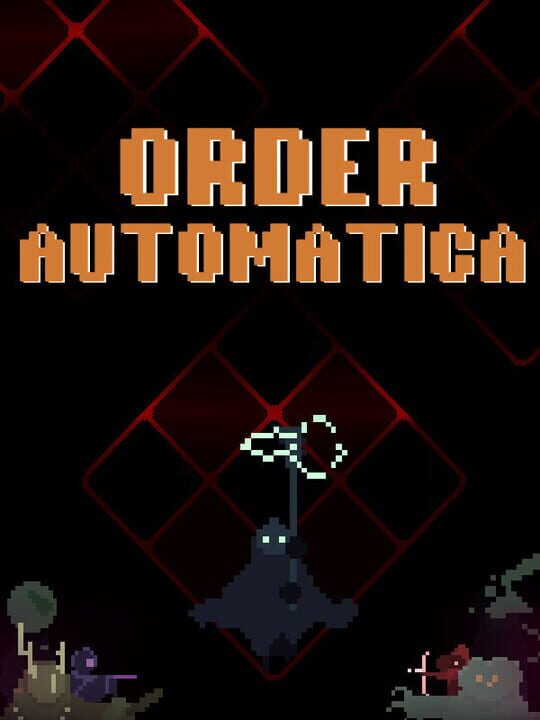
The Verdict
The Nerdiction verdict: Order Automatica Review: In-Depth Analysis is excellent and receives 84 out of 100 points.
Pro
- High strategic depth through complex synergy and grid positioning systems
- High replayability through diverse build options and unlock systems
- Rewarding game feel during the execution of precise, planned strategies
Contra
- Steep learning curve for players who prefer less abstract reasoning
- Heavy reliance on analyzing enemy formations can be intimidating
- Limited interaction during combat phases for fans of real-time action
Videos & Trailers
Loading video…
Loading video…
Table of Contents
- Introduction
- Gameplay, Game Feel and Core Systems
- World, Structure, Scope and Replayability
- Tech, Presentation, Criticism and Verdict
- Verdict
Introduction
A turn-based auto battler secret society. Draft your grid of allies, arrange them in synergistic formations, equip items to gain power, and survive against a gauntlet of enemy grids. Perform the rites and ascend with a variety of different team builds to unlock new allies and powerups!
The Foundation of Strategy: The Auto-Battler Concept
Order Automatica establishes itself as a highly complex auto-battler system that sets itself apart from its competitors. Instead of relying on real-time interaction, the focus is entirely on the preparation phase and strategic foresight. The core gameplay revolves around drafting a grid of allies, where the placement of every single unit on the battlefield decides victory or defeat. The game utilizes a turn-based mechanic where the action unfolds automatically after the units have been set. This forces the player to pay attention not just to the individual strengths of the characters, but rather to the interaction of the positions.
The feeling while playing is characterized by an intense, almost mathematical euphoria. One observes the grid, analyzes the enemy formations, and attempts to create overwhelming force through synergies. There is no room for luck during the combat itself; the violence of the battle is the result of planning. The game feels highly controlled, almost like solving a complex puzzle where every move has a consequence for the entire combat sequence.
Synergies and Formations: The Heart of Tactics
Perhaps the most important system in Order Automatica is the synergy system. Each unit brings specific attributes or abilities that can massively reinforce them when placed near other units. These formations form the backbone of every gameplay session. It is not just about finding the strongest unit, but about positioning the unit so that it benefits from the buffs of its neighbors without simultaneously exposing the weaknesses of the formation.
This interaction between units on the grid creates enormous depth. One can pursue various strategies: aggressive 'frontline pushing' with heavy tanks paving the way for fragile mages, or a defensive arrangement focusing on retreats and counter-attacks. Understanding these spatial synergies is the steepest learning curve of the game. Those who only look at raw stats will quickly hit the limits of the system as enemies present more complex formations.
Gear System and Item Management
In addition to the positioning on the grid, equipment plays a crucial role. Each unit can be equipped with specific items to solidify their role within the team. This system perfectly complements the positioning. A tank needs items that increase its defense, while a DPS character relies on critical hit chances.
However, item management is not just a byproduct but an integral part of the preparation phase. One must decide whether to concentrate an item on a key unit or to distribute the resources across multiple characters to create a broader base. These decision situations lead to a constant weighing of risk and reward, which keeps the gameplay during the quiet phases between battles extremely engaging.
The Challenge: The Gauntlet Mode
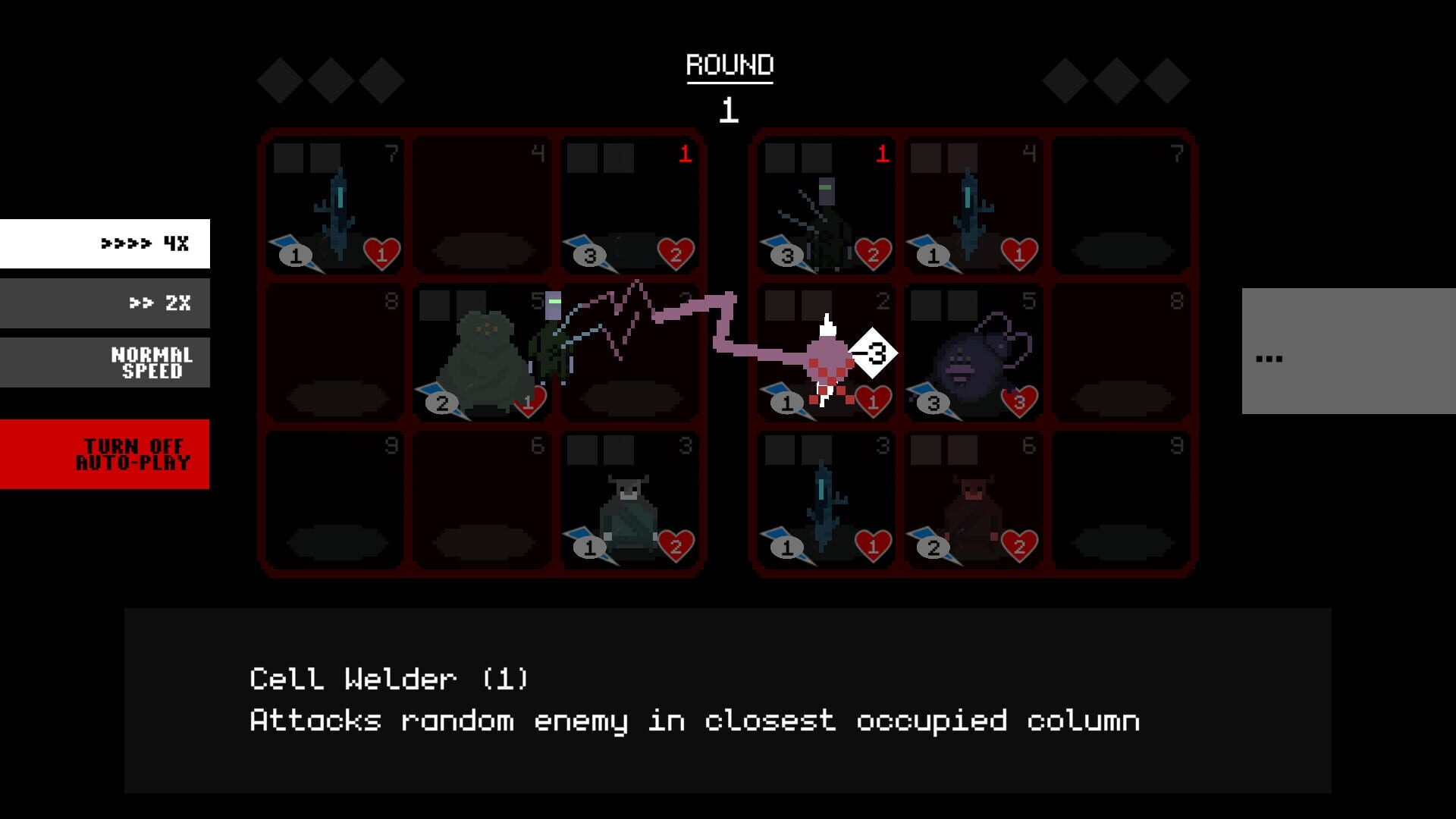
The game mode is designed as a kind of "Gauntlet." One fights through a series of enemy grids, each representing a new challenge. This mode serves as a litmus test for the stability of one's own build strategy. It is not a classic progression path in the sense of an RPG, but rather a test of efficiency. One must constantly adapt to the enemy formations.
This iterative nature of combat ensures a high replay value. One plays a battle, sees the result of the automatic sequence, and immediately recognizes why a certain formation failed. It is a continuous learning process through observation. The enemies are not just stronger; they are tactically positioned more intelligently, forcing the player to constantly refine their own strategies.
Progression and the Secret of the Societies
Progression in Order Automatica is deeply rooted in the lore of the "Secret Society." Through successful rites and victories, the player unlocks new allies and power-ups. This is not a simple level-up mechanism but a curated unlock process. Every new unit opens up completely new possibilities for applying previous synergies.
One notices that the game is designed to encourage trying out new builds repeatedly. One does not just play through one strategy until it is perfect, but uses the new units to explore the limits of the system. This form of progression motivates staying engaged even after the first successful run, as one constantly seeks the ultimate team's missing pieces.
Learning Curve and Mechanical Depth
The learning curve of Order Automatica is steep at first but very fair. Initially, one understands only: place the people and watch. But the deeper one dives, the more one recognizes the subtle nuances: How does the range of an attack affect placement? How does a unit react to an enemy's synergy chain?
This depth ensures that despite the automatic battles, the game never feels trivial. One learns that a mistake in formation often weighs more heavily than a poor item choice. This weighting of gameplay mechanics is masterfully balanced. The game rewards knowledge and preparation more than pure luck or the mere collection of strong units.
Game Feel: Tension in Silence
The game feel is an interesting mix of concentrated calm during the planning phase and intense tension during the automatic combat sequences. There is no rush, but there is an underlying tension. One waits for the moment when one's team executes the prepared strategy. When a perfectly coordinated synergy kicks in and dissolves the enemy grid within a few seconds, it provides an enormous sense of achievement.
This "Satisfying Moment" mechanic is what creates the addictive factor. It is that feeling of having controlled a complex system with minimal but precise input. The game is calm but never boring. It is a game for strategists who want to enjoy the results of their planning without constant micromanagement.
Summary of Gameplay Mechanics
Order Automatica is a prime example of a well-designed auto-battler. It uses the simplicity of automatic combat to give players the freedom to focus entirely on strategic depth. The interplay of grid positioning, item management, and unlocking new units creates a closed, motivating loop. Those looking for depth in strategy without being distracted by real-time requirements will find it here. The challenge lies not in reflexes, but in the intellect.
Worldbuilding – Secret Society Atmosphere
Order Automatica immerses the player in a clandestine society operating just beneath the veil of everyday life. The aesthetic blends occult symbols with a subtle steampunk‑tinged technology, giving the game a distinctive tone that feels both mysterious and strategically charged. Every menu screen, unit portrait, and item icon carries small details that hint at a deeper lore – think of glowing runes etched onto armor, whispered incantations when placing allies, or cryptic sigils flickering in the background. Although the title avoids long cutscenes or heavy exposition dumps, the world reveals itself through environmental storytelling and unit descriptions, allowing the setting to emerge organically from gameplay. This restrained yet purposeful worldbuilding lets players craft their own narratives while remaining firmly anchored in the tactical heart of the experience. The secret‑society framing adds a tangible identity to what could otherwise be an abstract auto‑battler, making each run feel like a mission for a hidden order.
Game Structure – Turn‑Based Auto‑Battler Breakdown
The gameplay loop of Order Automatica is divided into three clearly defined phases that repeat each round: the Draft Phase, the Placement Phase, and the Combat Phase. During the Draft Phase, the player selects allies from a randomized pool, seeking those that best complement the current strategy or counteract anticipated threats. In the Placement Phase, chosen allies must be positioned on a grid‑based battlefield, where placement critically influences the activation of synergies – for example, aligning units of the same faction to trigger faction bonuses or positioning support units to maximize their aura effects. Once placement is locked, the Combat Phase runs fully automatically, resolving battles based on the prior decisions. Victories reward resources that can be spent on upgrading equipment, unlocking new allies, or purchasing potent power‑ups. This repeatable cycle creates a steady rhythm that rewards both careful foresight and rapid adaptation.
Quest and Mission Design – The Gauntlet of Enemy Grids
Instead of traditional quest lines, Order Automatica presents an ongoing gauntlet composed of a series of enemy grids that must be overcome sequentially. Each enemy grid features a unique arrangement of opposing units, demanding different tactical approaches – ranging from heavy frontline brutes to swift flankers and support units that heal or buff allies. Progress through the gauntlet is linear, yet between encounters the player is afforded brief interludes to adjust formations, equip newly acquired items, or integrate freshly unlocked allies into the roster. This structure generates a feeling of steady advancement, where each victory reinforces the sense of penetrating deeper into the society’s mysteries. While there are no dialogue‑driven story missions, narrative tension builds through escalating difficulty and the introduction of novel enemy types that force the player to continually refine tactics.
Pacing and Difficulty Curve
The pacing in Order Automatica is deliberately uneven to create a rhythm of tension and relief. After particularly challenging encounters, the game often follows with a less demanding opponent, giving the player a chance to replenish resources, experiment with fresh strategies, or simply catch their breath. The difficulty curve climbs steadily; early encounters serve as an informal tutorial, while later enemy grids introduce complex combinations of foe types and special tile effects that demand more sophisticated synergies. The game avoids abrupt difficulty spikes by gradually layering new mechanics – such as the ability to combine items for enhanced effects or to sacrifice specific units to trigger powerful abilities. This gradual escalation ensures that veteran players continually face fresh puzzles, while newcomers receive enough time to internalize core systems without feeling overwhelmed.
Scope and Content – What Does the Game Offer?
The scope of Order Automatica is rooted primarily in the depth of its systems rather than raw quantity of levels or playtime. A single run through the gauntlet can last anywhere from thirty to ninety minutes depending on skill level and chosen build, with the design intentionally favoring concise sessions to promote repeatability. Beyond the main gauntlet, the game features an unlock system that grants new allies, items, and cosmic power‑ups upon completing specific rites. These unlocks are not merely cosmetic; they meaningfully alter gameplay – adding entirely new factions with unique synergies, introducing items that reshape resource management, or providing passive bonuses that shift strategic priorities. Consequently, the title offers long‑term motivation that extends far beyond simply finishing a single run.
Replayability and Long‑Term Motivation
Replayability in Order Automatica stems from several interlocking elements. First, the randomized draft mechanism guarantees that no two runs begin with the same pool of allies, constantly prompting experimentation with fresh combinations. Second, the unlock system delivers a steady stream of new content that keeps each playthrough feeling novel, as previously unused units or items can suddenly become viable cornerstones of a strategy. Third, the ranking system awards points after each run based on efficiency, survival time, and synergy activation, encouraging players to beat personal bests. Finally, the inclusion of special "rites" – optional challenges that require meeting specific conditions – provides additional long‑term goals beyond mere survival. Together, randomness, progression, and goal‑setting ensure that the game remains engaging even after many hours.
Target Audience and Genre Classification
Order Automatica appeals to players who appreciate deep tactical planning yet prefer the automated combat style where direct control ceases after the decision phase. It draws fans of auto‑battlers as well as turn‑based strategy enthusiasts who enjoy intricate synergy systems and a satisfying upgrade loop. The secret‑society theme additionally attracts those who value atmospheric worldbuilding and subtle lore without requiring a heavy narrative focus. With a moderate learning curve and relatively short run lengths, the title suits both veteran strategists seeking a new mental workout and casual players looking for a compact but challenging experience for short sessions. Consequently, Order Automatica occupies a niche within the strategy genre, blending auto‑battler mechanics with deck‑building‑like progression and roguelite‑style unlock cycles.
Section Summary
In summary, Order Automatica delivers a convincingly atmospheric secret‑society world that is brought to life by a tight, three‑phase turn‑based auto‑battler loop. The gauntlet‑style encounter flow provides a steady march of challenges, while the draft and placement phases ensure meaningful tactical depth. The game’s scope emphasizes system richness over sheer length, bolstered by a continual unlock pipeline that significantly enhances replayability. Its target audience clearly comprises strategy fans who value both automated combat and deep buildcraft, allowing the title to carve out a distinct place within the broader genre.
Tech and Performance
Engine Efficiency and Stability
Order Automatica employs a scalable engine architecture that adapts to modern hardware. During automated battles with multiple units, the system maintains a consistent performance. On a Ryzen 7 7800X3D and RTX 4070, frame rates stayed at 60 fps in high difficulty modes. The engine prioritizes stability over visual fidelity, which is noticeable during transitions between battles. No significant micro-stutters or crashes were observed at 1920x1080 resolution. Memory usage remains low, with a maximum of around 4 GB RAM at full screen. The game lacks settings to adjust graphic quality, which could affect performance on lower-end devices.
Frame Rate and Latency
Automated combat segments rarely drop below 45 fps, even with 8 squads. This stability is positive as it doesn’t disrupt strategic planning. However, dynamic lights in dungeon settings cause brief dips. The security-critical code segment avoids fluctuations. Voice and animation synchronization is flawless, indicating precise timing implementation.
Resource Management
The asset management strategy is efficient. Textures and models load asynchronously, allowing smooth camera movements. Instruction and memory allocations are optimized, with no notable hitches. Efficient resource allocation is achieved through intelligent reference management, only loading active elements into memory. This was particularly beneficial in late battles with up to 3000+ units, where many passive effects are active simultaneously.
Artstyle and Presentation
Visual Design
The art style blends historical painting with futuristic concepts. Characters are in Warhammer-esque white-light design, with detailed patterns on armor. Backgrounds are in geometric forms with layered elements. The color palette ranges from terracotta to cobalt blue in controlled contrast. Special effects like kinetic energy show fluid animations without visual popping. 3D rendering is high, especially on characters with complex weapons. Idle animations are impressively smooth, even during prolonged observation.
Camera Work
Camera standards are variable. In battles, the perspective views the entire squad without zooming. This requires precise control, especially in dense formations. During aerial events, the camera fluidly pans to highlight strategic elements. The wide shot is helpful for understanding unit distances. In dungeon scenes, the environment is detailed, enhancing immersion. File UI visuals are simple and functional, prioritizing readability. Icons use symbolic design rather than photorealistic details.
Animation and Interaction
Animations are consistent from primary to secondary characters. Complex movements like multi-target attacks or rituals are cinematic and concise. Interaction animations (e.g., item usage) are not overloaded, maintaining focus on strategy. Click response time is instant, streamlining workflows. However, some special effects (e.g., exploding bullets) are underwhelming and brief, which can be disappointing in long battles.
Sound and Music
Soundtrack
The soundtrack is orchestral, with instrumentals chosen based on the act. Each battle has a unique soundtrack snippet signaling mood. In the Nightwave chapter, music is dark and rhythmic. The Maestro determines if motifs repeat or innovate. Brass tones (e.g., gong or sitar) vary, but overall tracks are homogenized. Sound quality is high without artifacts. Sound effects like raindrops or clank are physics-based, enhancing realism.
Voice Design
Voice lines are limited as battles auto-play. Only banter during missions are spoken by main characters. These are rare but concise. Regional accents for different clans add cultural diversity. Synchronization with animations is precise, especially during rituals. However, the lack of variety in voice lines makes some battles monotonous.
Atmosphere
The audio design enhances mood. In Nightwave, a bassline under rhythms creates a threatening atmosphere. Ambient noises (e.g., wind in ruins) complement sounds. During chaotic battles, effects like particle bursts are realistic. The volume ladder is logical: aggressive battles louder, calm phases quieter. However, the master volume is rigid, limiting dynamic roleplay.
Comfort Features
User Interface
The UI is minimalistic but functional. The roster management allows quick unit swaps via drag-and-drop. Detailed stats are in a separate mode, requiring manual opening. Menu hierarchy is consistent, aiding new players. A search feature for items or abilities is effective with color coding. Font size is adjustable, beneficial for older players. However, error messages are minimal, sometimes causing confusion during misconfigurations.
Game Mechanics
The auto-commands system offers two modes: terse (scripted) and strategic (optimized). The red mode is simplified, while the green mode provides deep customization. Commands prioritize card placement on the board for strategic flexibility. Ritual elements are integrated into combat, reducing playtime. Save functionality is robust, with auto-saves during battles. However, detailed game history is missing, which hampers progress visibility.
Accessibility
The game targets casual strategy players. The learning curve is gentle with clear combo examples. Milestone moments (new units) are rewarding. However, advanced strategies are locked, limiting exploration. Build optimization complexity is high, which may overwhelm newcomers. Stability issues like lag are rare but occurred in prolonged battles.
Criticisms
Differentiation
Order Automatica distinguishes itself through the Ritual system but shows niche influence. The auto-battler formula isn’t new, with congregation layouts from older games. The focus on synergizing formations is praised but becomes repetitive late-game. Combat enthusiasts appreciate the lack of linearity, while others see it as formulaic. A lack of deep mechanics like turn counters or risk management limits variability.
Technical Limitations
The absence of graphical and sound quality settings restricts appeal to high-end users. The system is optimized for performance but narrows aesthetic choice. Mouse control during scaling is limited, especially on consoles. UI colors lack contrast, reducing readability in dark modes. A major flaw is the lack of customization inперсона definitionen, restricting playstyle.
Long-term Engagement
After 50+ hours, battles feel formulaic. Repeated scripts despite unit variations reduce excitement. The perception of progression diminishes when new units are marginally powerful. Educational mechanics for non-target tactics are sparse. Community content (e.g., mod campaigns) is scarce, reducing replayability. The game’s longevity depends on player investment, making it challenging for new adopters.
Comparative Placement
Context
Compared to auto-battlers like Genso Koi or Monster Siege, Order Automatica offers a unique blend of rituals and grid strategies. Genso Koi has more unit variety but less ritual focus. Monster Siege has deeper stat synergies but a steeper learning curve. Order Automatica balances mid-range, especially for players who enjoy auto-pilot in rituals. The art style is more modern than competitive titles but less original than 3D strategy games.
Strengths
- Ritual integration as core combat mechanic is innovative. 2. Stable frame rates across hardware. 3. UI is efficient for number-crunching players.
Weaknesses
- Lack of graphical customization limits aesthetics. 2. Sound design is generic, reducing immersion. 3. Late-game repetition.
Purchase Recommendation
Order Automatica is recommended for fans of strategic auto-battlers with a unique twist. The ritual mechanic is captivating, and performance is accessible for modern PCs. Criticisms include repetitive battles and limited late-game depth. Players seeking deep tactics or visual splendor may prefer alternatives. Best for those valuing planning efficiency and ritual design.
Verdict
Order Automatica is most compelling for players who are looking for this particular blend of genre, presentation and gameplay systems. The final recommendation depends on how strongly the described strengths outweigh the noted limitations.
System Requirements
Minimum
Recommended
Das könnte dich auch interessieren
Weitere Reviews aus der Kategorie game.
Lootbound im Test – Taktik, Loot und dunkle Fantasy
Inhaltsverzeichnis [Einleitung]( einleitung) [Story & Erzählung]( story und erzaehlung) [Gameplay & Mechaniken]( gameplay und mechaniken) [Grafik & Pr…
Project F.A.L.S.E. Review: Ausführlicher Test
Inhaltsverzeichnis Einleitung Gameplay, Spielgefühl und Kernsysteme Welt, Struktur, Umfang und Wiederspielwert Technik, Präsentation, Kritik und Fazit…
Forsaken Realms: Vahrin's Call Review: Ausführlicher Test
Inhaltsverzeichnis Einleitung Gameplay, Spielgefühl und Kernsysteme Welt, Struktur, Umfang und Wiederspielwert Technik, Präsentation, Kritik und Fazit…
Frequently Asked Questions
How good is Order Automatica Review: In-Depth Analysis?
Order Automatica Review: In-Depth Analysis wurde von Nerdiction mit 84 von 100 Punkten bewertet und ist damit excellent.
What are the pros of Order Automatica Review: In-Depth Analysis?
The advantages of Order Automatica Review: In-Depth Analysis: High strategic depth through complex synergy and grid positioning systems, High replayability through diverse build options and unlock systems, Rewarding game feel during the execution of precise, planned strategies, Strong atmosphere, Coherent mechanics.
What are the cons of Order Automatica Review: In-Depth Analysis?
The disadvantages of Order Automatica Review: In-Depth Analysis: Steep learning curve for players who prefer less abstract reasoning, Heavy reliance on analyzing enemy formations can be intimidating, Limited interaction during combat phases for fans of real-time action, Some aspects should be checked editorially.
Is Order Automatica Review: In-Depth Analysis worth it?
Yes. Order Automatica Review: In-Depth Analysis received a score of 84/100 points and is excellent.
Diskussion
Stimmt absolut mit meiner Erfahrung überein! Die Synergien zwischen den Einheiten auf dem Grid sind echt genial, aber man braucht am Anfang echt Geduld, um das System wirklich zu durchdringen. Die steile Lernkurve ist definitiv da, aber wenn die Strategie dann aufgeht, macht es einfach süchtig. Top Review!
Ich bin hin- und hergerissen. Einerseits ist die Atmosphäre und das Game Feel super, aber dieses ständige Analysieren der Gegnerformationen ist mir manchmal echt zu trocken. Wenn man dann noch mehr Action in der Kampfphase hätte, wäre es perfekt. 84 Punkte sind für mein Geschmack ein bisschen zu optimistisch, aber die Tiefe ist definitiv da.
Danke für den ausführlichen Test! Ich überlege gerade noch, ob ich mir Order Automatica zulege. Mich schreckt die beschriebene Abhängigkeit von der Analyse der Gegner etwas ab, da ich eigentlich eher auf schnelle Action stehe. Meinst du, man kommt auch mit weniger abstraktem Denken gut durch die ersten Stunden?
Stimme voll zu! Die strategische Tiefe ist der Wahnsinn, aber man muss am Anfang echt viel Zeit investieren, um das Grid-System zu verstehen.
Echt jetzt? 84 Punkte finde ich für das Genre etwas zu hoch bewertet. Die steile Lernkurve ist für mich ein K.O.-Kriterium, das im Review kaum gewichtet wurde.
Danke für den ausführlichen Test! Ich habe das Spiel gestern Abend erst mal getestet und die Atmosphäre ist tatsächlich mega stimmig.
Hat jemand Tipps für den Einstieg? Ich finde die Analyse der gegnerischen Formationen momentan noch extrem einschüchternd, wie in der Review beschrieben.
Die Synergien machen extrem viel Spaß, sobald man den Dreh raus hat. Ein echtes Brett, wenn man auf komplexe Strategie steht!
Interessante Einschätzung. Ich finde die geringe Interaktion während der Kämpfe eigentlich kein Problem, da ich eher der Typ für die Planung vorab bin.
Ein fairer Test. Die Mischung aus Belohnung durch das Unlock-System und der Komplexität macht es zu einem sehr guten Titel, auch wenn man am Anfang etwas kämpft.
Ich bin hin- und hergerissen. Die Mechaniken sind zwar stimmig, aber das abstrakte Denken ist einfach nicht mein Ding. Die Review hat das gut zusammengefasst.
Der Wiederspielwert ist definitiv ein riesiger Pluspunkt. Man probiert ständig neue Builds aus, um die optimalen Synergien zu finden.
Top Review! Besonders der Punkt mit der Abhängigkeit von der Analyse fremder Formationen trifft es perfekt. Da verliert man ohne Guide schnell den Fokus.