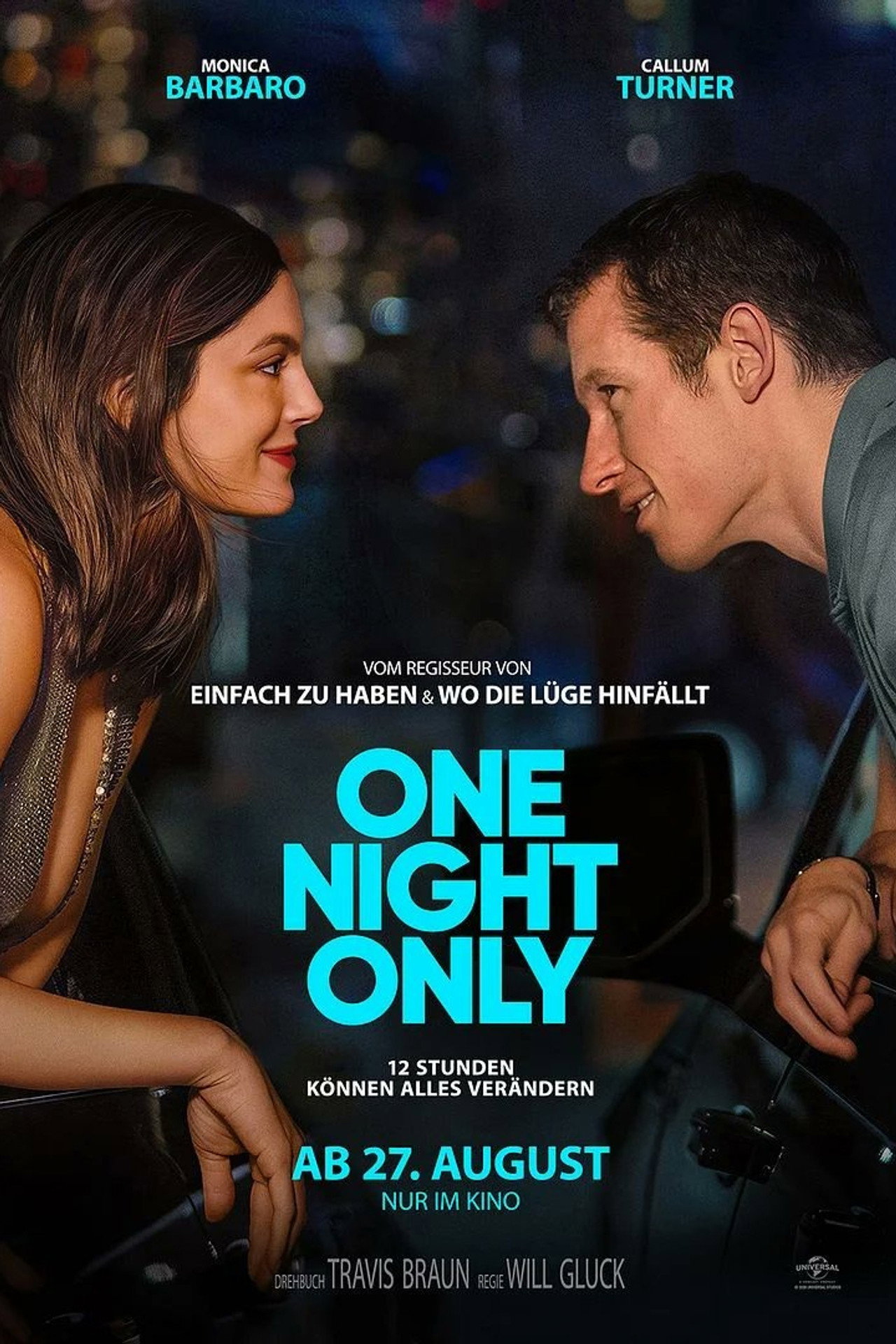
The Verdict
The Nerdiction verdict: One Night Only – Review: Charm and Contrasts in a Dystopian Rom-Com is satisfactory and receives 68 out of 100 points.
Pro
- Outstanding chemistry between Monica Barbaro and Callum Turner that makes the central romance feel authentic and engaging
- Sharp, witty dialogue that captures Gluck’s trademark style while delivering fresh humor
- Vivid, colour‑contrasted cinematography of New York that renders the dystopian setting both believable and visually striking
Contra
- World‑building remains partially superficial, leaving some aspects of the dystopian rule under‑explored
- Romantic plot leans on familiar beats, making it somewhat predictable at times
- Occasional tonal shifts between outright comedy and more reflective moments can slightly disrupt the flow
Videos & Trailers
Loading video…
Loading video…
Details
July 28, 2026
1h 42m
7.0
/ 10(61 votes)32.1
Genres
Production Companies
Production Countries
Spoken Languages
Cast
Table of Contents
Introduction Plot & Narrative Acting & Characters Direction & Cinematography Music & Sound Design Visual Effects & Technical Craft Themes & Message Comparison with Similar Films Who Is This Film For? Verdict
Introduction
One Night Only arrives in summer 2026 as one of the first major rom‑com releases to blend a dystopian setting with a classic love story. Directed by Will Gluck, whose previous work such as Easy A and Friends with Benefits is known for its snappy wit and charismatic leads, the film presents an unusual premise: in a near‑future society, sex for singles is legally permitted only on a single designated day each year. On that day, the hopelessly romantic Allie (Monica Barbaro) and the freshly dumped Owen (Callum Turner) meet in New York. The film promises both humorous situations and a critical reflection on societal norms surrounding intimacy and freedom.
On first viewing, the vibrant cinematography stands out, capturing the pulsing nightlife of New York in neon‑tinged hues. The soundtrack—mixing contemporary pop tracks with an original score—immediately establishes an energetic mood. Expectations are high: a film that aims to make audiences laugh while prompting thought could either become a fresh highlight of the genre or become tangled in its own concept.
The opening minutes succeed in introducing the world‑building elements without heavy exposition. Quick dialogue and visual cue signs create the feeling of inhabiting a world where desire is both regulated and coveted. This atmosphere lays a solid foundation for the ensuing romance and comedic entanglements.
[[IMAGE_1]]
Plot & Narrative
The plot follows the classic rom‑com structure, but it is twisted by the dystopian rule. After Allie and Owen meet at a crowded party, they quickly discover that the “One Night Only” day brings both opportunities and constraints. The narrative exploits the time pressure of the sole permitted day to generate situational comedy: dates that get interrupted, misunderstandings caused by the rule, and a constant awareness that every gesture might have consequences.
The film avoids spoiling its ending early by keeping the central question open: Will the encounter remain a one‑off event or evolve into something deeper? This creates a steady tension, even if some plot points feel slightly contrived. Turning points are subtle—a sudden confession, a misread signal—rather than grand, over‑the‑top revelations.
Dialogue is a strong suit. It balances dry humor with heartfelt moments, with characters often expressing insecurity through rapid‑fire exchanges. The pacing stays even: the first two acts focus on building the relationship and exploring the rule, while the third act attempts to deepen emotional resonance without tipping into outright melodrama.
Although the structure is entertaining, the world‑building is not fully fleshed out. Certain aspects of the dystopian society remain in the background, shifting focus more toward the romantic comedy. This results in a certain predictability that is, however, partially offset by the charm of the cast.
[[IMAGE_2]]
Acting & Characters
Monica Barbaro delivers a standout performance as Allie. She blends youthful enthusiasm with a surprising vulnerability, making her character both accessible and multi‑dimensional. Barbaro uses her physical expressiveness—from subtle gestures to striking gazes—to make Allie’s inner conflicts visible without resorting to cliché romance tropes.
Callum Turner complements her as Owen with a natural, slightly shy charm. His ability to swing between sarcastic remarks and earnest confessions gives the character notable depth. The chemistry between Barbaro and Turner is immediate; their scenes together feel organic and avoid the forced feeling often found in rom‑com duos.
The supporting ensemble further lifts the film. Maya Hawke as Malika adds a wry, ironic note, while King Princess as Jacinta embodies the queer‑friendly side of the story. Molly Ringwald and LeVar Burton provide seasoned comic relief and warm wisdom that ground the proceedings emotionally.
Each character receives enough screen time to show a recognizable arc, even if some supporting figures serve mostly functional roles. Still, the cast manages to keep the balance between humor and heart, allowing viewers to both laugh and empathize.
[[IMAGE_3]]
Direction & Cinematography
Will Gluck again shows his talent for fast‑paced comedy with a clear sense of timing and visual composition. His direction uses New York’s urban landscape to highlight the contrasts between the regulated daylight of the “One Night Only” event and the freer night‑time feel. Camera movements are fluid, often employing steadicam shots to capture the dynamism of mass gatherings.
Editing is brisk without sacrificing narrative clarity. Gluck relies on rapid cross‑cuts between subplots to visualize the day’s time pressure, while longer takes in quieter moments give the actors space to let their emotions breathe, granting intimate scenes extra weight.
The visual style is marked by a contrast‑rich look: cool blues and greys dominate the official scenes, while warm yellows and oranges appear in intimate encounters. This colour palette reinforces the thematic opposition of regulation versus freedom.
Gluck’s experience with character‑driven comedies shines through in that he directs the performers not merely as joke vessels but as emotionally complex individuals. Even when the plot occasionally feels contrived, the direction stays firmly focused on the interpersonal dynamics that drive the film.
[[IMAGE_4]]
Music & Sound Design
The score, composed by an uncredited team, blends modern pop elements with orchestral undertones to hit both the contemporary vibe and the slightly surreal feeling of the dystopian world. Especially notable is the use of catchy motifs that are varied each time the “One Night Only” day recurs, creating an audible leitmotif.
The soundtrack features carefully selected songs from the 2024‑2026 charts that both energize scenes and provide cultural context. Tracks from rising indie acts as well as established pop stars ensure the musical backing never feels overpowering but consistently supports the mood.
Sound effects are subtle yet effective: the distant hum of the city, the faint murmur of crowds, and the occasional click of heels on pavement enhance the sensation of being in a lively metropolis. In moments of heightened emotional intensity, the sound design is pulled back so dialogue and music can take center stage.
Overall, the acoustic design significantly contributes to making the film both entertaining and atmospherically dense. It binds the comic elements with the deeper themes without letting any single aspect dominate.
Visual Effects & Technical Craft
Although One Night Only is not a effects‑heavy blockbuster, it employs selective visual effects to make the dystopian setting believable. Digital extensions of the skyline show subtle holographic ads that hint at the state‑regulated intimacy rule without overwhelming the realistic cityscape.
Production design blends contemporary architecture with futuristic accents: clean lines, reduced billboards, and specific lighting rigs that mark the “One Night Only” day. These details create a believable world that remains familiar enough not to eclipse the rom‑com roots.
Cinematography mainly uses Arri Alexa cameras, delivering high dynamic range and precise colour reproduction. This yields clear, sharp images in both daylight and night scenes. Colour grading emphasizes the aforementioned contrast between cool and warm tones.
Technically, the film is solidly executed: the edit runs smoothly, the sound mix is clear, and dialogue remains intelligible even in loud settings. While no groundbreaking technical breakthroughs are present, the craft meets the expectations for a high‑quality studio release from Universal.
Themes & Message
At its core, One Night Only tackles the tension between individual freedom and societal control. The prescribed “One Night Only” day serves as a metaphor for how societies attempt to regulate the most intimate of acts—a theme that resonates in contemporary debates over privacy, reproductive rights, and personal autonomy.
The film uses comedy to make these weighty questions approachable. Through humorous situations it shows how arbitrary rules can distort behaviour while simultaneously emphasizing the yearning for genuine connection. The romance between Allie and Owen operates as a human counterpoint to the cold bureaucracy that surrounds them.
Another theme is the search for authenticity in a world of performance. Both leads must learn to show their true feelings beneath the façade expected by society. This internal conflict lends the story emotional depth that goes beyond the standard “boy meets girl” formula.
Although the film does not attempt a comprehensive political statement, it invites reflection. The ending leaves room for interpretation: whether the characters accept, challenge, or simply navigate the system is left to the viewer, allowing a personal connection to the theme.
Comparison with Similar Films
Compared to classic rom‑coms like Crazy Rich Asians or The Big Sick, One Night Only distinguishes itself through its dystopian world‑building. While those films mainly explore cultural or familial conflicts, this one leans on a speculative premise to test the relationship in an unconventional setting.
A closer relative is the 2024 film The Premiere, which also introduces a special rule for romantic encounters. There the focus sat more on satirical societal critique, whereas One Night Only puts greater weight on the interpersonal chemistry. Consequently, the film sits somewhere between pure entertainment and light social commentary.
When measured against other works by Will Gluck—such as Easy A or Friends with Benefits—there is a stylistic continuity in snappy dialogue and charming lead performances, yet with an increased effort toward world‑building and visual contrast. The result preserves the director’s known strengths while venturing into fresh thematic terrain.
Finally, One Night Only differs from pure dystopian titles like The Hunger Games or Dune because it does not center on survival or conflict but on the humorous and romantic exploration of social rules. It therefore appeals to an audience that seeks both light‑hearted entertainment and thoughtful moments.
Who Is This Film For?
One Night Only targets viewers who appreciate a blend of romance, comedy, and a light science‑fiction touch. Fans of Will Gluck’s earlier work will recognize the rapid wit and likable leads, while those interested in societally critical satires will find the dystopian element a useful entry point.
The movie works well both in theatres and for home streaming. Its moderate 102‑minute runtime fits neatly into a movie night without overstaying its welcome. Anyone looking for a light date‑night option will likely enjoy the chemistry between Barbaro and Turner.
In terms of value, the film sits within the standard range for contemporary studio releases. With a typical theatre ticket around $12‑15 or its streaming equivalent, it offers a solid entertainment return, particularly when considering the production values and on‑screen talent.
Viewers who expect an exhaustively detailed dystopian world‑building or a very heavy drama‑centric narrative may feel slightly underwhelmed. For those seeking a deeper sci‑fi thriller or a serious drama, alternative titles might serve them better.
Verdict
One Night Only is a solid, if not revolutionary, addition to the rom‑com genre. The film succeeds in pairing the attractive chemistry of its two leads with an original, if somewhat contrived, premise. Direction‑wise, Will Gluck delivers a brisk, visually appealing piece that balances comic timing with emotional resonance.
Strengths clearly lie in the performances of Monica Barbaro and Callum Turner, whose shared scenes form the film’s heart. The lively New‑York look, the capable supporting cast, and the well‑chosen soundtrack further boost the overall experience. Weaknesses appear in the world‑building, which is not fully fleshed out, and in the occasional predictability of the romantic arc.
Weighing these factors yields a score of 68 out of 100. This score reflects the film’s solid entertainment value while acknowledging that the concept could have been pushed further for a richer, more resonant outcome. For audiences seeking a breezy, charmingly witty film with a dash of social reflection, One Night Only comes recommended.
Das könnte dich auch interessieren
Weitere Reviews aus der Kategorie movie.

The Last Sunrise: Eine sommerliche Liebesgeschichte zwischen Hoffnung und Verzweiflung
Inhaltsverzeichnis [Einleitung]( einleitung) [Handlung & Erzählung]( handlung erzaehlung) [Schauspiel & Charaktere]( schauspiel charaktere) [Regie & I…
Mayday
Einleitung Auf dem Höhepunkt des Kalten Krieges gerät US Navy Pilot Lieutenant Troy „Assassin“ Kelly während einer streng geheimen Mission über russis…

Matchbox: Der Film – Spielzeug-Abenteuer zwischen Action, Humor und zähem Ensemble
Inhaltsverzeichnis [Einleitung]( einleitung) [Handlung & Erzählung]( handlung und erzaehlung) [Schauspiel & Charaktere]( schauspiel und charaktere) [R…
Frequently Asked Questions
How good is One Night Only – Review: Charm and Contrasts in a Dystopian Rom-Com?
One Night Only – Review: Charm and Contrasts in a Dystopian Rom-Com wurde von Nerdiction mit 68 von 100 Punkten bewertet und ist damit satisfactory.
What are the pros of One Night Only – Review: Charm and Contrasts in a Dystopian Rom-Com?
The advantages of One Night Only – Review: Charm and Contrasts in a Dystopian Rom-Com: Outstanding chemistry between Monica Barbaro and Callum Turner that makes the central romance feel authentic and engaging, Sharp, witty dialogue that captures Gluck’s trademark style while delivering fresh humor, Vivid, colour‑contrasted cinematography of New York that renders the dystopian setting both believable and visually striking, Effective soundtrack mixing current pop hits with an original score that perfectly matches the film’s tone, Strong supporting performances from Maya Hawke, King Princess, Molly Ringwald, and LeVar Burton that add both comic relief and emotional depth.
What are the cons of One Night Only – Review: Charm and Contrasts in a Dystopian Rom-Com?
The disadvantages of One Night Only – Review: Charm and Contrasts in a Dystopian Rom-Com: World‑building remains partially superficial, leaving some aspects of the dystopian rule under‑explored, Romantic plot leans on familiar beats, making it somewhat predictable at times, Occasional tonal shifts between outright comedy and more reflective moments can slightly disrupt the flow, Several supporting characters serve largely functional roles and receive limited development, The 102‑minute runtime leads to brief segments where the central idea is not fully elaborated.
Is One Night Only – Review: Charm and Contrasts in a Dystopian Rom-Com worth it?
Only conditionally. One Night Only – Review: Charm and Contrasts in a Dystopian Rom-Com received a score of 68/100 points.