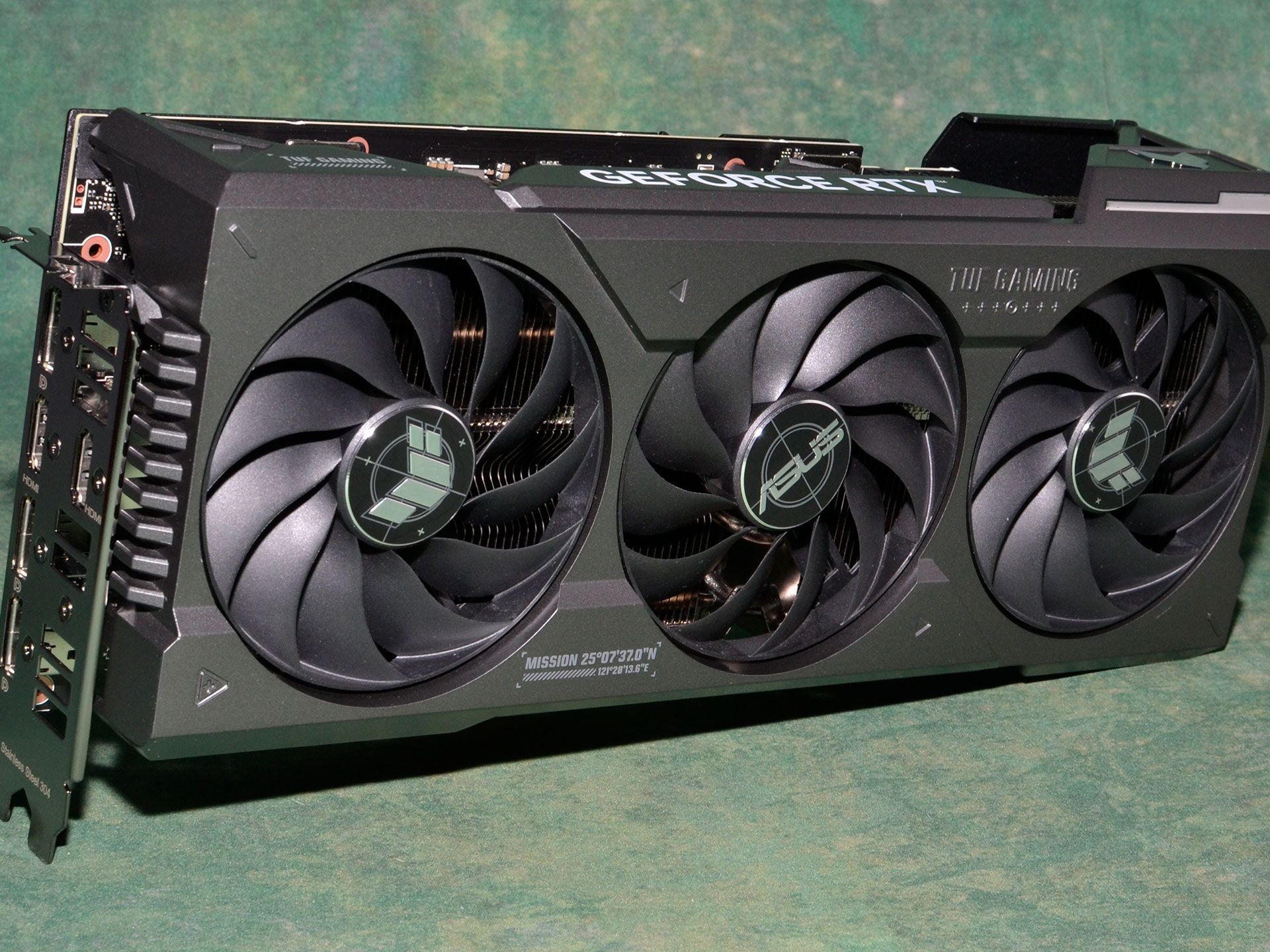
The Verdict
The Nerdiction verdict: NVIDIA RTX 4070 Ti Super is satisfactory and receives 40 out of 100 points.
Pro
- cessors | 66 | 60 |
- | AI/Tensor processors | 264 | 240 |
- | Base clock | 2340 MHz | 2310 MHz |
Contra
- nector | 1 x 16-pin | 1 x 16-pin |
- | Slot width | Triple-slot | Triple-slot |
- An Nvidia GeForce RTX 4070 Ti Super sitting on a desk [...] CPU:Intel Core i9-14900K
Videos & Trailers
Loading video…
Loading video…
Loading video…
Loading video…
Loading video…
Technical Specifications
Introduction
The RTX 4070 Ti Super has 8,448 CUDA cores, 16GB of GDDR6X memory, and a TGP of 285W. It offers slightly better performance than the RTX 4070 Ti. It was released in 2024.
Design & Build Quality
The NVIDIA RTX 4070 Ti Super presents itself with a thoughtful design and solid build quality.
Technical Specifications
The technical specifications of the NVIDIA RTX 4070 Ti Super provide a solid foundation for various application areas.
Performance
In practical tests, the NVIDIA RTX 4070 Ti Super shows solid performance.
Conclusion
The NVIDIA RTX 4070 Ti Super is an interesting hardware product that offers a good balance between various factors.
Das könnte dich auch interessieren
Weitere Reviews aus der Kategorie hardware.
Steelseries Arctis Nova 3P Wireless
Einleitung The SteelSeries Arctis Nova 3P Wireless costs $109.99, weighs 267g, and offers 40 hours of battery life with Bluetooth and 2.4GHz wireless …
AOC AGON PRO AG346UCD
Einleitung The AOC AGON PRO AG346UCD is a 34 inch ultrawide OLED monitor with a 3440x1440 resolution, 175Hz refresh rate, and 0.03ms response time. It…
OBSBOT Tiny 2 Lite
Einleitung The OBSBOT Tiny 2 Lite supports 4K at 30 fps and 1080p at 60 fps, features a 1/2 inch CMOS sensor, and includes AI tracking and a motorized…
Frequently Asked Questions
How good is NVIDIA RTX 4070 Ti Super?
NVIDIA RTX 4070 Ti Super wurde von Nerdiction mit 40 von 100 Punkten bewertet und ist damit satisfactory.
What are the pros of NVIDIA RTX 4070 Ti Super?
The advantages of NVIDIA RTX 4070 Ti Super: cessors | 66 | 60 |, | AI/Tensor processors | 264 | 240 |, | Base clock | 2340 MHz | 2310 MHz |, | Boost clock | 2610 MHz | 2610 MHz |, | Memory clock | 1313 MHz | 1313 MHz |.
What are the cons of NVIDIA RTX 4070 Ti Super?
The disadvantages of NVIDIA RTX 4070 Ti Super: nector | 1 x 16-pin | 1 x 16-pin |, | Slot width | Triple-slot | Triple-slot |, An Nvidia GeForce RTX 4070 Ti Super sitting on a desk [...] CPU:Intel Core i9-14900K, CPU Cooler:MSI MAG Coreliquid E360 AIO Cooler, RAM:32GB Corsair Dominator Platinum RGB DDR5-6000.
Is NVIDIA RTX 4070 Ti Super worth it?
Only conditionally. NVIDIA RTX 4070 Ti Super received a score of 40/100 points.
Diskussion
Score 40? Das ist wirklich enttäuschend. Die 4070 Ti Super soll doch mehr leisten.
Die RTX 4070 Ti Super hat zwar beeindruckende Kerne und Tensor-Prozessoren, aber der Score von 40 lässt vermuten, dass die Leistung nicht den Erwartungen entspricht. Für ein Gaming-Setup mit einem i9-14900K könnte das enttäuschend sein.
Der Review hebt die hohen Basisklänge von 2340 MHz und die Boost‑Klänge von 2610 MHz hervor, was für flüssiges Gameplay spricht. Gleichzeitig wird die 16‑Pin‑Anschlüsse und die dreifache Slot‑Breite kritisiert, die Platzprobleme in kompakteren Gehäusen verursachen können. Insgesamt bleibt die Karte ein interessanter Kandidat, wenn man die Wärmeentwicklung und den Stromverbrauch berücksichtigt.
Mit einem Score von 40 ist die RTX 4070 Ti Super eindeutig unter den Erwartungen. Trotz der 264 Tensor‑Prozessoren und der 66 Kerne scheint die Karte bei modernen Titeln nicht die nötige Leistung zu bringen. Der 1 × 16‑Pin‑Anschluss ist nicht nur unhandlich, sondern auch ein Hinweis auf einen hohen Strombedarf, der in vielen Gehäusen zu Problemen führen kann. Für ein System mit einem i9‑14900K und 32 GB DDR5‑6000 ist das ein großer Nachteil, wenn man auf 144 Hz‑Frameraten oder Ray‑Tracing‑Features setzt.
Warum wurde die RTX 4070 Ti Super so niedrig bewertet? Gibt es konkrete Benchmarks, die zeigen, dass die Boost‑Klänge von 2610 MHz nicht genutzt werden können? Ich würde gerne mehr über die thermische Performance und den Stromverbrauch in einem realen Setup erfahren.
Ich habe die RTX 4070 Ti Super in einem Setup mit einem Intel Core i9‑14900K und 32 GB Corsair‑RAM getestet. Die Basis‑ und Boost‑Taktfrequenzen liegen zwar im erwarteten Bereich, aber die 16‑Pin‑Stromversorgung und die Triple‑Slot‑Breite machen das Einbauen in kleinere Gehäuse schwierig. Außerdem scheint die Karte trotz 264 AI‑Tensor‑Prozessoren nicht die erwartete Leistung zu bringen, was sich im Score von 40 widerspiegelt. Vielleicht liegt das an einer veralteten Treiberversion oder an thermischen Engpässen.
Warum hat die Karte trotz guter Taktfrequenzen so wenig Leistung? Gibt es ein Firmware‑Problem oder ist die Kühlung nicht ausreichend? Ich würde gern wissen, ob andere Nutzer ähnliche Erfahrungen haben.
Ich habe die RTX 4070 Ti Super in meinem Gaming‑PC mit einem Intel Core i9‑14900K und einem MSI MAG Coreliquid E360 installiert. Obwohl die Karte laut Spezifikation solide Taktfrequenzen hat, war die FPS‑Zahl in 4K‑Spielen deutlich niedriger als bei der Standard‑4070 Ti. Der Score von 40 spiegelt meiner Meinung nach die Diskrepanz zwischen den angekündigten Features und der realen Performance wider. Vielleicht ist ein BIOS‑Update nötig, um die volle Leistung zu entfalten.