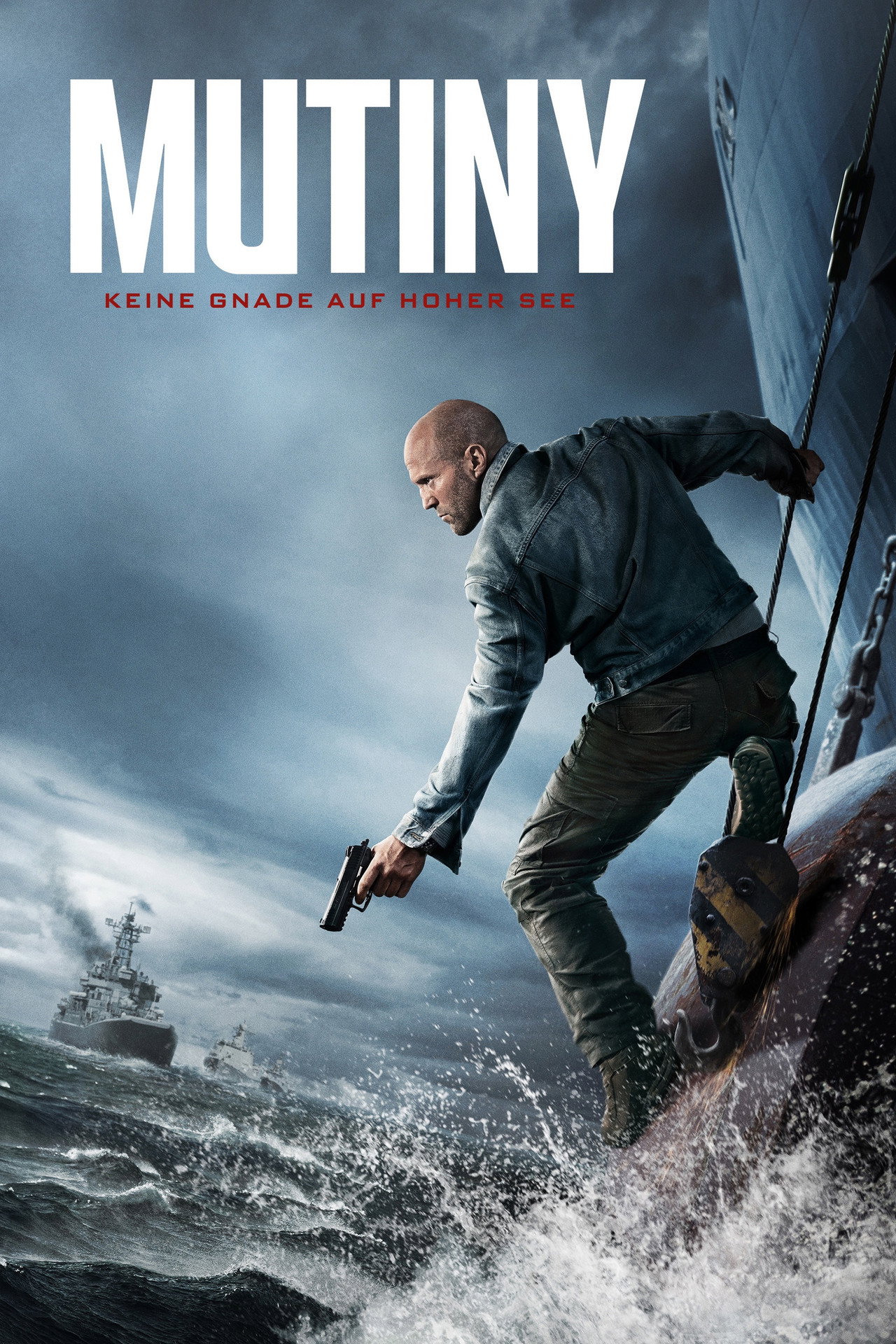
The Verdict
The Nerdiction verdict: Mutiny: A formulaic action thriller with Jason Statham is satisfactory and receives 67 out of 100 points.
Pro
- High-energy action sequences with clear editing and visual coherence
- Strong screen presence from Jason Statham, elevating even schematic roles
- Professional sound design that enhances the intensity of action scenes
Contra
- Predictable plot structure with no meaningful surprises
- Shallow character development and lack of emotional depth
- Generic dialogue and absence of nuanced character interaction
Videos & Trailers
Loading video…
Loading video…
Loading video…
Details
August 19, 2026
1h 35m
6.7
/ 10(95 votes)356.4
Genres
Production Companies
Production Countries
Spoken Languages
Cast
Table of Contents
- Introduction
- Plot & Narrative
- Acting & Characters
- Direction & Cinematography
- Music & Sound Design
- Visual Effects & Technical Craft
- Themes & Message
- Comparison with Similar Films
- Who Is This Film For?
- Verdict
Introduction
With Mutiny, Jason Statham once again steps into the shoes of a man on the run who must fight back against a conspiracy. The British-American action thriller, directed by Jean-François Richet, hit theaters on August 19, 2026, and promises a blend of intense action, international intrigue, and Statham’s signature blend of cool composure and raw physicality. Expectations were high—not least because of the seasoned cast, which includes actors such as Ramon Tikaram, Annabelle Wallis, and Roland Møller.
The initial impression is mixed. While the action sequences are energetically staged and Statham delivers his familiar mix of stoicism and inner tension, the narrative structure proves to be largely predictable. Mutiny relies heavily on long-standing genre conventions without subverting or questioning them. This mirrors the predominantly mixed-to-negative critical reception, which describes the film as formulaic and shallow. Still, a certain entertainment value persists—especially thanks to the adrenaline-fueled set pieces and Statham’s effortlessly charismatic screen presence.
For fans of the classic “Jason Statham takes on the world” archetype, Mutiny may serve as a welcome distraction. Critics, however, are likely to dismiss it as a stale rehash of overused cinematic tropes. With the 2026 film landscape already saturated with similar concepts, Mutiny attempts to carve out space with a combination of brutality and conspiracy that feels more market-driven than creatively ambitious.
The chase for truth—and for survival—is on; but the real question remains: Does Mutiny bring anything genuinely fresh to a genre already weary of its own clichés?
Plot & Narrative
The story of Mutiny follows a straightforward narrative framework: Cole Reed (Jason Statham) is framed for the murder of his billionaire industrialist boss, who was killed right before his eyes. Forced into hiding, Reed sets out to expose an international conspiracy while clearing his name. The narrative unfolds linearly, with revelations building gradually—though they rarely surprise. Tension arises mainly through the fugitive-like structure, compelling Reed to navigate from one clue to the next under constant threat.
Pacing remains consistently high, driven by a steady stream of action sequences that often follow one another with little pause. However, the plot twists feel largely conventional, relying on familiar genre patterns rather than innovative turns. Notably, critics have pointed out references reminiscent of Die Hard, which come across as less clever and more derivative. Even dramatic moments—such as those questioning Reed’s identity or motivations—remain superficial, serving plot convenience more than deep character development.
Dialogue throughout the film is functional but generic. Characters speak mostly in clichéd phrasing that leans toward advancing the action rather than enriching characterization. There is little room for nuance or subtle emotional exchange. Similarly, the international settings—from London to what appears to be Eastern Europe—are rendered atmospherically but lack cultural specificity, weakening the depth of the world-building.
Despite these shortcomings, the combination of strong visual energy and Statham’s natural charisma delivers an adequate viewing experience. Though the plot lacks originality, it pairs well with the polished action scenes to offer a satisfying—if unremarkable—cinematic outing.
Acting & Characters
Jason Statham continues to impress as the stoic, relentless protagonist. His performance blends cool detachment with an undercurrent of simmering resolve—hallmarks of his most enduring roles. In Mutiny, he reveals few new dimensions to his acting repertoire, but his magnetic screen presence lends credibility even to a largely archetypal role. He anchors the film convincingly, whether in quiet confrontations or explosive showdowns, though he rarely ventures into emotional complexity.
Annabelle Wallis provides solid support as Angie Ellis, bringing a level of competence and poise to her scenes alongside Statham. Her delivery is confident, though her emotional range feels constrained—perhaps by design, given the stoic nature of her character. Similarly, Roland Møller’s portrayal of Captain Marko Madsen leans more toward function than depth, embodying the antagonist with intensity but little psychological nuance.
Supporting players like Ramon Tikaram, Arnas Fedaravičius, and Adrian Lester inject moments of authenticity and gravity into otherwise routine exchanges. Their interactions with Statham generate occasional sparks of chemistry, though these never evolve into deeper connections. The interpersonal dynamics remain transactional, serving the plot rather than enhancing the emotional stakes.
Overall, the performances in Mutiny are serviceable rather than standout. Statham carries the film with his trademark gravitas, but even his efforts can’t mask the fact that many of these roles seem designed more for commercial appeal than dramatic substance.
Direction & Cinematography
Jean-François Richet, known for his work in action and thriller genres, directs Mutiny with stylistic consistency but limited ambition. His attention is focused on clean compositions, kinetic action sequences, and a smooth narrative flow that prioritizes momentum over visual poetry. Camera work tends to follow genre conventions—close-ups during fight scenes, wide shots to establish geography—and rarely experiments beyond standard techniques.
Where Richet excels is in orchestrating the action. He demonstrates a clear understanding of pacing and tension, particularly in chase sequences and combat scenes that unfold with mechanical precision and energy. Fast cuts enhance the urgency, though at times they sacrifice spatial clarity. The editing style is rhythmic but unambitious—an efficient tool for maintaining engagement, yet devoid of creative flair.
Cinematographically, the film maintains a grounded, realistic aesthetic. There’s little deviation into stylized visuals or symbolic imagery. The look is polished and market-savvy, meeting audience expectations without pushing boundaries. This pragmatic approach supports the overall tone but limits the film’s emotional resonance and artistic impact.
Richet’s direction in Mutiny represents competent genre filmmaking—effective, reliable, and unobtrusive. While it lacks boldness, it succeeds in keeping the experience cohesive and watchable, especially for viewers seeking straightforward entertainment.
Music & Sound Design
The score of Mutiny adheres closely to the conventional soundtrack of modern action thrillers: pulsing rhythms, sweeping orchestral tones, and hard-hitting electronic textures. It effectively underscores key moments, particularly during high-intensity sequences, though it rarely establishes its own musical identity. The composition supports the mood without elevating it—functional more than exceptional.
Sound design is consistently professional. From gunfire to engine roars, every effect feels integrated into the environment, contributing to a believable and immersive sonic landscape. However, the audio elements mostly serve the action, leaving limited room for atmospheric nuance or mood-driven subtlety. The balance between music and effects is clear, occasionally bordering on separated, resulting in clean but somewhat flat auditory depth.
During quieter scenes, the music becomes more introspective but still fails to leave a lasting impression. The overall auditory experience is technically sound but emotionally restrained—a fitting match for a film that leans more on structure than sentiment.
Das könnte dich auch interessieren
Weitere Reviews aus der Kategorie movie.
Die Festnahme: Thermische Spannung und authentische Action im Herzen Mexikos
Inhaltsverzeichnis [Einleitung]( einleitung) [Handlung & Erzählung]( handlung und erzaehlung) [Schauspiel & Charaktere]( schauspiel und charaktere) [R…
The Runner – ein intensiver Thriller mit Gal Gadot
Inhaltsverzeichnis [Einleitung]( einleitung) [Handlung & Erzählung]( handlung und erzaehlung) [Schauspiel & Charaktere]( schauspiel und charaktere) [R…
Primetime – Eine medienkritische Analyse von Lance Oppenheim
Inhaltsverzeichnis [Einleitung]( einleitung) [Handlung & Erzählung]( handlung erzaehlung) [Schauspiel & Charaktere]( schauspiel charaktere) [Regie & I…
Frequently Asked Questions
How good is Mutiny: A formulaic action thriller with Jason Statham?
Mutiny: A formulaic action thriller with Jason Statham wurde von Nerdiction mit 67 von 100 Punkten bewertet und ist damit satisfactory.
What are the pros of Mutiny: A formulaic action thriller with Jason Statham?
The advantages of Mutiny: A formulaic action thriller with Jason Statham: High-energy action sequences with clear editing and visual coherence, Strong screen presence from Jason Statham, elevating even schematic roles, Professional sound design that enhances the intensity of action scenes, Consistent direction with a sharp focus on pacing and narrative momentum, Seasoned supporting cast delivering credible peripheral performances.
What are the cons of Mutiny: A formulaic action thriller with Jason Statham?
The disadvantages of Mutiny: A formulaic action thriller with Jason Statham: Predictable plot structure with no meaningful surprises, Shallow character development and lack of emotional depth, Generic dialogue and absence of nuanced character interaction, Lacking in original visual style and relying on genre clichés, Underwhelming score that only modestly supports the atmosphere.
Is Mutiny: A formulaic action thriller with Jason Statham worth it?
Only conditionally. Mutiny: A formulaic action thriller with Jason Statham received a score of 67/100 points.