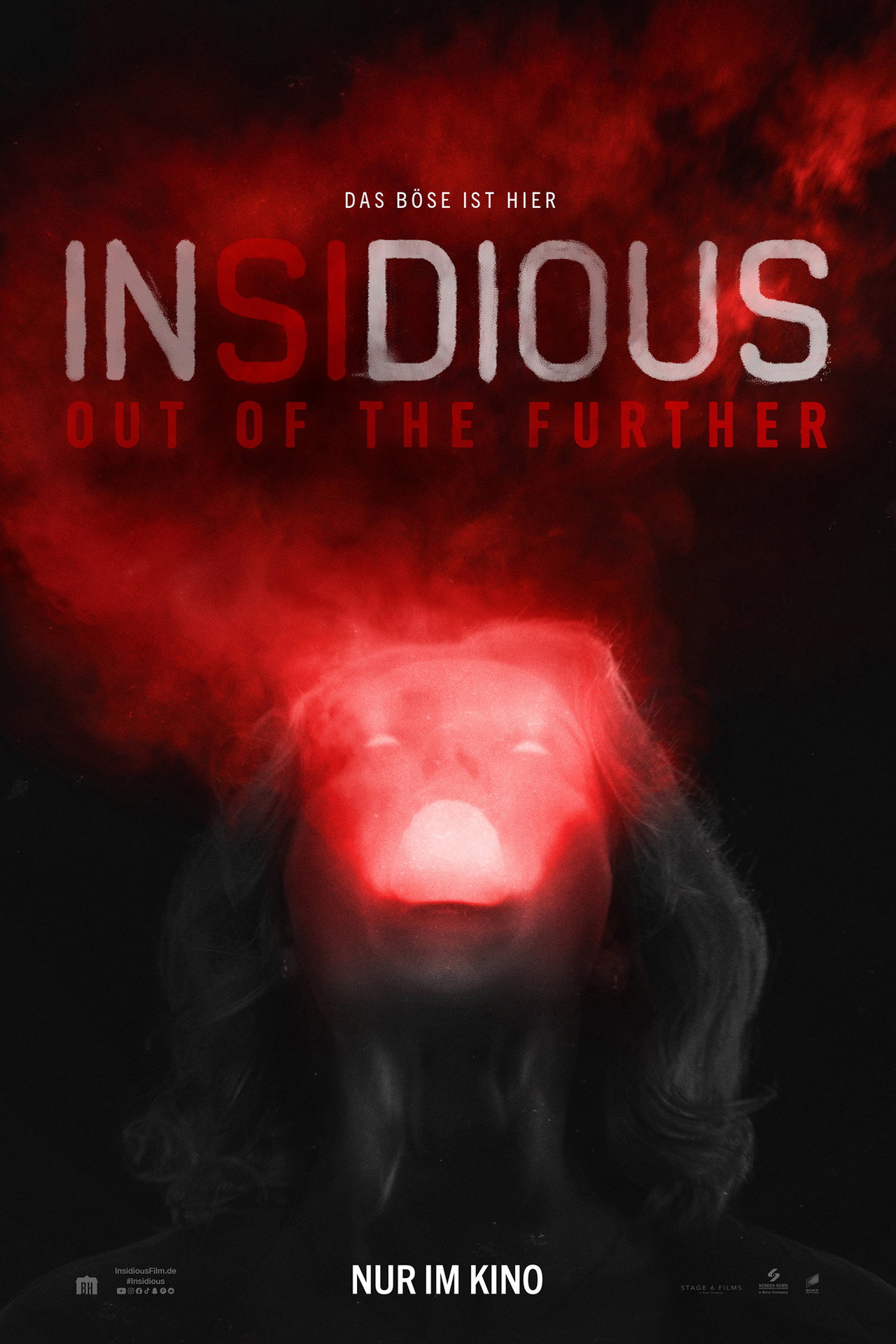
The Verdict
The Nerdiction verdict: Insidious: Out of the Further – Review and Analysis is satisfactory and receives 66 out of 100 points.
Pro
- Amelia Eve delivers a convincing, nuanced performance as Gemma Hall, balancing emotional depth with credible fear.
- The visually contrasting design between the earthly house and the vivid Further creates memorable imagery and reinforces the transition between worlds.
- Jacob Chase’s direction combines practical effects with clever editing to make jump‑scares impactful without over‑relying on CGI.
Contra
- The middle section occasionally drags, causing tension to dissipate between scare sequences.
- Some supporting characters remain underdeveloped, functioning more as plot devices than fully realized personalities.
- The return of Elise Rainier, while nostalgically welcome, at times feels slightly forced and not fully integrated into the current plot.
Videos & Trailers
Loading video…
Details
August 19, 2026
1h 46m
6.6
/ 10(68 votes)107.1
Genres
Production Companies
Production Countries
Spoken Languages
Cast
Table of Contents
- Introduction
- Plot & Narrative
- Acting & Characters
- Direction & Cinematography
- Music & Sound Design
- Visual Effects & Technical Craft
- Themes & Message
- Comparison with Similar Films
- Who Is This Film For?
- Verdict
Introduction
Insidious: Out of the Further continues the successful Blumhouse franchise and attempts to revitalize the mythology surrounding The Further. Released in summer 2026, the film was directed by Jacob Chase, who has previously worked on several genre projects. With a runtime of 106 minutes, it offers ample space to build both atmospheric tension and character‑driven moments. At first glance, the dense visual language stands out, preserving the familiar unease of its predecessors while introducing fresh visual accents. Expectations were high: could this fourth entry correct the series’ recent shortcomings while delivering novel impulses? The opening scene instantly establishes an eerie feeling without giving too much away, leaving the audience curious about the revelations to come.
Plot & Narrative
The story follows Gemma Hall, a young mother who returns with her daughter Maya to the house where she herself grew up. She quickly discovers that she can enter The Further – a dark dimension inhabited by lost souls. This ability not only lets her travel there but also enables her to bring demons from The Further back into the real world. As the plot unfolds, it becomes clear that a malevolent force, rooted in a fanatic cult, seeks to exploit Gemma’s power for its own ends. The film builds tension gradually, beginning with the protagonist’s everyday life before the supernatural slowly takes center stage. Turning points occur when Gemma first senses a creature from The Further manifesting noticeably in her living room, sparking an escalation of conflict. The pacing alternates between calm, almost familial scenes and sudden, adrenaline‑charged moments typical of the Insidious universe. Dialogue is largely functional, yet it effectively conveys Gemma’s emotional burden as a mother and as the bearer of a dangerous power. The narrative avoids fully explaining the finale, leaving enough room for speculation about the franchise’s future while still providing a satisfying arc.
Acting & Characters
Amelia Eve takes on the lead role of Gemma Hall and delivers a nuanced performance that balances vulnerability with growing determination. Her ability to shift from tender mother‑hearted moments to frantic panic attacks lends credibility to the character. Island Austin as Maya Hall contributes the innocent childlike presence that contrasts with the dark events and serves as an emotional anchor for Gemma’s motivation. Lin Shaye reprises her iconic role as Elise Rainier; her brief but pointed appearances act as a spiritual guide that deepens the mythology without overwhelming the plot. Sam Spruell portrays the antagonistic cult leader Cyrus Lam, whose restrained yet threatening presence embodies the danger emanating from The Further. Brandon Perea as Nick Mendoza offers the skeptical friend who initially doubts Gemma’s abilities, later becoming an essential ally. Maisie Richardson‑Sellers as Clare and the remaining supporting cast round out the ensemble, adding smaller yet impactful accents. The chemistry among the cast works especially well in scenes where familial bonds intersect with supernatural threat, enhancing the film’s emotional depth.
Direction & Cinematography
Jacob Chase directs with a clear eye for atmospheric suspense and visual storytelling. He exploits the confined layout of the house to generate claustrophobia, while simultaneously employing wide, almost surreal shots of The Further to visualize the unknown. Editing is rhythmically tuned to the jump‑scares but also permits longer takes that increase the emotional weight of scenes. Particularly noteworthy are the long takes in the house’s hallways, where the camera slowly drifts through dark corridors, immersing the audience in a feeling of anticipation. The visual palette combines muted tones in the earthly realm with saturated, almost garish colors in The Further, visually underscoring the transition between worlds. Chase leans on practical effects and skillful lighting rather than overreliance on CGI, making the uncanny feel tangible. These directorial choices help the film produce moments of genuine unpredictability despite its genre conventions.
Music & Sound Design
The score by Joseph Bishara, who composed for previous Insidious entries, returns and blends familiar motifs with new, dissonant sounds. The main theme employs deep strings and distorted synths to create a lingering unease, while softer, piano‑based passages underscore the intimate family moments. Sound design plays a pivotal role in constructing tension: subtle background noises such as distant whispers, creaking doors, and the remote echo from The Further are carefully placed in the mix, often perceived subconsciously. During jump‑scares, a precise alignment of a sudden sonic burst with the visual shock maximizes the fright effect. Notably, the use of silence immediately before a scare heightens anticipation, making the ensuing sound spike feel even stronger. Overall, the auditory concept reinforces the visual effects and strengthens the sensation that The Further is constantly present, even when unseen.
Visual Effects & Technical Craft
The visual effects in Insidious: Out of the Further aim to portray The Further as a distinct, unsettling dimension without making it look like a purely computer‑generated construct. Practical sets were expanded to hint at the surreal architecture of The Further, while digital additions were subtly employed to introduce light‑bending phenomena and warped perspectives. The production design of the house itself received meticulous attention: weathered wallpaper, creaking stairs, and familiar family photos on the walls convey a genuine sense of lived‑in history. Costume design for the entities from The Further ranges from almost‑human silhouettes to distinctly altered forms, with makeup and prosthetics executed to a high standard. Cinematography utilizes handheld shots for immediate intensity as well as static, almost tableau‑like compositions to emphasize the surreal. Technically, the film was shot in high resolution with a color grade that highlights the cool tones of The Further while preserving warm nuances in the earthly segments. These technical decisions ensure that the supernatural feels credible and remains in service of the narrative.
Themes & Message
At its core, Insidious: Out of the Further explores themes of motherhood, the inheritance of fear, and the confrontation with repressed trauma. Gemma’s ability to enter The Further can be read as a metaphor for grappling with inner demons: the more she attempts to control her power, the stronger the external threat becomes. The film investigates how family bonds can be both a source of strength and a point of vulnerability—a motif especially evident in the interactions between Gemma and her daughter. Furthermore, it suggests that evil is not always external; personal anxieties and guilt can open a gateway to darker forces. By reintroducing Elise Rainier as a wise guide, the film also touches on the idea of transmitting knowledge across generations. The message remains suggestive rather than didactic, inviting the viewer to reflect on their own relationship with fear and loss without offering simple answers. This thematic depth lifts the film somewhat above a pure jump‑spectacle, granting it additional emotional resonance.
Comparison with Similar Films
Compared to earlier Insidious installments, Out of the Further displays a noticeable maturity in narrative structure, placing stronger emphasis on character development while retaining the series’ foundational framework. Similar titles such as “The Conjuring” or “Sinister” also employ supernatural elements to mirror familial conflicts, yet Insidious distinguishes itself through its unique concept of The Further as a tangible, traversable realm. When measured against recent horror releases like “A Quiet Place Part II” or “Heretic”, Out of the Further relies less on sustained silence and more on loud, immediate shock moments coupled with a slower unveiling of its mythology. The film thus situates itself somewhere between traditional jump‑scare horror and the more atmospherically driven horror‑drama. This hybrid profile explains why critics praised both its effective scare sequences and its attempted deeper layers, while some found the balance uneven.
Who Is This Film For?
Insidious: Out of the Further targets franchise fans seeking a continuation that delivers the familiar feel while venturing onto new narrative ground. Viewers particularly drawn to strong mother‑daughter dynamics and psychological horror will appreciate the performances of Amelia Eve and Island Austin. Likewise, admirers of practical effects and meticulous set design will enjoy the handcrafted apparatus and the richly detailed house. The movie works well in a theater, thanks to its potent sound and visual components, as well as in a home‑streaming setting, where darkness enhances its atmosphere. Price‑to‑value is reasonable given Blumhouse’s average production budget; the entertainment value justifies the ticket price, especially when weighing the mix of scares and emotional depth. However, those looking solely for relentless, uninterrupted terror may find the somewhat quieter, character‑focused middle of the film less satisfying.
Verdict
Insidious: Out of the Further manages to keep the franchise on solid ground while introducing fresh accents. Jacob Chase’s direction delivers a cohesive audiovisual concept that effectively governs tension, while the performances of Amelia Eve and the ensemble supply the film’s emotional core. The blend of practical effects, thoughtful production design, and a score that feels both familiar and novel yields a consistent horror experience. Although the film does not reach the peaks of the genre’s strongest entries, it surpasses its immediate predecessor and offers a balanced package of scares, character, and theme. Considering the analyzed strengths and weaknesses, a score of 66 out of 100 reflects its solid execution while leaving room for improvement. For fans of the series and for viewers who desire a horror film with both heart and intellect, Insidious: Out of the Further comes recommended.
Das könnte dich auch interessieren
Weitere Reviews aus der Kategorie movie.

Verity – Dunkle Geheimnisse: Ein Psychothriller voller verschwommener Realitäten und intensiver Performances
Inhaltsverzeichnis [Einleitung]( einleitung) [Handlung & Erzählung]( handlung erz%C3%A4hlung) [Schauspiel & Charaktere]( schauspiel charaktere) [Regie…

Mutiny: Ein konventionelles Action-Thriller-Duell mit Jason Statham
Inhaltsverzeichnis [Einleitung]( einleitung) [Handlung & Erzählung]( handlung und erzaehlung) [Schauspiel & Charaktere]( schauspiel und charaktere) [R…

Primetime – Eine medienkritische Analyse von Lance Oppenheim
Inhaltsverzeichnis [Einleitung]( einleitung) [Handlung & Erzählung]( handlung erzaehlung) [Schauspiel & Charaktere]( schauspiel charaktere) [Regie & I…
Frequently Asked Questions
How good is Insidious: Out of the Further – Review and Analysis?
Insidious: Out of the Further – Review and Analysis wurde von Nerdiction mit 66 von 100 Punkten bewertet und ist damit satisfactory.
What are the pros of Insidious: Out of the Further – Review and Analysis?
The advantages of Insidious: Out of the Further – Review and Analysis: Amelia Eve delivers a convincing, nuanced performance as Gemma Hall, balancing emotional depth with credible fear., The visually contrasting design between the earthly house and the vivid Further creates memorable imagery and reinforces the transition between worlds., Jacob Chase’s direction combines practical effects with clever editing to make jump‑scares impactful without over‑relying on CGI., Joseph Bishara’s score blends familiar motifs with new dissonant tones, sustaining an audible sense of unease throughout., The film subtly weaves themes of motherhood and inner demons into its horror, granting the scares emotional resonance beyond mere shock..
What are the cons of Insidious: Out of the Further – Review and Analysis?
The disadvantages of Insidious: Out of the Further – Review and Analysis: The middle section occasionally drags, causing tension to dissipate between scare sequences., Some supporting characters remain underdeveloped, functioning more as plot devices than fully realized personalities., The return of Elise Rainier, while nostalgically welcome, at times feels slightly forced and not fully integrated into the current plot., The balance between character drama and pure scare moments may leave both hardcore horror fans and pure drama viewers partially unsatisfied., The rules and limits of The Further are only sparsely explained, which can lead to occasional confusion about its internal logic..
Is Insidious: Out of the Further – Review and Analysis worth it?
Only conditionally. Insidious: Out of the Further – Review and Analysis received a score of 66/100 points.