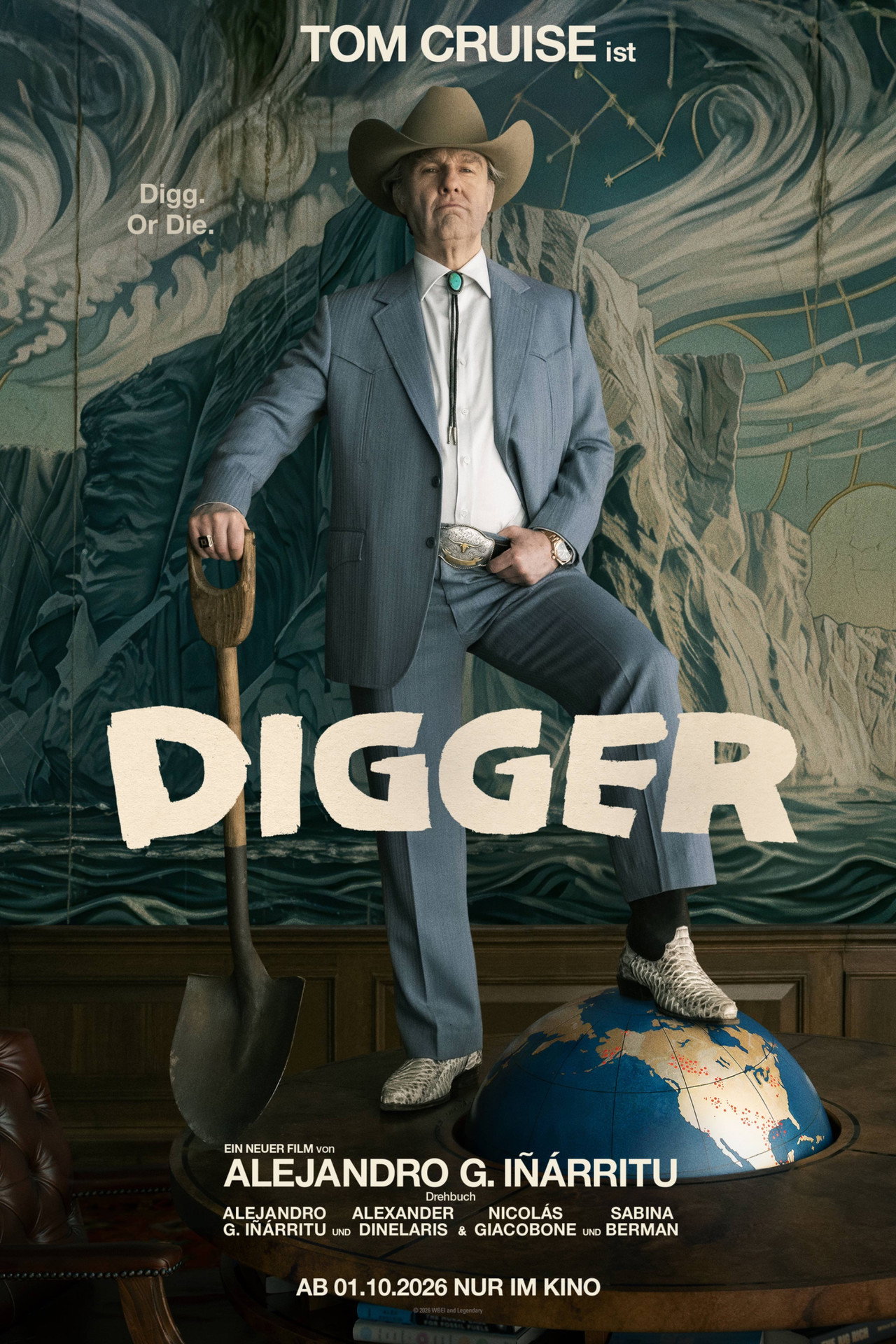
The Verdict
The Nerdiction verdict: Digger – Tom Cruise’s Ambiguous Satire on Power and Apocalypse is good and receives 78 out of 100 points.
Pro
- Tom Cruise delivers a standout, morally complex performance as Digger Rockwell.
- Iñárritu’s visual direction is opulent, with striking cinematography that enhances thematic depth.
- Sharp, satirical dialogue offers incisive commentary on contemporary politics.
Contra
- Imbalanced tonal shifts between comedy and drama occasionally undermine coherence.
- Uneven pacing slows narrative momentum in several sections.
- Supporting characters often remain underdeveloped, limiting emotional depth.
Videos & Trailers
Loading video…
Details
September 28, 2026
2h 9m
7.5
/ 10(258 votes)165.9
Genres
Production Companies
Production Countries
Spoken Languages
Cast
Table of Contents
Introduction Plot & Narrative Acting & Characters Direction & Cinematography Music & Sound Design Visual Effects & Technical Craft Themes & Message Comparison with Similar Films Who Is This Film For? Verdict
Introduction
Digger is a bold and ambitious cinematic endeavor by director Alejandro G. Iñárritu, straddling the line between grand satire and fragmented self‑reflection. Spanning 129 minutes and boasting a star‑studded cast—most notably Tom Cruise as the eponymous Digger Rockwell—the film probes the perils of power, responsibility, and the self‑inflicted apocalypse that drives its protagonist. Iñárritu’s signature opulence and narrative experimentation are present, but they are now framed within a comedy‑drama that asks whether a leader can ever truly be a savior for humanity. The movie’s genres—comedy and drama—allow for a fluid exchange between humor and tragedy, encouraging viewers to reconsider their expectations of political storytelling.
Reception has been decidedly mixed: Metacritic awards the film a score of 46 based on 53 critic reviews (28 % positive, 47 % mixed, 26 % negative). Conversely, user scores hover around 7.9, indicating a more favorable audience response. This divide highlights how Digger challenges both critics and viewers—critics often lament the uneven balance of humor and seriousness, while audiences seem drawn to its audacious tone and performances. This review seeks to dissect both the commendable aspects and the shortcomings, offering a comprehensive perspective for anyone trying to decide whether Digger is worth watching.
Plot & Narrative
At its core, Digger follows Digger Rockwell, a charismatic yet polarizing global leader who finds himself in a desperate race against an impending catastrophe that he himself set in motion. His mission: to prove he can serve as humanity’s savior before the disaster obliterates everything. The storyline unfolds through a blend of comedy and drama, employing exaggeration and satirical elements to lampoon the absurdity of hero worship in a hyper‑connected world. The narrative structure oscillates between lighter, comic moments and intense, often somber sequences, keeping the pacing lively while reflecting Rockwell’s internal conflict.
The screenplay, penned by Iñárritu together with Sabina Berman, Jez Butterworth, Alexander Dinelaris, and Nicolás Giacobone, crafts a complex timeline that moves between public spectacles and private reckonings. Key turning points include Rockwell’s high‑profile speeches, his clandestine moments of doubt with advisors such as Emma (Sandra Hüller) and the Vice President (Michael Stuhlbarg), and a series of cataclysmic events that force him to reassess his moral standing. While the specifics of the catastrophe remain largely unseen—maintaining a sense of abstraction—the story leverages atmospheric tension and symbolic action to drive home its thematic core.
Narrative Technique and Pacing
Iñárritu’s storytelling is characterized by a non‑linear approach that interweaves recurring visual motifs with episodic plot developments. Rapid cuts alternate with lingering, contemplative shots, creating a rhythm that mirrors Digger’s frantic yet self‑reflective journey. Montage sequences juxtaposing political maneuvering with intimate self‑examination underscore the film’s central tension. Though the pacing can feel uneven at moments, it largely sustains viewer engagement, ensuring that even the more reflective interludes contribute to the overall dramatic arc.
Dialogue and Chemistry
Dialogue in Digger serves as both weapon and mirror. Witty repartee often carries sharp social commentary, while quieter exchanges reveal deeper anxieties. Notably, the dynamic between Cruise’s Rockwell and Riz Ahmed’s Nirav Ganesh illustrates a subtle interplay of authority and counsel, highlighting the complexities of loyalty and manipulation. The chemistry among the ensemble—John Goodman as President Compson, Jesse Plemons as Kenny, and Robert John Burke as General Fitzgerald—adds layers of intrigue, reinforcing the political intricacies without overshadowing the central narrative.
Acting & Characters
Tom Cruise’s performance as Digger Rockwell stands as the film’s fulcrum. Through deliberate gestures and a commanding presence, Cruise portrays a leader torn between hubris and genuine self‑questioning. His ability to convey vulnerability while maintaining an aura of power makes Rockwell a compelling, morally ambiguous figure. Supporting performances are equally noteworthy: Riz Ahmed delivers a measured, intellectual counterpoint to Cruise’s volatility, while Sandra Hüller’s Emma exudes quiet authority, suggesting an inner world that fuels the protagonist’s evolution.
The ensemble’s chemistry is honed with precision; scenes between Cruise and Ahmed, for instance, balance confrontational tension with moments of genuine introspection. John Goodman brings dark humor and gravitas as President Compson, while Michael Stuhlbarg’s Vice President offers a more cerebral perspective. Even smaller roles—such as Jesse Plemons’s Kenny and Robert John Burke’s General Fitzgerald—add texture to the political landscape, though some characters remain sketchily developed.
The character arcs reflect a journey through power, responsibility, and the search for redemption, yet the pacing of these evolutions occasionally feels rushed, leaving certain emotional beats under‑explored.
Direction & Cinematography
Alejandro González Iñárritu’s direction in Digger showcases his mastery of visual storytelling. The film’s cinematography balances sweeping, panoramic vistas of the powerful with intimate close‑ups that reveal Rockwell’s internal turmoil. The visual palette is vivid, employing high contrast lighting to symbolize the moral binaries that the narrative constantly questions.
Editing rhythms alternate between rapid, kinetic sequences and slow, meditative shots, mirroring the protagonist’s oscillation between action and contemplation. Iñárritu’s use of recurring motifs—such as reflective surfaces and expansive skies—serves to reinforce themes of duality and isolation. Production design is meticulously crafted, with sets that feel both grandiose and claustrophobic, echoing the paradox of a leader who commands the world yet feels trapped by his own ambitions.
Technical execution is top‑notch, with crisp image quality that renders everything from the grain of fabric on costumes to the texture of architectural details, thereby immersing the audience in the film's hyperreal world.
Music & Sound Design
The score for Digger is composed by a frequent collaborator of Iñárritu, blending orchestral swells with electronic undertones. The opening theme—filled with brass fanfares and pulsating rhythms—captures Rockwell’s magnetic charisma while hinting at his inner unrest. Occasional electronic textures punctuate intense moments, lending the soundtrack a contemporary edge that aligns with the film’s modern setting.
Sound design plays a crucial role, employing layered ambience to immerse viewers. Subtle alarm tones, bureaucratic chatter, and distant crowd murmurs blend seamlessly with the music, accentuating the tension of political machinations. A recurring low‑pitched hum appears during moments of decision, symbolizing the underlying anxiety that fuels the protagonist’s actions. The audio mixing maintains clarity, ensuring dialogues cut through while preserving the immersive atmosphere.
Visual Effects & Technical Craft
Visually, Digger leverages cutting‑edge CGI to portray the catastrophic events that drive the narrative. The effects are integrated smoothly, avoiding overt exposition while still delivering a sense of impending doom. A notable sequence shows a massive dam breaching, unleashing a flood that reshapes the urban landscape—an impressive visual that underscores the stakes without overwhelming the story.
Production design and costume departments are equally impressive, delivering a world that feels both opulent and gritty. The meticulous attention to detail in props, set dressings, and costume textures enhances the film’s realism, reinforcing its speculative premise.
Technical craftsmanship extends to the cinematography, with sharp focus and dynamic range that capture both bright, sun‑drenched exteriors and dim, interior corridors with equal finesse. The visual language supports the narrative, ensuring that each scene contributes meaningfully to the overarching story.
Themes & Message
Digger interrogates the nature of power and its attendant responsibilities, presenting a protagonist whose self‑perceived salvation is both tragic and absurd. By portraying a leader who actively seeks redemption while perpetuating chaos, the film questions conventional heroic tropes. It also reflects on the impact of technology, governance, and personal accountability in a rapidly evolving global society.
The juxtaposition of humor and tragedy underscores the moral ambiguity that characterizes contemporary politics. The film suggests that salvation cannot be achieved through spectacle alone; it demands genuine introspection and ethical action. Ultimately, Digger invites viewers to confront their own perceptions of authority and to consider the cost of ambition unchecked by conscience.
Comparison with Similar Films
When placed alongside other political satires, Digger bears similarities to "The Death of Stalin" in its incisive critique of power structures, yet it diverges by employing a more stylized visual language that leans toward the surreal. Compared to "The Big Short," Digger’s narrative focuses less on economic systems and more on the personality cult surrounding a global leader, offering a distinct perspective on contemporary authority.
The pacing and episodic nature of Digger echo "In the Loop," but with a heightened emphasis on visual grandeur and philosophical questioning. While "The Big Short" delivers a relatively linear financial narrative, Digger explores a broader spectrum of societal institutions, making it a unique entry in the satire genre.
Who Is This Film For?
Digger is tailored for audiences seeking a thought‑provoking, genre‑blending experience. It will attract film enthusiasts who appreciate complex political commentary, as well as general viewers drawn by Tom Cruise’s star power and Iñárritu’s reputation for visual innovation. The blend of comedy and drama makes it accessible to those who typically favor either genre, offering moments of levity amid weighty themes.
For creators and analysts, the film provides a rich case study in narrative structure and visual storytelling. Its bold approach to satirizing modern leadership will resonate with viewers eager to engage with contemporary socio‑political issues. The mixed critical reception and strong audience score indicate that Digger can satisfy both detractors and admirers, making it a compelling option for a diverse movie night.
Verdict
Digger stands as an impressive yet imperfect satire that boldly navigates the terrain of power, redemption, and apocalypse. Its strongest assets—Cruise’s compelling performance, Iñárritu’s sumptuous cinematography, and sharp, cutting dialogue—shine brightly, yet the film’s uneven tone and inconsistent pacing prevent it from reaching full cohesion. The balance between humor and gravitas is often off‑kilter, leading to moments where the narrative feels either overly whimsical or unintentionally heavy.
In summary, Digger is a daring political satire that succeeds in delivering striking visuals and a provocative central performance, but it falters in narrative discipline and character development.
Pros:
- Tom Cruise delivers a standout, morally complex performance as Digger Rockwell.
- Iñárritu’s visual direction is opulent, with striking cinematography that enhances thematic depth.
- Sharp, satirical dialogue offers incisive commentary on contemporary politics.
- Strong ensemble chemistry, especially between Cruise and Ahmed, fuels narrative tension.
- Meticulous production design creates a vivid, hyperreal world that supports the story.
Cons:
- Imbalanced tonal shifts between comedy and drama occasionally undermine coherence.
- Uneven pacing slows narrative momentum in several sections.
- Supporting characters often remain underdeveloped, limiting emotional depth.
- Low Metacritic critic score (46) signals divided critical opinion, potentially off‑putting to some viewers.
- Overly grand visual effects sometimes eclipse quieter, more intimate moments.
Score: 78 / 100
Das könnte dich auch interessieren
Weitere Reviews aus der Kategorie movie.

Don't Say Good Luck – Eine herzliche Netflix-Dramedy
Inhaltsverzeichnis [Einleitung]( einleitung) [Handlung & Erzählung]( story und erzaehlung) [Schauspiel & Charaktere]( schauspiel und charaktere) [Regi…
Toxic Review: Stil über Substanz – Yash glänzt, die Story schwächelt
Inhaltsverzeichnis [Einleitung]( einleitung) [Handlung & Erzählung]( handlung und erzaehlung) [Schauspiel & Charaktere]( schauspiel und charaktere) [R…
Coyote vs. ACME – Das Gerichtsurteil der Looney Tunes
Inhaltsverzeichnis [Einleitung]( einleitung) | [Handlung & Erzählung]( handlung und erzaehlung) | [Schauspiel & Charaktere]( schauspiel und charaktere…
Frequently Asked Questions
How good is Digger – Tom Cruise’s Ambiguous Satire on Power and Apocalypse?
Digger – Tom Cruise’s Ambiguous Satire on Power and Apocalypse wurde von Nerdiction mit 78 von 100 Punkten bewertet und ist damit good.
What are the pros of Digger – Tom Cruise’s Ambiguous Satire on Power and Apocalypse?
The advantages of Digger – Tom Cruise’s Ambiguous Satire on Power and Apocalypse: Tom Cruise delivers a standout, morally complex performance as Digger Rockwell., Iñárritu’s visual direction is opulent, with striking cinematography that enhances thematic depth., Sharp, satirical dialogue offers incisive commentary on contemporary politics., Strong ensemble chemistry, especially between Cruise and Ahmed, fuels narrative tension., Meticulous production design creates a vivid, hyperreal world that supports the story..
What are the cons of Digger – Tom Cruise’s Ambiguous Satire on Power and Apocalypse?
The disadvantages of Digger – Tom Cruise’s Ambiguous Satire on Power and Apocalypse: Imbalanced tonal shifts between comedy and drama occasionally undermine coherence., Uneven pacing slows narrative momentum in several sections., Supporting characters often remain underdeveloped, limiting emotional depth., Low Metacritic critic score (46) signals divided critical opinion, potentially off‑putting to some viewers., Overly grand visual effects sometimes eclipse quieter, more intimate moments..
Is Digger – Tom Cruise’s Ambiguous Satire on Power and Apocalypse worth it?
Yes. Digger – Tom Cruise’s Ambiguous Satire on Power and Apocalypse received a score of 78/100 points and is good.