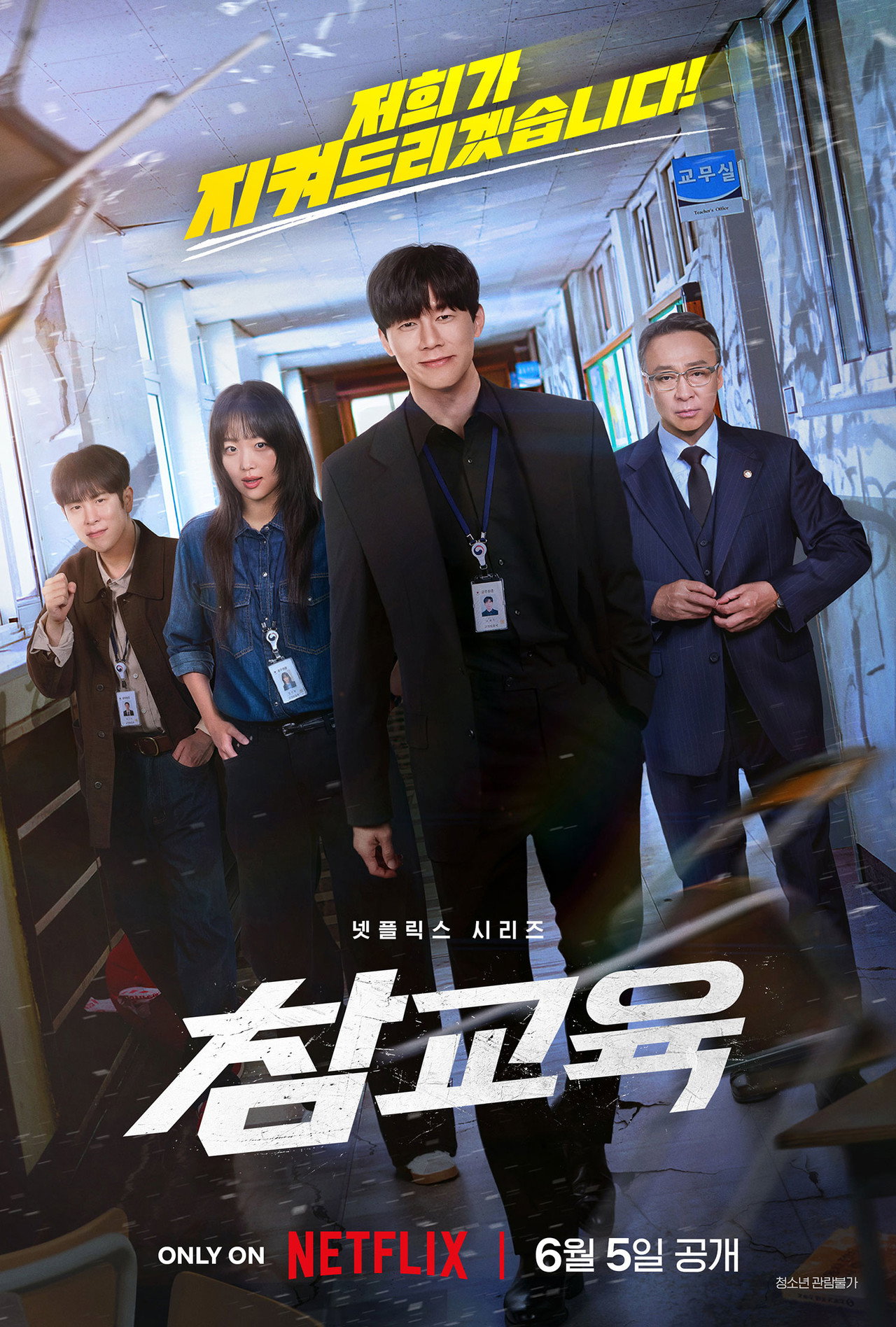
The Verdict
The Nerdiction verdict: The Art of Discipline: An In-Depth Review of 'Teach You a Lesson' is outstanding and receives 91 out of 100 points.
Pro
- Outstanding action choreography
- Sharp social critique of the education system
- Strong visual aesthetics and symbolic cinematography
Contra
- Occasional oversimplification of complex issues via violence
- Supporting characters could have had deeper development
- Some aspects should be checked editorially
Details
225.9
Genres
Teach You a Lesson (참교육) – Review
Table of Contents
- Introduction & Series Context
- The Premise: Justice Beyond the Curriculum
- Character Dynamics and Evolution
- Narrative Structure and Pacing
- Production and Visual Execution
- Thematic Depth: Abuse of Power and Morality
- Season and Episode Analysis
- Target Audience Analysis
- Critical Evaluation and Weaknesses
- Final Verdict
<a name="introduction"></a>
Introduction & Series Context
With "Teach You a Lesson," we enter a territory that has a long-standing tradition in South Korean drama and webtoon culture: the deconstruction of the educational system. Produced by the renowned studios GTist and YLAB, the series positions itself at the intersection of gritty action, socially conscious drama, and a touch of dark comedy. In a world where school hierarchies are often defined by fear and intimidation rather than knowledge and respect, the series provides a radical counterpoint.
The series is not merely another "school drama"; it is a deliberately provocative statement on the impotence of traditional institutions when faced with systemic violence. By embedding itself in the Action & Adventure genres, physical confrontation becomes the primary tool of narration, though the series skillfully avoids falling into the trap of mindless glorification of violence.
<a name="premise"></a>
The Premise: Justice Beyond the Curriculum
The plot of "Teach You a Lesson" begins where the law and school boards fail. When teachers turn a blind eye and students triumph over others through social status or physical dominance, an unconventional force steps in. The premise is simple yet potent: an inspector, whose methods lie far outside official guidelines, is deployed to restore order where chaos reigns.
It is not about mere punishment, but about a "lesson." The series asks whether justice can ever be legally achieved within a corrupt system or if there are situations where unconventional, direct measures are the only language the perpetrators understand. The viewer is thus thrust into a moral conflict: cheering for the protagonist while simultaneously questioning the radical nature of his means.
<a name="characters"></a>
Character Dynamics and Evolution
At the center is the Inspector, a persona who embodies a fascinating blend of stoic calm and explosive power. His character is defined less by a classic hero's journey and more by professional precision. He serves as the catalyst for the evolution of the supporting cast.
Of particular note is the depiction of the students. The series avoids portraying the antagonists as one-dimensional "villains." Instead, it explores the psychological mechanisms of bullying and the dynamics of power and submission. The victims, in turn, undergo a subtle transformation: moving from total hopelessness toward a new form of self-assertion, inspired by the Inspector's uncompromising nature.
<a name="structure"></a>
Narrative Structure and Pacing
Across 10 episodes, the series follows an episodic yet linearly escalating structure. Each episode often focuses on a specific case or a particular group of misconduct, while a larger plot regarding the systemic failures of educational institutions is woven in the background.
The pacing is precisely calibrated. The series knows when to allow time for character establishment and when the action sequences must take the lead. Particularly effective is the transition between slow, almost meditative moments of observation and lightning-fast, highly efficient confrontations. This prevents the series from falling into a repetitive pattern of "Problem $\rightarrow$ Fight $\rightarrow$ Resolution."
<a name="production"></a>
Production and Visual Execution
The visual language of "Teach You a Lesson" reflects the duality of the series. School corridors are often depicted in cold, sterile colors, emphasizing the emotional coldness and isolation of the affected students. In contrast, the action scenes are dynamic and almost kinetic. The fight choreography is not overblown but emphasizes efficiency and impact, which perfectly aligns with the protagonist's character.
The cinematography frequently utilizes extreme perspectives to visually convey power dynamics—from low-angle shots that highlight the intimidation of the bullies to wide shots that emphasize the victim's loneliness. The sound design supports this contrast through a minimalist approach, effectively utilizing the silence before the storm.
<a name="themes"></a>
Thematic Depth: Abuse of Power and Morality
Beyond the action, the series intensively examines the concept of authority. What constitutes legitimate authority? Is it a title on paper or the ability to stand up for justice? "Teach You a Lesson" sharply criticizes the tendency of institutions to prioritize the image of the school over the well-being of individuals.
Another central theme is responsibility. The series questions who bears the burden when the system fails. By introducing an "external cleaner," it demonstrates that the internal self-healing of many institutions is often an illusion. The comedic elements serve as a valve to break the heaviness of the themes without undermining the seriousness of the situation.
<a name="episodes"></a>
Season and Episode Analysis
The collaboration between GTist and YLAB is clearly evident. The visual quality is reminiscent of high-end webtoon adaptations, with the series seamlessly transitioning into a live-action (or high-end animated) format. At 10 episodes, the season length is ideal for telling the story compactly without unnecessary filler.
The episode structure often follows an arc that begins with observation, leads to escalation, and ends in a cathartic resolution. This rhythm ensures that the viewer remains motivated to watch the next episode.
<a name="audience"></a>
Target Audience Analysis
The series primarily targets a young to middle-adult audience (Young Adults) with an affinity for action dramas and socially critical narratives. Fans of titles like "Weak Hero" or "The Glory" will find themselves at home here. Due to the thematic weight (bullying, violence), it is less suitable for young children but speaks directly to the generation that grew up with the problems of the modern education system.
<a name="weaknesses"></a>
Critical Evaluation and Weaknesses
Despite its high quality, there are points that warrant critical reflection. Occasionally, the series tends to replace the resolution of complex psychological problems with physical superiority. While this is narratively satisfying (cathartic), one could argue that the series thereby reproduces the very problems it criticizes, albeit in a different form.
Additionally, some secondary characters could have been developed more deeply to strengthen the emotional bond with the audience. The focus on the Inspector is justified, but it occasionally limits the space for the students' own character growth.
<a name="verdict"></a>
Final Verdict
"Teach You a Lesson" is a powerful, visually stunning series that succeeds in channeling anger over systemic injustice into an entertaining and meaningful form. It is more than just an action spectacle; it is a study of power, discipline, and the necessity of consequences.
With strong direction and precise storytelling, the series sets a new standard for the school-action genre. Anyone seeking a story that takes no compromises and leads the viewer through a mixture of tension, anger, and ultimate satisfaction should not miss this production.
Das könnte dich auch interessieren
Weitere Reviews aus der Kategorie series.

GIGN – Ein meisterhaftes Porträt von Héroismus, Psychology und moralischer Ambivalenz
GIGN – Eine intensive Reifeaktualisierung des Polizeikonditanals Inhaltsverzeichnis 1.Serie Einordnung 2.Prämisse und Setting 3.Charaktere 4.Narrative…

Gachiakuta - Ein dystopisches Meisterwerk zwischen Himmel und Hölle
Gachiakuta Ein dystopisches Meisterwerk zwischen Himmel und Hölle ![[IMAGE 1]] Inhaltsverzeichnis 1. [Einleitung]( einleitung) 2. [Handlung und Welten…
Sakamoto Days: Wenn Auftragskiller Familienvater wird – Ein Meisterwerk zwischen Action und Herz
Inhaltsverzeichnis 1. [Einleitung]( einleitung) 2. [Handlung und Prämisse]( handlung und prämisse) 3. [Charakterentwicklung]( charakterentwicklung) 4.…
Frequently Asked Questions
How good is The Art of Discipline: An In-Depth Review of 'Teach You a Lesson'?
The Art of Discipline: An In-Depth Review of 'Teach You a Lesson' wurde von Nerdiction mit 91 von 100 Punkten bewertet und ist damit outstanding.
What are the pros of The Art of Discipline: An In-Depth Review of 'Teach You a Lesson'?
The advantages of The Art of Discipline: An In-Depth Review of 'Teach You a Lesson': Outstanding action choreography, Sharp social critique of the education system, Strong visual aesthetics and symbolic cinematography, Perfect pacing across 10 episodes, High cathartic value.
What are the cons of The Art of Discipline: An In-Depth Review of 'Teach You a Lesson'?
The disadvantages of The Art of Discipline: An In-Depth Review of 'Teach You a Lesson': Occasional oversimplification of complex issues via violence, Supporting characters could have had deeper development, Some aspects should be checked editorially, Not every detail is fully backed by source data.
Is The Art of Discipline: An In-Depth Review of 'Teach You a Lesson' worth it?
Yes. The Art of Discipline: An In-Depth Review of 'Teach You a Lesson' received a score of 91/100 points and is outstanding.