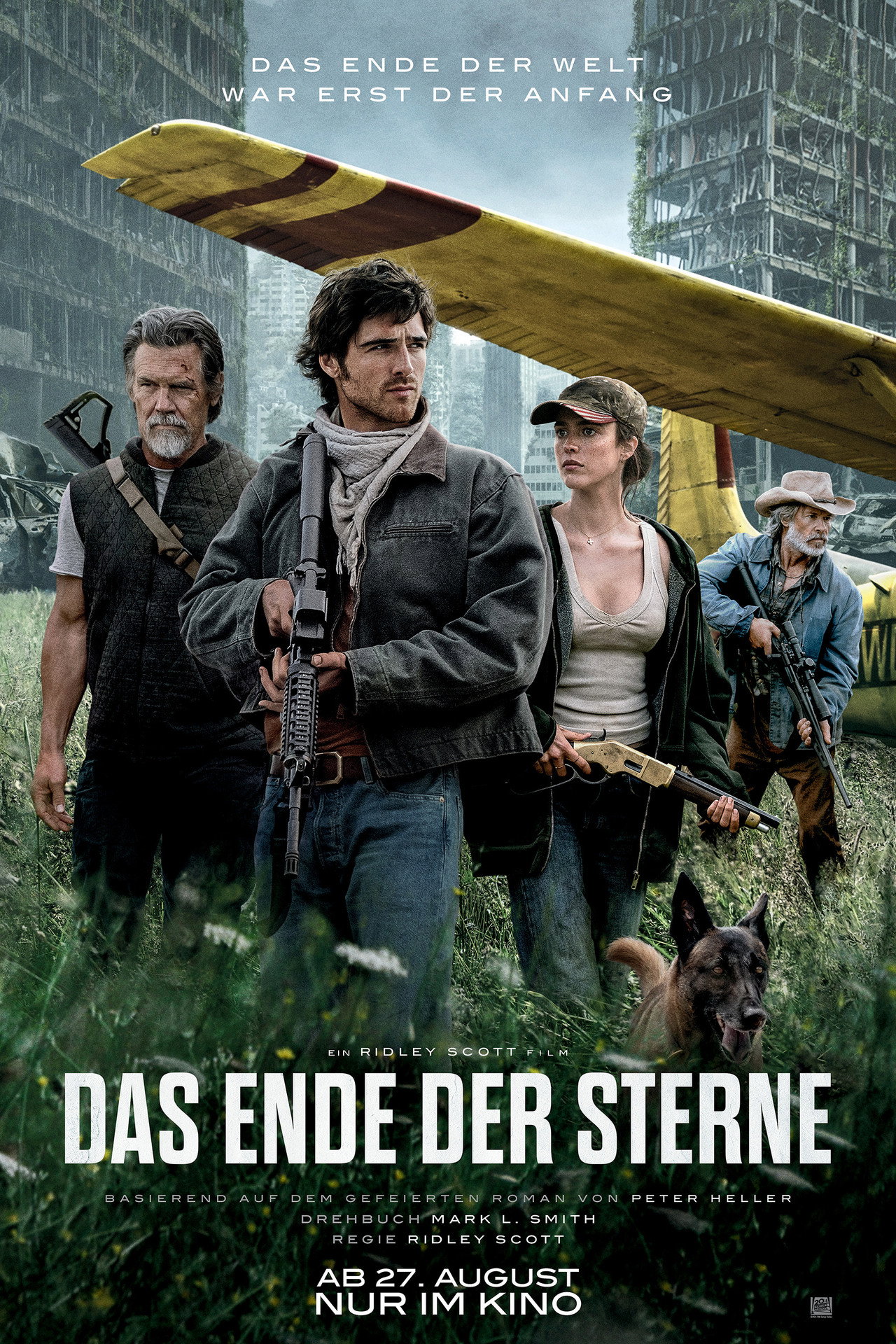
The Verdict
The Nerdiction verdict: The Dog Stars Review – Ridley Scott's Quiet Apocalypse is good and receives 73 out of 100 points.
Pro
- Jacob Elordi delivers a mature, restrained performance that carries the film emotionally and consolidates his star status in the long term.
- Ridley Scott's visual language uses the Colorado landscape as an independent protagonist, creating an authenticity that many CGI-heavy genre peers lack.
- The score works with reduced sound surfaces and uses silence as a narrative tool, lifting the film acoustically to a level above the mainstream.
Contra
- The quiet pace of the first half hour demands considerable patience from the audience and may put off viewers who are looking for action.
- Supporting characters such as Pops, Darlene and Aaron remain sketchy in their development and could have used more depth.
- In some flight sequences, the transitions between real shots and digital extensions are noticeable, diminishing the otherwise strong visual impression.
Videos & Trailers
Loading video…
Loading video…
Loading video…
Details
August 26, 2026
1h 59m
7.1
/ 10(62 votes)86.8
Genres
Production Companies
Production Countries
Spoken Languages
Cast
Table of Contents
- Introduction
- Plot & Narrative
- Acting & Characters
- Direction & Cinematography
- Music & Sound Design
- Visual Effects & Technical Craft
- Themes & Message
- Comparison with Similar Films
- Who Is This Film For?
- Verdict
Introduction
There are films that begin with the promise of showing the world as we know it – and then proceed to level it, piece by piece. And there are films that do the exact opposite: they pick up long after the apocalypse has run its course, after the rubble has cooled and only a faint hum remains over an empty landscape. „The Dog Stars" clearly belongs to the second category. Ridley Scott, who has shaped post-apocalyptic cinema in such decisive ways with „Blade Runner" and the unforgettable opening act of „Alien", returns with this film to familiar territory – to a world after the fall that no longer burns but merely breathes. Expectations ahead of its theatrical release were correspondingly high: an experienced director, a young leading man with a growing star profile, a cast that signals weight, and a source material that uses the death of most of humanity and the survival of a single pilot as its emotional core.
From the very first minutes, it becomes clear that „The Dog Stars" has no intention of being a loud disaster movie. It is not about explosions, not about pathos-laden farewell scenes, not about the grand finale of a civilization that collapses in real time. Instead, the viewer is met with a quiet, almost meditative opening that takes its time to establish a new normal. That normal is bleak, but functional: an airplane hangar somewhere in Colorado becomes a home, the daily routine turns into a lifeline, and the dog at the protagonist's side becomes perhaps the most important living being left to him. Scott directs this opening phase with a patience that has not always been associated with his work, and in doing so creates a setting that immediately demands that the audience commit to its own sound track.
The first impression is that of a film that wants to feel more than explain. The images work with large, empty spaces, the score with sparse tones, and Jacob Elordi carries this opening as the silent center of a world that no longer demands much of him. Anyone hoping for the grand blockbuster opening will initially be disappointed. But anyone willing to surrender to an atmosphere that oscillates between melancholy and cautious hope is quickly drawn into the spell of this production. Precisely this tension – between what the film could be and what it actually wants to be – accompanies the viewer through the coming 119 minutes, and it is one of the reasons why a differentiated examination of this work is worthwhile.
Plot & Narrative
The narrative architecture of „The Dog Stars" follows a clear, almost classical three-act structure, which Ridley Scott combines with a modern tempo and a great sense for the spaces between moments. The beginning is the establishment of the premise: humanity has been nearly wiped out by a pandemic, and the protagonist Hig, a pilot, ekes out his existence in a hangar in Colorado, together with his dog and the suspicious gun enthusiast Bangley. This constellation is no accident, because it forms the emotional foundation on which the entire film rests. It is about coexistence in close quarters, about shared resources, about mistrust, and about that kind of loyalty that only arises when one knows there is no alternative. Scott and his screenwriting team – Mark L. Smith along with Peter Heller as co-author – take their time introducing this triangular relationship, and in doing so create a multi-layered web of bonds that carries the story for a long stretch.
The first break in the quiet everyday comes when Hig takes his old Cessna out on a reconnaissance flight and picks up a mysterious radio transmission. What initially seems like a technical detail quickly reveals itself as the narrative catalyst: the signal awakens something in Hig that had long been thought lost – curiosity, perhaps even hope. This moment is dramatically the decisive turning point of the film. It divides the story into a „before" and an „after" and at the same time defines the central question around which everything else revolves: is it worth taking the risk of a journey into the unknown when one's own microcosm is working just fine? This question is not answered, it is lived, and that is exactly what makes the narrative so strong.
The tempo of the film is overall quiet, but never sluggish. Scott relies on long takes that force the viewer to experience the landscape and the silence along with him, and on scenes in which little is spoken but much is communicated. Dialogue is sparse but precisely placed; it often hits the mark precisely because it does not drown in inflationary exposition. Exposition is instead conveyed through images, through casually mentioned details, and through the behavior of the figures. Anyone expecting a typical post-apocalyptic action thriller in which a new danger lurks every three minutes may feel under-challenged. But anyone who appreciates the power of quiet storytelling will soon recognize how precisely this script is constructed.
The middle phase of the film belongs to the journey itself – a journey that takes place not only physically but above all internally. The Cessna becomes a symbol of mobility, vulnerability and freedom at the same time, and the dog on board ensures that the emotional axis never snaps. Scott's screenplay manages to stage encounters, intermediate stops and confrontations in such a way that each individual scene contributes something to character development. The last half hour finally condenses the threads and leads to a final act that tells more about the question of human connection than about the concrete fate of individual characters. Without giving away the ending, it can be said that the resolution remains true to the tone of the film: consistent, quiet and free of cheap reconciliation. Those who already know the outcome may miss the suspense – those who do not know it will be rewarded with a finale that lingers long after the credits roll.
Acting & Characters
If „The Dog Stars" has one great strength, it is the composure with which Jacob Elordi carries his role as Hig. The Australian actor, who in recent years has drawn attention with appearances in „Euphoria" and „Saltburn", delivers here a performance that sets itself apart in welcome fashion from his previous work. Instead of relying on grand gestures or charismatic one-liners, Elordi works with looks, with small physical reactions and with a controlled vulnerability that draws the viewer imperceptibly into its spell. His character is no classic action hero, but a man who has learned to make do with the little that remains to him – and who, through the radio signal, is confronted for the first time in a long while with the possibility that life could be more than a mere reproduction of the familiar.
Alongside him, Josh Brolin as Bangley delivers a counterpoint of sorts, filling every scene with his own, rough energy. Brolin plays the grumpy shooter as someone who hides his humanity behind weapons and mistrust, but who never turns into a caricature. The chemistry between Elordi and Brolin is the real heart of the film: two men who cannot choose whether they like each other, but who must learn to trust one another. The screenplay gives them enough space to do so, and both actors use that space to weave an independent, credible fabric out of the relationship between their characters. Precisely in the quiet moments – a shared meal, a glance over the horizon, an unanswered radio call – it becomes clear how much is contained in this constellation.
Margaret Qualley, who in recent years has rightly been counted among the most exciting actresses of her generation with roles in „Once Upon a Time in Hollywood" and „The Leftovers", appears as Cima. Her figure brings a different tonality to the film, a mixture of caution and quiet determination that adds a new dimension to the narrative. Qualley plays this with a minimalist intensity that fits perfectly with the tone of the film. In the scenes in which she meets Elordi, a chemistry emerges that is restrained but palpable – two people who size each other up before they open up. Guy Pearce as Pops, as well as Allison Janney as Darlene and Benedict Wong as Aaron, round out the cast with figures who, while receiving less screen time, set decisive accents in the moments assigned to them.
The character development proceeds slowly but steadily overall. Nobody undergoes a radical metamorphosis here, and that is precisely what distinguishes „The Dog Stars" from many of its genre peers. Change is shown not as a sudden break, but as a slight shift in behavior: a look that lingers a little longer; a decision that would have been unthinkable earlier; a gesture that reveals more than any spoken truth. This style of direction demands a certain amount of patience from the audience, but rewards it with characters that linger in the memory. Those who rely on loud drama may find the occasional scene too restrained – those who surrender to the rhythm will recognize how precise the work on characters is being done here.
Direction & Cinematography
Ridley Scott is a director whose signature cannot be denied, and „The Dog Stars" carries that signature in almost every shot. The opening sequence alone establishes a visual language shaped equally by silence and vastness. Scott, who has repeatedly proven throughout his career that he can read spaces, uses the landscape of Colorado as an independent protagonist: the empty highways, the abandoned farms, the wide plains under a gigantic sky tell at least as much as any dialogue. It is this ability to give space meaning that sets the film apart from many contemporary post-apocalyptic productions. Where other directors rely on computer-generated wastelands, Scott trusts in the power of real locations and in what the camera makes of them.
The visual style of the film is marked by a cool, slightly desaturated color palette that keeps the viewer emotionally at a distance without excluding them. Blues and grays dominate the exterior shots, while the interiors, with their warm earth tones, mark a kind of refuge. This contrast is no accident, but conscious staging: inside means safety, outside means danger – and each flight in the Cessna thus becomes a controlled loss of control. Scott's cinematographer frequently works with long, calm pans that give the viewer time to perceive the environment. Where other films cut hectically, this film trusts in the effect of the moment.
The editing is overall restrained and serves the narrative instead of pushing itself into the foreground. Particularly in the quiet scenes between Hig and Bangley, Scott trusts in longer takes that let the actors and their characters breathe. This gives the film a documentary quality that fits the subject perfectly: a world in which nobody poses for the camera anymore because there is no audience left. When the editing then picks up tempo in the action scenes – and there are a few of them, especially in the later course – it feels all the more precise. The choreography of these scenes is solid in terms of craft, even if it cannot necessarily match the most furious set pieces of the genre. What sets them apart, however, is their down-to-earth quality: nothing here feels digitally inflated, but organic and plausible.
Overall, the direction is a prime example of how an experienced filmmaker can recalibrate a supposedly familiar genre. „The Dog Stars" is no „Mad Max", no „The Last of Us" and no „Children of Men". It is a film that seeks out its own language and finds it. That this language is quiet rather than loud may not be to everyone's taste, but it is undoubtedly the braver and, in this context, also the more consistent choice. Scott proves once again that he not only knows the post-apocalyptic discourse of cinema, but is able to think it further.
Music & Sound Design
The music in „The Dog Stars" understands itself not as accompaniment, but as an independent narrator. The score – composed with a feel for what happens between the notes – relies on long, modulating sound surfaces that lie over the images like a second horizon. There is a broad renunciation of orchestral weight; instead, synthetic textures, restrained percussion and a few, precisely placed piano accents dominate. This sonic language creates an atmosphere that oscillates between hope and threat, without ever wanting to commit itself unambiguously. It is precisely this ambiguity that makes the score one of the strongest narrative tools of the film.
Particularly effective is the use of music in the flight sequences. While Hig glides over the depopulated landscape in his Cessna, the sounds of the engine, the wind and the instrumental layer merge into a sound space that makes the protagonist's solitude audible. It is these moments, in which the score does not underscore but is integrated, that lift the film acoustically to a level that sets it apart from many current productions. At the same time, the composer is wise enough to hold back in the quiet scenes and give silence its space. That is a virtue that has become rare in the current cinematic landscape.
The sound design carries this approach consistently forward. The world that Scott designs here is not one of a permanent threat cinema, but one in which the absence of sound has just as much meaning as its presence. The hum of old generators, the quiet ticking of a grandfather clock, the distant echo of a gunshot – all of these are acoustic markers that the viewer processes unconsciously and that intensify the feeling of being lost. Particularly impressive is the staging of the radio transmission that forms the narrative center of the film: here an abstract signal becomes a physically tangible event that makes the viewer prick up his ears just as much as the protagonist.
Of course, there are also scenes in which the sound design works more conventionally: action scenes are equipped with the usual acoustic amplifiers, shots crack, footsteps echo. These moments, however, never feel out of place, but fit into the overall picture. They form the acoustic exception in an otherwise reduction-defined sound space and thus create an interplay that never lets the viewer fall into a listening routine. Overall, the sonic side of the film is a prime example of how sound spaces can create meaning without imposing themselves.
Visual Effects & Technical Craft
One of the most remarkable aspects of „The Dog Stars" is the conscious renunciation of visual effects that push themselves into the foreground. At a time when post-apocalyptic films often work with dense CGI layering, Scott relies on what actually exists in front of the camera. Colorado provides the perfect canvas: dry plains, abandoned roads, weathered structures and a sky large enough to make one's own insignificance palpable. Where digital effects are used, they serve to expand this visual impression, not to overwrite it. Precisely this restraint gives the film an authenticity that many of its genre peers lack.
The production design deserves special mention in this context. The hangar, which serves as the center of the action for a large part of the film, is furnished with an attention to detail that makes the little material available to the characters credible. Tools, canned goods, weapons, spare parts – everything looks used, everything has a story. This care continues in the exterior locations: abandoned gas stations, collapsed bridges, overgrown residential settlements. What emerges is the image of a world that was not destroyed, but is slowly decaying – which in itself is a stronger metaphor than any total devastation.
The flight sequences are solid in terms of craft and combine real footage with digital extensions in a way that does not pull the viewer out of the film. Especially the scenes in which the Cessna in the air merges with the sound design and the score show how an immersive experience can arise from the interplay of all the departments. Of course, there are limits here as well: a few exterior shots, especially in poorer lighting conditions, are less convincing in their depth of field, and in a few moments the transition between practical set and digital extension is noticeable. These places are rare and do not change the overall impression, but they are noticeable upon repeated viewing.
The technical execution as a whole moves at a level that is to be expected for a Ridley Scott project: precise, professional and capable of translating the director's vision into images without losing itself in technical self-indulgence. 20th Century Studios and Scott Free Productions deliver a production that is convincing in its craft without being ostentatious. That is, in a time when major studios increasingly rely on visual excess, a welcome change and an indication that cinematographic quality does not necessarily require a multi-million-dollar budget of VFX shots.
Themes & Message
At its core, „The Dog Stars" is a film about the question of what it means to keep going when there seems to be no reason to keep going. The pandemic that has wiped out most of humanity is less a plot event than a metaphor: it stands for every collective loss, for every experience in which the familiar collapses and only fragments remain. What is left is what Ridley Scott has always been interested in – the human being in his vulnerability, his ability to reorient himself, and his tendency to seek connection even under the most extreme conditions. Precisely this search for connection forms the emotional center of the film.
The relationship between Hig and his dog is far more than a narrative trick – it is a philosophical statement. In a world in which most human relationships have either broken down or degenerated into purely utilitarian alliances, the animal stands for a form of loyalty and unconditional presence that humans can neither give nor guarantee. Scott directs this relationship with a tenderness that does not slide into kitsch, but makes visible the humanity in the human-animal relationship. The scene in which Hig realizes that his dog is getting old is one of the quiet highlights of the film – not because it is loud, but because it touches on the universal in the reduction of its expression.
Another central theme is the relationship between routines and departure. Hig's everyday life in the hangar is a carefully calibrated microcosm that offers security, but also means standstill. The radio signal acts like a crack in this security, an invitation to question the familiar. Ridley Scott does not stage this conflict as a black-and-white portrayal between security and risk, but as an inner struggle that is waged differently in each character. Bangley, who refuses to leave the microcosm; Pops, who has a different view of the world; Cima, who perceives the signal from a different perspective – they all embody possible answers to a question that every viewer must answer for himself.
Finally, „The Dog Stars" is also a film about the power of imagination. In a world without cinema, without literature, without the great narratives of civilization, imagination becomes the last remaining resource. The radio signal that reaches Hig is not just an acoustic signal, but a promise – the promise that beyond one's own horizon there is something that is worth the effort of the journey. Scott directs this idea with a clarity that is worthy of his age and experience. The message of the film is not optimistic in a naive sense, but it is humanistic: it is worth listening, looking and setting out – even if the outcome is uncertain.
Comparison with Similar Films
Anyone wishing to place „The Dog Stars" in a film-historical context cannot avoid drawing on a number of comparable works. The most obvious kinship is with „The Road" (2009), which likewise uses post-apocalyptic America as a stage for a journey between father and son. Both films share a preference for a reduced visual language and the question of what humanity means in a dehumanized world. However, Scott's film is less pessimistic than the adaptation of Cormac McCarthy: where „The Road" takes place in a world without hope, „The Dog Stars" at least leaves open the possibility of change. The journey does not lead into ruin, but into the unknown – and that is a decisive difference.
„I Am Legend" with Will Smith, also a production in the wider orbit of post-apocalyptic cinema, can likewise be cited as a reference. Both films are set in a depopulated world, both work with the figure of a lone survivor, both rely on atmospheric density. The decisive difference lies in the narrative structure: „I Am Legend" builds its suspense around the question of what became of humanity, while „The Dog Stars" rather asks whether and how one can rebuild community among the survivors. That is a quiet but essential shift in perspective that locates the new film more firmly in drama than in classic horror.
Another comparison is suggested by „Leave No Trace", in which Ben Foster and Thomasin McKenzie portray the life of a father-daughter duo on the margins of society. Here, too, the focus is on the question of how much withdrawal a person can bear before opening himself up to the world again. Scott's film, however, is more radical in that the option of withdrawal is forced upon the characters by a global catastrophe and not chosen by them. What both films share is the sensitivity with which they portray interpersonal relationships in a daily life reduced to the essentials. These parallels show that „The Dog Stars" is part of a tradition of quiet post-apocalypse cinema that tells more about closeness than about distance.
Finally, „The Last of Us" – both as a video game and as a series – is an obvious comparison. In all three cases, the question is how much humanity remains in a dehumanized world, and what role companions – whether human or animal – play for survival. „The Dog Stars" stands in relation to these works as a quiet counterpoint to their louder, more action-heavy stagings. Anyone who appreciates one of the aforementioned works will find here no mere repetition, but an independent perspective on a familiar scenario. That is not the worst thing one can say about a film.
Who Is This Film For?
The question of who „The Dog Stars" is for cannot be answered with a simple yes or no. Anyone expecting an adrenaline-fueled post-apocalyptic blockbuster in which a new threat lurks every ten minutes will probably not warm to this film. Anyone, on the other hand, who enjoys quiet, atmospherically dense dramas that tell more about the question of connection than about mere survival will get their money's worth. This applies in particular to viewers who appreciate Ridley Scott's restrained direction in „The Martian" or the first „Alien" film, and who are willing to commit to a story that takes its time developing its characters before throwing them into conflicts.
Fans of Jacob Elordi will also find the film a must-see. The actor shows here a maturity that consistently advances his previous work, and delivers a performance that carries even in quiet moments. Josh Brolin fans get their star in a role that is cast against the grain – not as a muscle-bound hero, but as a vulnerable, mistrustful survivor. Margaret Qualley, in turn, underscores her reputation as one of the most interesting actresses of her generation. The cast is thus an independent argument for seeing the film in the cinema or at least on a large screen.
In terms of format, a visit to the cinema is recommended. The image compositions, the sound design and the score unfold their full effect only in a space that does justice to the staging. Those who stream the film should at least pay attention to a good sound system – the acoustic design contributes decisively to the overall experience. In terms of value for money, the film is in the upper middle range: 119 minutes that rarely feel unnecessary, in a production that is convincing in its craft. Those who are willing to surrender to the film's rhythm get a coherent overall package for their money that not only entertains but also encourages thought.
The film is less suitable for viewers who are looking for a clear answer to the question of how humanity survived the pandemic or how things will continue with the characters in the long term. „The Dog Stars" is not an explanatory film, but a mood film – anyone who does not accept that may find themselves frustrated. Even those who rely on the classic Hollywood experience with clear villains, unambiguous conflicts and a triumphant ending should temper their expectations. The film is uncompromising in its tonality, and that is simultaneously its greatest strength and its potential weakness.
Verdict
„The Dog Stars" is a film that cannot be filed into a single drawer – and that is precisely what makes it one of the most interesting contributions to the post-apocalyptic genre in recent years. Ridley Scott delivers a work that pours the great themes of his career – loss, survival, human connection – into a new form and, in doing so, relies on a clarity that many a modern blockbuster lacks. The quiet narrative style, the precise images and the restrained but effective soundtrack shape a cinematic experience that lingers in the memory, even if it does not loudly call for attention. Jacob Elordi and Josh Brolin carry the film with performances that are as quiet as they are intense, and the screenplay gives them the space they deserve.
Of course, „The Dog Stars" is not a perfect film. Those who rely on tempo, action and a conventional dramaturgy will occasionally feel under-challenged. Some characters, above all the supporting roles, could have stood to be more developed, and the pace of the first half hour is not everyone's cup of tea. However, these points of criticism barely register in proportion to what the film gets right. What is generated here in terms of atmosphere, acting and emotional density is rare – and those who commit to it will be richly rewarded.
Compared to the external reference rating of around 71/100 (TMDB 7.1/10), a placement in the range around 70/100 seems appropriate, if anything with a slight upward tendency. The analytical assessment is above average because the film is clearly above the genre average in the central categories – acting, direction, sound design and thematic coherence. The weaknesses mentioned, however, prevent a top score. All in all, this results in a score of 73/100, which marks the film as an ambitious, in large parts successful work that is an experience in its own right, even if it does not reach all audience groups across the board.
Those who give the genre a chance and are willing to surrender to the quiet tones get with „The Dog Stars" a film that reframes the great questions of post-apocalyptic cinema – and answers them in a way that is convincing not only intellectually but also emotionally. Ridley Scott proves once again that he is a director who masters silence as a narrative tool. For fans of quiet, atmospheric cinema, this film is a must. For everyone else, it remains at least a recommendation – with the caveat that the expectation of action and tempo should be adjusted accordingly.
Das könnte dich auch interessieren
Weitere Reviews aus der Kategorie movie.
Resident Evil (2026): Eine unfassbar fesselnde Neuinterpretation des Kult-Horrors
Inhaltsverzeichnis [Einleitung]( einleitung) [Handlung & Erzählung]( handlung erzählung) [Schauspiel & Charaktere]( schauspiel charaktere) [Regie & In…

Matchbox: Der Film – Spielzeug-Abenteuer zwischen Action, Humor und zähem Ensemble
Inhaltsverzeichnis [Einleitung]( einleitung) [Handlung & Erzählung]( handlung und erzaehlung) [Schauspiel & Charaktere]( schauspiel und charaktere) [R…
UNABOMBER
Einleitung In diesem Drama nach wahren Ereignissen wird Ted Kaczynskis Weg vom Harvard Wunderkind und Testobjekt zum berüchtigten, vom FBI gejagten Un…
Frequently Asked Questions
How good is The Dog Stars Review – Ridley Scott's Quiet Apocalypse?
The Dog Stars Review – Ridley Scott's Quiet Apocalypse wurde von Nerdiction mit 73 von 100 Punkten bewertet und ist damit good.
What are the pros of The Dog Stars Review – Ridley Scott's Quiet Apocalypse?
The advantages of The Dog Stars Review – Ridley Scott's Quiet Apocalypse: Jacob Elordi delivers a mature, restrained performance that carries the film emotionally and consolidates his star status in the long term., Ridley Scott's visual language uses the Colorado landscape as an independent protagonist, creating an authenticity that many CGI-heavy genre peers lack., The score works with reduced sound surfaces and uses silence as a narrative tool, lifting the film acoustically to a level above the mainstream., The chemistry between Elordi and Josh Brolin as Bangley forms the real emotional backbone of the film and is carried consistently by the screenplay., The thematic exploration of connection, loss and the meaning of perseverance gives the film a depth that goes beyond the pure genre experience..
What are the cons of The Dog Stars Review – Ridley Scott's Quiet Apocalypse?
The disadvantages of The Dog Stars Review – Ridley Scott's Quiet Apocalypse: The quiet pace of the first half hour demands considerable patience from the audience and may put off viewers who are looking for action., Supporting characters such as Pops, Darlene and Aaron remain sketchy in their development and could have used more depth., In some flight sequences, the transitions between real shots and digital extensions are noticeable, diminishing the otherwise strong visual impression., The middle section occasionally relies too heavily on the journey itself without pushing the character drama forward consistently enough., The final act feels dampened in its suspense for viewers who already know the outcome, even if it remains emotionally consistent..
Is The Dog Stars Review – Ridley Scott's Quiet Apocalypse worth it?
Yes. The Dog Stars Review – Ridley Scott's Quiet Apocalypse received a score of 73/100 points and is good.