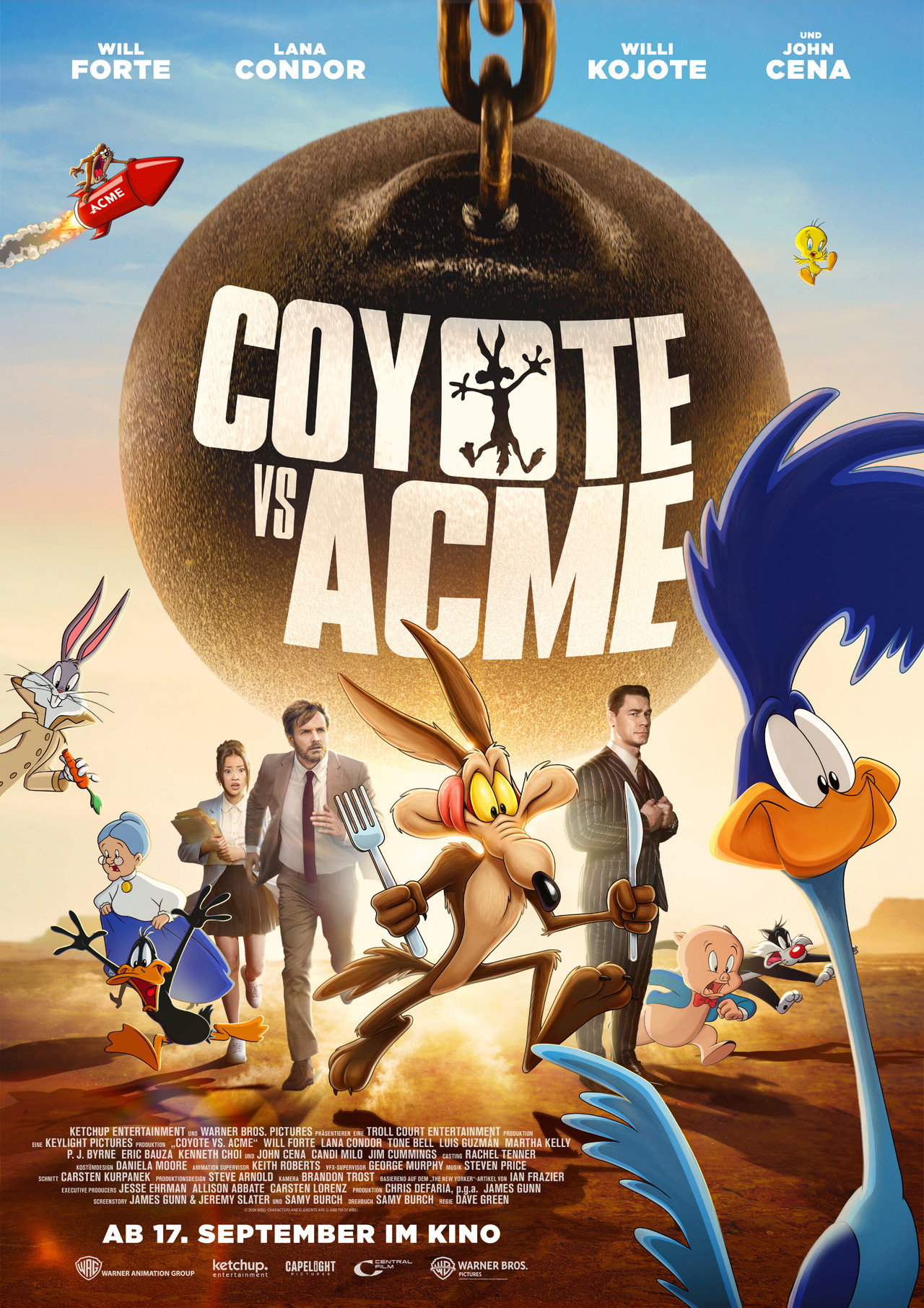
The Verdict
The Nerdiction verdict: Coyote vs. ACME – The Looney Tunes Courtroom Verdict is good and receives 78 out of 100 points.
Pro
- Near‑perfect critical consensus (95 % on Rotten Tomatoes) and strong audience response
- Compelling blend of Looney Tunes slapstick with a legal‑drama storyline that broadens appeal
- Stunning visual effects marrying classic cartoon style with cutting‑edge CGI
Contra
- Wile E. Coyote’s character depth remains superficial, lacking exploration of his cunning side
- Will Forte’s performance as Kevin Avery is seen as one‑note and limited
- The hungry, predatory aspect of Coyote is underused and underexplored
Videos & Trailers
Loading video…
Loading video…
Details
August 20, 2026
1h 41m
7.8
/ 10(70 votes)173.5
Genres
Production Companies
Production Countries
Spoken Languages
Cast
Table of Contents
Introduction | Plot & Narrative | Acting & Characters | Direction & Cinematography | Music & Sound Design | Visual Effects & Technical Craft | Themes & Message | Comparison with Similar Films | Who Is This Film For? | Verdict
Introduction
The new family adventure film Coyote vs. ACME hits screens in August 2026 and promises a comical courtroom showdown starring the iconic Looney Tunes characters. Produced by the Warner Animation Group, the project carries the weight of a film that was controversially shelved in 2024 before resurfacing to break records. Early buzz highlights a movie that blends classic Wile E. Coyote chaos with a surprisingly earnest legal premise—the coyote’s lawsuit against the ACME Corporation for products that repeatedly foil his hunt. The film aims to deliver a family‑friendly comedy‑action hybrid with a fresh spin on a beloved character, potentially marrying nostalgia with modern storytelling. Whether the promised laughs and emotional depth can sustain the hype is what we’ll explore in this in‑depth review. Below, we dive into the narrative, performances, direction, sound, visual effects, themes, genre comparisons, target audience, and final judgment. Let’s begin.
Plot & Narrative
Based on the official synopsis, the story follows Wile E. Coyote, who, after years of fruitless attempts to outsmart ACME’s ever‑failure‑prone gadgets, decides to sue the corporation for product liability. He hires the ambitious lawyer Kevin Avery, only to discover that ACME’s legal department is headed by Buddy Crane— the self‑confident boss of his former law firm and a personal rival. The film uses this professional clash as a central conflict, tracking the coyote’s quest to win the trial while also confronting his own limitations. The narrative blends slapstick chaos with courtroom drama, relying on witty dialogue between Kevin’s unconventional legal team and ACME’s eccentric executives. Even after the rejected story arc, the pacing remains brisk, mixing visual gags with comedic exchanges that aim to entertain both kids and adults who love Looney Tunes. The storyline keeps the tension high, balancing the physical humor of the coyote’s mishaps with the seriousness of a legal battle, ultimately delivering a family‑friendly experience that feels both nostalgic and fresh.
Acting & Characters
The cast includes Will Forte as Kevin Avery, Lana Condor as Paige Avery, John Cena as Buddy Crane, Tone Bell as Sal Maltese, Martha Kelly as Dottie Jones, Luis Guzmán as Judge Troppogrosso, P.J. Byrne as Bill Pellicano, and John Early as Henry Heslop. The lead role of Wile E. Coyote is performed by Will Forte, reprising his familiar, wordless discontent. Critics note a strong chemistry between Forte and Condor as the Avery duo, with their banter providing heartfelt moments. John Cena brings gravitas as Buddy Crane, his performance precise and commanding. Supporting actors like Tone Bell add comedic lightness as Sal Maltese, while the rest of the ensemble fills out the legal courtroom setting. While the story invests in Kevin’s determination, the development of Wile E. Coyote’s character feels one‑dimensional, with critics pointing out that the hungry predator side of the coyote is underexplored. Nevertheless, the cast delivers solid entertainment, especially in the comedic set‑pieces that drive the film’s humor.
Direction & Cinematography
Dave Green helms Coyote vs. ACME, balancing drama and comedy with a kinetic sense of timing. The camera work marries vibrant, cartoon‑style environments with the intensity of a courtroom drama, accentuating both the film’s comical and serious beats. Editing cuts are brisk, capturing the rapid-fire slapstick of the coyote’s mishaps while allowing the legal proceedings a measured pace. The visual aesthetic fuses classic Looney Tunes illustration with modern CGI, creating a timeless feel that honors the source while feeling contemporary. Production design showcases ACME’s satirical corporate world—glamorous yet chaotic offices that underscore the film’s parody of big‑business. Green also creates moments of quiet tension during the trial, making these scenes as compelling as the physical gags. The interplay of camera, cutting, and design establishes a consistent tone that swings between light‑hearted fun and poignant drama, leaving the visual style both memorable and engaging.
Music & Sound Design
The soundtrack merges classic Looney Tunes whistling and scoring with a modern orchestral layer, reinforcing the film’s timeless comedy. The music underscores action sequences with high energy while providing melodic piano motifs for courtroom moments, adding emotional depth without overwhelming the narrative. Sound effects retain the iconic “thwack,” “meep‑meep,” and cartoonish noises, integrating them into realistic audio formats that feel both authentic and newly interpreted. Dialogue remains clear and crisp, ensuring witty lines are audible even amid chaotic scenes, while serious moments retain their gravitas. The sound mix balances volume perfectly during high‑octane chases, never letting dialogue get drowned out, and the music enhances emotional engagement without becoming intrusive. The design maintains the cartoonish illusion while grounding the story in a believable soundscape, contributing heavily to the film’s immersive quality.
Visual Effects & Technical Craft
Visually, the film is a triumph, marrying classic toon style with cutting‑edge CGI. The most striking elements are the animated ACME products—rendered with imaginative flair and showcasing their repeated failures with humorous precision. Environments are colorful and dynamic, featuring intricate set designs that both parody and celebrate corporate excess. The technical execution of the coyote’s movement remains impressive, allowing fluid, exaggerated physics as he navigates obstacles. Road Runner’s animation showcases fine texture work and lively eyes, adding personality. Lighting and shadow work add depth, making scenes feel three‑dimensional. The visual effects reinforce the story’s parody, offering jokes that work both for kids and adults. Strategic placement of image placeholders highlights key visual beats, such as the climactic clash between Coyote and ACME’s gadget arsenal.
Themes & Message
Beneath the comedy, Coyote vs. ACME explores a few underlying themes. The underdog taking on a massive corporation mirrors classic triumph‑over‑adversity tales, encouraging younger viewers to stand up for justice. The narrative also touches on perseverance after repeated failure—Kevin’s journey reflects the universal experience of bouncing back. The mentor‑rival dynamic adds layers of professional ethics, appealing to older audiences. The film avoids heavy moralizing, instead celebrating chaos and creativity as tools for overcoming obstacles. Its social relevance—commenting on product liability and corporate accountability—adds contemporary resonance, making it both a nostalgic treat and a subtly aware piece. The overall message is upbeat: humor and determination can solve many problems.
Comparison with Similar Films
When measuring Coyote vs. ACME against similar Looney Tunes adventures, it distinguishes itself with its legal‑drama twist. While The Day the Earth Blew Up leans more heavily into slapstick, this film balances comedy with a courtroom storyline. It also recalls Space Jam: A New Legacy and Flinstones: The Movie for blending classic cartoons with modern action. The visual design hints at The Day the Earth Blew Up’s aesthetic but with a stronger narrative focus. The mix of contemporary pacing and traditional cartoon storytelling could position it as a hallmark entry for the genre.
Who Is This Film For?
Coyote vs. ACME is ideal for families, children, and anyone nostalgic for Looney Tunes. It offers moments of action and slapstick that appeal to younger viewers, while its subtle satire and character dynamics give adults something to appreciate. The 101‑minute runtime fits well for a matinee or weekend outing, and the family‑friendly rating makes it suitable for all ages. Strong audience scores (near‑perfect Rotten Tomatoes rating) and solid box‑office returns indicate broad appeal, making it a worthwhile watch both in theaters and on streaming platforms. Its high production values and universal resonance provide good value for money.
Verdict
Coyote vs. ACME delivers a satisfying blend of Looney Tunes slapstick and legal drama, catering to both nostalgic fans and new viewers. Its strengths lie in an impressive critical consensus (95 % Rotten Tomatoes), crisp direction, vibrant visual design, and crowd‑pleasing humor. While the depth of Wile E. Coyote’s character and some performances, particularly Will Forte’s, feel limited, the film compensates with energy, laughs, and a clear message. Sound and music enhance both comic and dramatic moments, and the production design’s satirical take on corporate greed adds layers of meaning. The film’s top five pros include its near‑perfect critical reception, compelling mix of comedy and drama, stunning visual effects, solid family‑friendly entertainment, and strong audience engagement. Its five cons are the shallow development of Coyote’s multifaceted personality, Forte’s one‑note performance, the underexplored hungry predator side of the coyote, occasional logic gaps in the plot, and a soundtrack that, while effective, lacks emotional breadth. An overall score of 78/100 reflects the film’s high quality while acknowledging areas where it could have pushed further. If you’re looking for an entertaining, family‑oriented escape that cleverly blends classic cartoon chaos with a modern courtroom twist, Coyote vs. ACME is well worth your time.
Rating: 78/100
Das könnte dich auch interessieren
Weitere Reviews aus der Kategorie movie.

Matchbox: Der Film – Spielzeug-Abenteuer zwischen Action, Humor und zähem Ensemble
Inhaltsverzeichnis [Einleitung]( einleitung) [Handlung & Erzählung]( handlung und erzaehlung) [Schauspiel & Charaktere]( schauspiel und charaktere) [R…

Digger – Tom Cruises ambivalente Satire über Macht und Untergang
Inhaltsverzeichnis [Einleitung]( einleitung) [Handlung & Erzählung]( handlung und erzaehlung) [Schauspiel & Charaktere]( schauspiel und charaktere) [R…

Resident Evil (2026): Eine unfassbar fesselnde Neuinterpretation des Kult-Horrors
Inhaltsverzeichnis [Einleitung]( einleitung) [Handlung & Erzählung]( handlung erzählung) [Schauspiel & Charaktere]( schauspiel charaktere) [Regie & In…
Frequently Asked Questions
How good is Coyote vs. ACME – The Looney Tunes Courtroom Verdict?
Coyote vs. ACME – The Looney Tunes Courtroom Verdict wurde von Nerdiction mit 78 von 100 Punkten bewertet und ist damit good.
What are the pros of Coyote vs. ACME – The Looney Tunes Courtroom Verdict?
The advantages of Coyote vs. ACME – The Looney Tunes Courtroom Verdict: Near‑perfect critical consensus (95 % on Rotten Tomatoes) and strong audience response, Compelling blend of Looney Tunes slapstick with a legal‑drama storyline that broadens appeal, Stunning visual effects marrying classic cartoon style with cutting‑edge CGI, Solid performances from an ensemble cast that sustain humor throughout, Family‑friendly runtime and rating making it suitable for a wide audience.
What are the cons of Coyote vs. ACME – The Looney Tunes Courtroom Verdict?
The disadvantages of Coyote vs. ACME – The Looney Tunes Courtroom Verdict: Wile E. Coyote’s character depth remains superficial, lacking exploration of his cunning side, Will Forte’s performance as Kevin Avery is seen as one‑note and limited, The hungry, predatory aspect of Coyote is underused and underexplored, Some plot logic gaps in ACME’s gadgets and courtroom procedures can disrupt immersion, Soundtrack, while effective, offers limited emotional range in key scenes.
Is Coyote vs. ACME – The Looney Tunes Courtroom Verdict worth it?
Yes. Coyote vs. ACME – The Looney Tunes Courtroom Verdict received a score of 78/100 points and is good.