The Verdict
The Nerdiction verdict: Chainsmoker Cat Review – An In‑Depth Analysis of the Quirky Anime Series is excellent and receives 82 out of 100 points.
Pro
- Authentic and nuanced portrayal of addiction and social precarity through the protagonist Yani.
- Strong voice‑acting performances, especially Yuko Natsuyoshi’s multifaceted interpretation of Yaniko.
- Distinctive visual style from Bibury Animation Studios featuring vivid colours and expressive character designs.
Contra
- Episodic structure may feel repetitive for viewers who prefer continuous narrative tension.
- Absence of major plot twists or an overarching mythology lowers re‑watch value for some fans.
- Explicit depictions of smoking can trigger discomfort among sensitive audience members.
Details
July 3, 2026
1
12
Returning Series
August 14, 2026
8.5
/ 10(52 votes)47.1
Genres
Production Companies
Production Countries
Spoken Languages
Cast
Table of Contents
- Introduction
- Plot & Setting
- Characters & Acting
- Seasons & Episode Structure
- Direction, Cinematography & Visuals
- Music & Sound Design
- Themes & Depth
- Comparison with Similar Series
- Binge-worthiness
- Verdict
Introduction
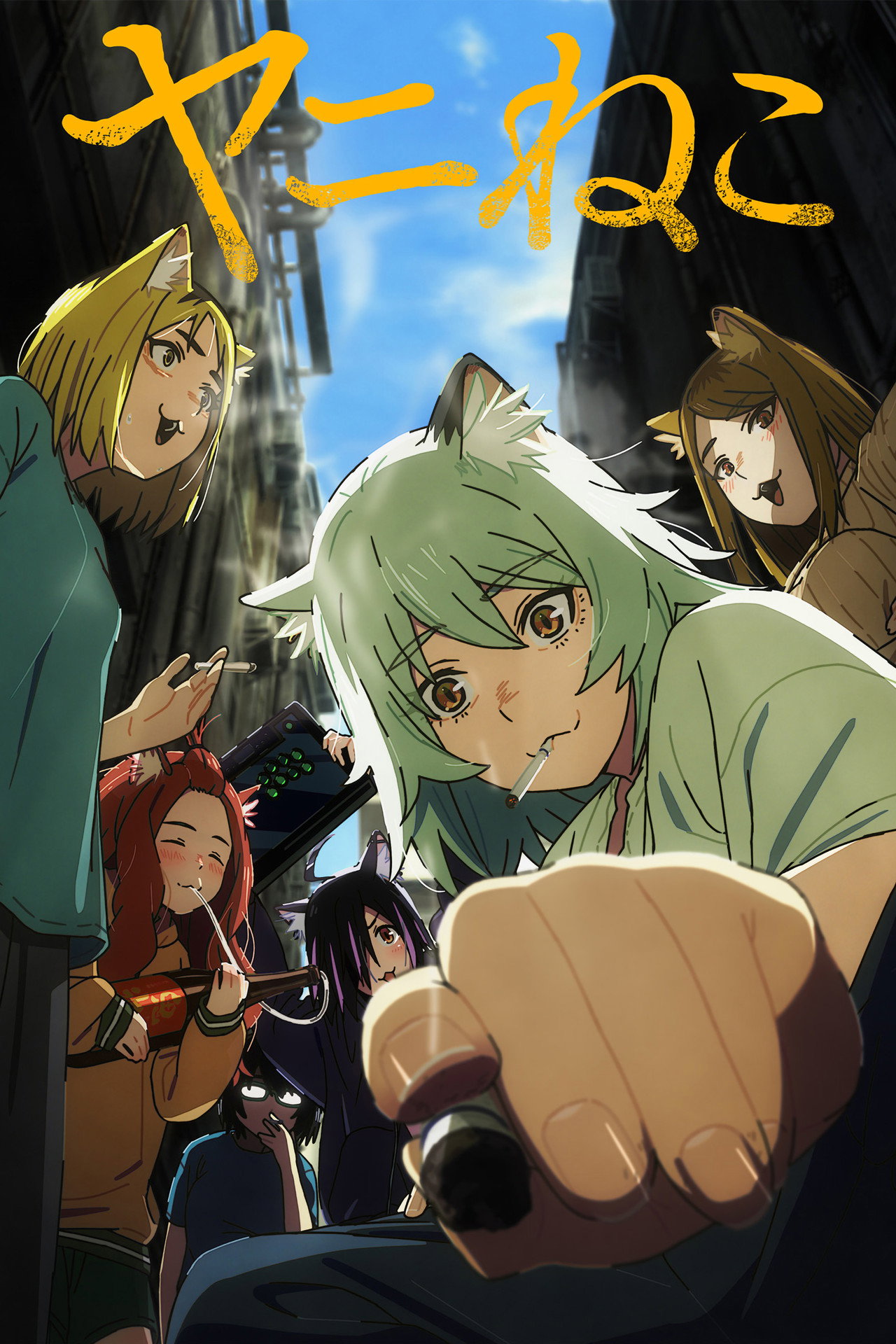
Chainsmoker Cat premiered in July 2026 and immediately attracted attention, not only because of its provocative title but also due to its unusual premise of a smoking catgirl protagonist. The series was produced by Bibury Animation Studios, a name already known for works such as Witch Watch and The 100 Girlfriends Who Really, Really, Really, Really, Really Love You. Consequently, the studio emphasized a highly expressive character design and a vivid, at times exaggerated aesthetic. The show first aired on Tokyo MX and later became available on international streaming platforms, quickly reaching a global audience. Although TMDB lists an average rating of 8.5/10, discussions in fan forums and reviews reveal a divided response: some praise the bold style and the honest portrayal of addiction and social decline, while others criticize the explicit depiction of smoking as problematic. This contrast makes Chainsmoker Cat an interesting case study of how an anime can generate niche appeal while simultaneously sparking broader societal debates. In this review we will examine the series comprehensively, sticking strictly to the available facts and avoiding speculative details.
Plot & Setting
The central figure of Chainsmoker Cat is Yaniko ‚Yani‑Neko‘ Satō, a young catgirl whose nicotine‑dependent lifestyle makes it difficult for her to pay rent and keep a steady job. The story takes place in a contemporary urban setting that contains realistic elements such as housing markets and part‑time work, yet it is simultaneously loosened by over‑the‑top visual gags and surreal dream sequences. The narrative follows a largely episodic slice‑of‑life approach, with each episode observing Yani as she tries to balance her social obligations with her smoking habit. No major plot twist is revealed; instead the focus lies on the gradual escalation of her problems and the small glimmers of hope that arise from friendships and familial support. The setting is deliberately kept general, allowing viewers to recognize Yani’s challenges as a mirror of universal youthful insecurity without relying on specific cultural references that could hinder understanding. By maintaining this deliberate generality the series manages to sketch a concrete milieu while still leaving room for interpretation.
Characters & Acting
The voice cast of Chainsmoker Cat consists of seasoned actors who each bring a distinctive nuance to their roles. Yuko Natsuyoshi voices Yaniko and manages to convey both the vulnerable side of a young woman struggling with existential anxieties and the dry, sometimes sarcastic tone of a cat‑person who uses smoking as a coping mechanism. Misato Matsuoka voices Masuko ‚Yaku-Neko‘ Koshijimaru, Yani’s best friend, whose relaxed demeanor and humorous comments frequently serve as a counterweight to Yani’s self‑doubt. 船戸ゆり絵 gives Yurufuwa*Tenshi ‚Hame-Neko‘ Hameko a somewhat naïve‑optimistic voice that occasionally drifts into absurd fantasies, providing comic relief. Ayaka Shimizu as Kaoruko ‚Kansai-Neko‘ Nishi adds a stronger dialectal flavor, bringing regional cultural nuances into the mix, while Shiori Izawa as Aruko ‚Al-Neko‘ Sakai takes on the role of the calm, thoughtful confidante. 明智璃子 as Tatsurō Ochinpo and Tetsu Inada as the landlord supply supporting figures that further expand Yani’s social environment. Finally, Rina Honnizumi as Imoko rounds out the ensemble by portraying a younger sister or neighbour who occasionally questions Yani’s impulsive actions. The chemistry within the ensemble emerges from the contrasting personality traits: while some characters present smoking as a social taboo, others display a degree of understanding or even normalization, thereby delivering a nuanced picture of interpersonal dynamics.
Seasons & Episode Structure
Chainsmoker Cat currently consists of one season comprising twelve episodes, each roughly twenty minutes long. The season lacks an overarching mythology and is strictly episodic: each episode presents a self‑contained problem that Yani faces – whether it is a job interview, a dispute with the landlord, or a social gathering where smoking becomes a strain. The pacing is deliberately measured to mirror the everyday rhythm of the protagonist; there are hardly any action sequences, with the focus placed on dialogue and internal monologues that are often visualized through inner voice or visual metaphors. Because there are no season‑long arcs, the viewing experience can feel like a long stream of everyday scenes, whereby individual episodes work on their own while together forming a cohesive picture of Yani’s gradual self‑understanding. Filler material is hardly noticeable, as almost every scene either advances character development or deepens a theme; there is little pure comedy that exists solely for laughs without offering further insight. This structure supports the slice‑of‑life approach and gives viewers the chance to follow Yani’s small successes and setbacks over the twelve‑episode run.
Direction, Cinematography & Visuals
Although no single director is credited, the overall direction of Chainsmoker Cat aligns with the style associated with Bibury Animation Studios, characterized by clean lines, vibrant colour palettes and a tendency to exaggerate facial expressions for comic effect. The virtual camera work within the 2‑D animation frequently employs close‑ups to highlight the fine details of Yani’s expression, especially when she holds a cigarette or when her face is surrounded by smoke. At the same time, wide shots are used to show the urban surroundings, with background details often simplified to keep the focus on the characters. Editing is predominantly calm, featuring few rapid cuts; instead, longer takes dominate, allowing the mood of a scene to be fully absorbed. The colour scheme leans toward warm tones in scenes of comfort – for example, during gatherings with friends – and shifts to cooler, slightly desaturated hues in moments of loneliness or financial strain. This conscious colour separation supports the emotional undercurrent without becoming overbearing. Additionally, occasional surreal dream sequences appear, where the borders between reality and imagination blur, granting the series its distinct visual signature.
Music & Sound Design
The soundtrack of Chainsmoker Cat remains mostly in the background, consisting mainly of light, electronically tinged pieces that underscore the everyday action without demanding attention. In moments of heightened tension – for instance, when Yani faces an important interview or feels financial pressure – the composition slightly raises the tempo and employs repetitive motifs that create a sense of urgency. Conversely, in scenes of relaxation or friendship, softer chords and gentle melodies are used to convey a feeling of safety. Sound design also plays a crucial role: the distinctive crackle of a lighter, the soft hiss during inhalation and the audible exhale of smoke are deliberately made audible, so that the smoking habit is not only visible but also perceptible through sound. This acoustic detail enhances the immersive quality of the series and ensures that smoking is perceived as part of the protagonist’s sensory experience rather than a mere visual gag. Ambient noises – the hum of city traffic, the chime of doorbells, the distant murmur of neighbours – are carefully mixed to convey a credible urban atmosphere.
Themes & Depth
Chainsmoker Cat explores several profound themes that go beyond the simple motive of smoking. The most obvious aspect is the portrayal of addiction and its impact on daily functioning: Yani’s repeated attempts to quit smoking are set against the backdrop of her financial insecurity and her desire for social acceptance. This links neatly to the theme of self‑esteem, as Yani often feels she is not doing enough to meet either her own expectations or those of her loved ones. Another central point is social precarity: the series shows how a lack of financial stability and precarious employment can undermine the self‑image of young people. At the same time, the theme of friendship and familial support is examined, with Yani’s close bonds to Masuko, Hameko and others acting as a buffer against her decline. Furthermore, the series questions society’s view of smoking: while it does not glorify the habit, it shows how it can function as a coping mechanism, thereby creating an ambivalent space that is neither outright condemnation nor uncritical acceptance. Finally, an existential undertone emerges, asking how young people deal with uncertainty and which means they find to regain a sense of control. These themes are conveyed not through didactic monologues but through the characters’ everyday actions and subtle interpersonal interactions, allowing the series’ depth to arise organically.
Comparison with Similar Series
Compared to other slice‑of‑life anime, Chainsmoker Cat stands out chiefly due to its explicit focus on a controversial behaviour – smoking – and the associated social stigma. Series such as "Barakamon" or "Non Non Biyori" concentrate on idyllic rural settings and interpersonal warmth without dark societal undertones. Even "Wotakoi: Love is Hard for Otaku", although it deals with everyday topics of young adults, puts stronger emphasis on romance and hobby‑obsession rather than on addictive behaviour. In the realm of more experimental titles, the visually daring approach of Chainsmoker Cat recalls works like "Paprika" or "Mind Game", although the present series remains far more grounded in everyday life and relies less on surreal narratives. An interesting point of comparison is "Aggretsuko", which likewise portrays protagonists coping with stress – there the outlet is karaoke singing, whereas here smoking assumes the central role. Despite these similarities, Chainsmoker Cat maintains a unique position within the contemporary anime landscape owing to its frank depiction of smoking and its somewhat critical stance toward prevailing social norms.
Binge-worthiness
The binge‑factor of Chainsmoker Cat derives less from cliff‑hanging plot twists and more from the authentic rendering of the protagonist’s everyday struggle, which invites viewers to watch episode after episode to see whether Yani makes progress or suffers setbacks. The measured tempo and the absence of exaggerated action sequences make it easy to consume several instalments in succession without feeling overwhelmed. Thanks to the compact episode length of about twenty minutes, the whole season can be watched in a single sitting of roughly four hours, making it a suitable candidate for a relaxed binge‑watching weekend. At the same time, the recurring motif of smoking may be burdensome for some viewers, so shorter sessions might be preferable to avoid emotional fatigue. Overall, waiting for a potential second season is worthwhile, provided the creators decide to further develop the already introduced themes while preserving the balance between critical depiction and hopeful outlook.
Verdict
Chainsmoker Cat presents itself as a brave and yet contradictory anime work that draws immediate attention through its unconcentration on a smoking catgirl heroine. Its strengths lie in the authentic characterisation, the convincing voice performances – especially Yuko Natsuyoshi’s layered portrayal of Yaniko – the clear visual identity of Bibury Animation Studios and the serious treatment of topics such as addiction, social precarity and interpersonal support. Weaknesses appear in the somewhat repetitive episodic structure, the lack of surprise elements for viewers seeking complex story arcs and the potentially triggering nature of smoking depictions for sensitive audiences. Considering the TMDB score of 8.5/10 and the generally positive reception in specialist circles, a rating of 82/100 seems appropriate: this figure reflects the solid quality of the execution while acknowledging the controversial aspects that may limit universal appeal. For anyone interested in sincere, character‑driven narratives who is willing to reflect critically on the theme of smoking, Chainsmoker Cat offers a worthwhile and thought‑provoking viewing experience.
Das könnte dich auch interessieren
Weitere Reviews aus der Kategorie series.
Among Us
Exzentrische, einfarbige Besatzungsmitglieder eines Mülltransport Raumschiffes müssen einen Verräter enttarnen, bevor sie selbst Opfer seines mörderis…

Stuart versucht, das Universum zu retten – Eine amüsante Sci-Fi-Serie mit einer ungewöhnlichen Heldengruppe
Inhaltsverzeichnis [Serienkontext]( serienkontext) [Spoilerfreie Prämisse]( spoilerfreie prämisse) [Hauptfiguren]( hauptfiguren) [Erzählstruktur]( erz…
The East Palace (동궽): Eine faszinierende Mischung aus Mystik und Politik
Inhaltsverzeichnis Serien Einordnung und Produktionshintergrund Prämisse ohne Spoiler Charaktere und ihre Entwicklung Erzählstruktur und Pacing Inszen…
Frequently Asked Questions
How good is Chainsmoker Cat Review – An In‑Depth Analysis of the Quirky Anime Series?
Chainsmoker Cat Review – An In‑Depth Analysis of the Quirky Anime Series wurde von Nerdiction mit 82 von 100 Punkten bewertet und ist damit excellent.
What are the pros of Chainsmoker Cat Review – An In‑Depth Analysis of the Quirky Anime Series?
The advantages of Chainsmoker Cat Review – An In‑Depth Analysis of the Quirky Anime Series: Authentic and nuanced portrayal of addiction and social precarity through the protagonist Yani., Strong voice‑acting performances, especially Yuko Natsuyoshi’s multifaceted interpretation of Yaniko., Distinctive visual style from Bibury Animation Studios featuring vivid colours and expressive character designs., Effective use of sound design that makes the smoking habit acoustically tangible and enriches the atmosphere., Thought‑provoking themes such as friendship, self‑esteem and coping mechanisms that arise organically from the story..
What are the cons of Chainsmoker Cat Review – An In‑Depth Analysis of the Quirky Anime Series?
The disadvantages of Chainsmoker Cat Review – An In‑Depth Analysis of the Quirky Anime Series: Episodic structure may feel repetitive for viewers who prefer continuous narrative tension., Absence of major plot twists or an overarching mythology lowers re‑watch value for some fans., Explicit depictions of smoking can trigger discomfort among sensitive audience members., Certain comedic moments appear overstated and could dilute the series’ more serious themes., The show’s deliberate generality means that specific cultural nuances are less pronounced..
Is Chainsmoker Cat Review – An In‑Depth Analysis of the Quirky Anime Series worth it?
Yes. Chainsmoker Cat Review – An In‑Depth Analysis of the Quirky Anime Series received a score of 82/100 points and is excellent.