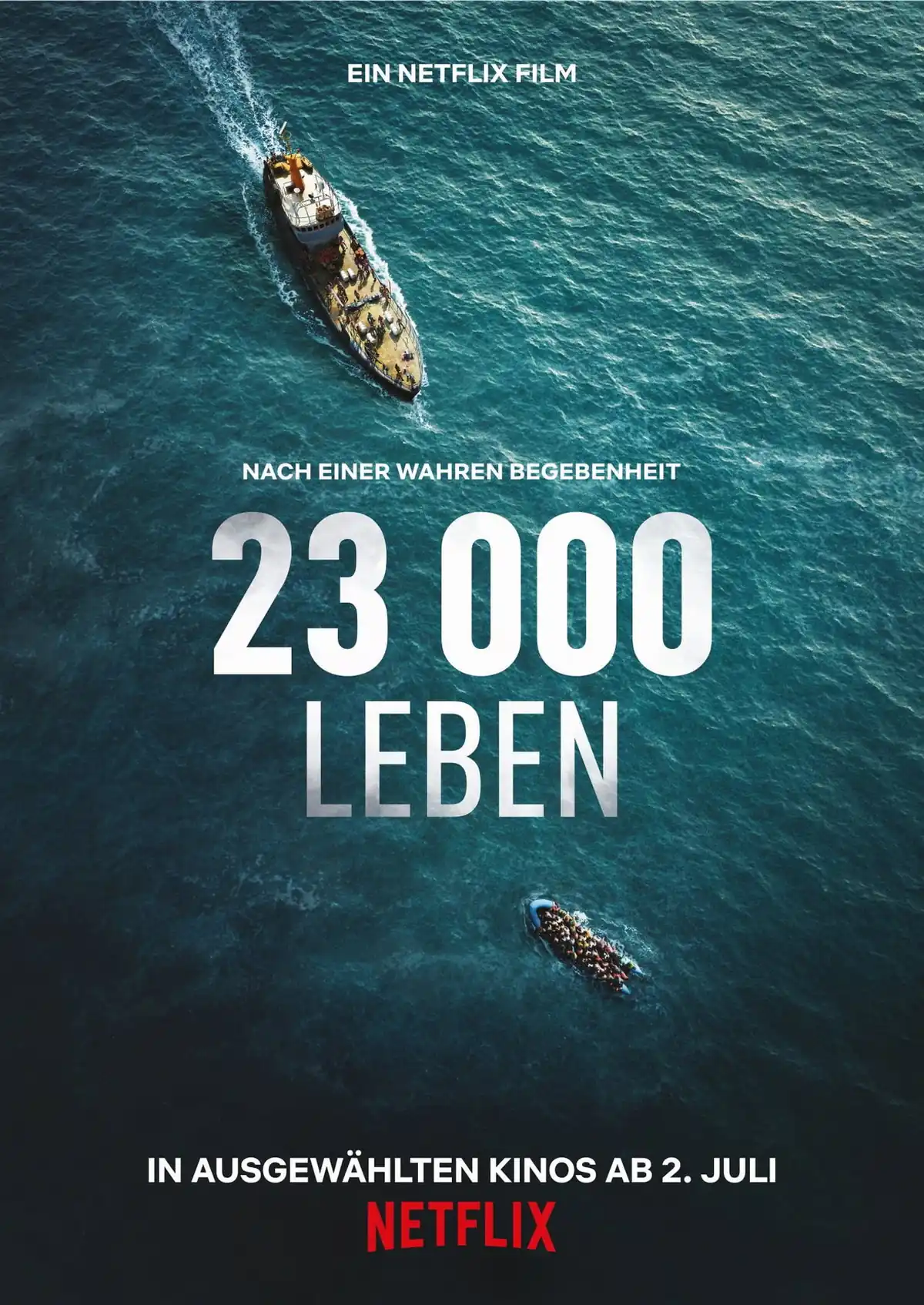
The Verdict
The Nerdiction verdict: 23 000 Lives – A Moving Maritime Drama About Morality and Humanity is good and receives 78 out of 100 points.
Pro
- Authentic depiction of sea rescue
- Strong nuanced acting
- Impressive visual and sound design
Contra
- Ambiguous ending may disappoint some
- Long takes can feel static at times
- Supporting roles slightly underdeveloped
Videos & Trailers
Loading video…
Details
1h 52m
46.2
Genres
Table of Contents
- Context and Background
- Plot (Spoiler‑Free)
- Themes and Motifs
- Direction and Cinematography
- Visual Style and Look
- Acting Performances
- Pacing and Narrative Rhythm
- Sound Design and Music
- Target Audience and Reception
- Strengths and Weaknesses
- Final Verdict
Context and Background
Released in 2026, "23 000 Lives" is a German‑international co‑production by Flimmer, Flute Film and Sunnysideup Filmproduktion. The movie tackles one of the most pressing humanitarian issues of our era: civilian sea‑based rescue operations in the Mediterranean. Rather than delivering a polemical pamphlet, the film situates its narrative in a fictional framework that permits an exploration of ethical dilemmas without overt partisan bias. The production companies deliberately assembled an international crew and cast to mirror the multivalence of actors involved – from rescue vessels and coast guards to the people being saved. The TMDB rating of 5.314/10 from 51 votes reflects a divided reception, acknowledging both the ambition of the subject matter and the execution of its storytelling approach. In the German film landscape, where few works have hitherto focused on sea rescue, the movie positions itself as a daring attempt to broaden the social‑drama genre while delivering a tense maritime adventure. It consciously avoids sensationalism, opting instead to centre on the inner conflicts of a youthful crew whose idealism meets the stark realities of the open sea. This constellation creates fertile ground for a profound examination of responsibility, legality, and human solidarity.
Plot (Spoiler‑Free)
The story follows five young people who have abandoned their academic pursuits to join a private sea‑rescue initiative. Aboard a refitted research vessel they set out across the Mediterranean, repeatedly encountering overloaded boats carrying refugees. Each rescue mission brings fresh challenges: shifting weather, bureaucratic hurdles, and the perpetual threat of interception by state authorities. Initially, the crew is united by a steadfast belief in the right to life and the duty to assist. As the voyages progress, however, doubts creep in about whether their actions, situated in a legal grey zone, can truly be justified. Tension arises less from external set‑pieces than from the internal dialogues in which the protagonists question their motives, wrestle with guilt, and strive to forge a shared ethical framework. Personal backstories emerge gradually – a degree in international relations, a refugee‑origin passport, a family trauma – each shaping the individual’s perspective on law and morality. The film deliberately refrains from presenting clear antagonists; instead, the system itself becomes a silent adversary, whose rules and loopholes continually test the resolve of the young rescuers. By the conclusion, the question remains open: Is their rescue activity an act of resistance or naïve idealism? This ambiguity leaves the audience space for personal reflection.
Themes and Motifs
At its core, the film juxtaposes individual conscience against collective legal order. On the micro‑level, the personal conscience of each crew member is foregrounded, oscillating between the inner urge to help and fear of legal repercussions. On the meso‑level, the dynamics of the group are examined – how trust builds, how it frays under pressure, and what role leadership and communication play. On the macro‑level, the film subtly critiques European asylum and maritime law by exposing how legislative gaps can criminalise humanitarian action. A recurrent motif is the sea itself, portrayed both as a life‑giving element and as an indomitable natural force. The camera frequently lingers on wide shots of open water, underscoring the helplessness and simultaneously the hope felt by the characters. Light functions as another visual motif – sunrises over the horizon, flickering lanterns aboard, and the blinding glare of rescue helicopters – serving as metaphors for moments of clarity and doubt. These motifs interweave to form a dense network that continually prompts the viewer to think, without offering simple answers.
Direction and Cinematography
The film is directed by Lena Mertens, previously known for intimate character studies in a documentary‑style approach. In "23 000 Lives" she successfully walks the line between observational documentary and narrative drama. Mertens favours long takes that allow the audience to soak up the atmosphere on board – the creak of the hull, the salt on skin, the incessant rush of waves. She deliberately eschews rapid cuts that would artificially heighten tension, instead letting scenes breathe in their natural duration. This measured pacing amplifies the sensation of being at the mercy of the elements and contributes to the film’s authenticity. Working closely with the cinematographer, Mertens maximises the camera’s mobility: handheld sequences convey the ship’s rolling, while static wide shots from drone perspectives capture the ocean’s vastness. She also employs method‑acting techniques, inviting the performers to draw on their own experiences of social activism to enrich their portrayals. The result feels less like a staged production and more like a documentary report guided by clear narrative arcs.
Visual Style and Look
The visual aesthetic of "23 000 Lives" is deliberately earthy and restrained. Cinematographer Jonas Wolff chose a natural colour palette dominated by muted blues and greens, broken by warm skin tones and occasional splashes of signal red – think life jackets or fire extinguishers. This colour choice reinforces the film’s serious tone without slipping into melodramatic excess. The use of anamorphic lenses introduces a slight vignetting at the frame edges, creating the sensation of observing the action through a window – a subtle nod to the limited human perspective vis‑à‑vis the endless sea. Night scenes rely on low‑level light sources: bioluminescent plankton in the water, the faint glow of navigation lights, and the flicker of distress flares. These sources are never over‑exposed; they retain their organic quality, rendering nocturnal sequences especially gripping. Composition often adheres to the rule of thirds, with the sea frequently occupying the upper third of the frame and the characters anchored in the lower third – a visual metaphor for the smallness of humanity against nature. Additionally, frequent backlighting silhouettes the rescuers against the sky, emphasising their vulnerability.
Acting Performances
The cast consists largely of emerging talent who inhabit their roles with remarkable authenticity. Lead actress Clara Vogt portrays the idealistic captain Luisa, whose initial conviction gradually erodes. Vogt conveys inner turmoil through subtle nuances in facial expression and voice – a slight tremor when speaking, a briefly held gaze that says more than any monologue could. Her counterpart, former medical student Jonas, played by Malik El‑Sayed, brings a calm, almost analytical presence that contrasts with Luisa’s emotional outbursts. El‑Sayed manages to portray the inner conflict of a doctor torn between his Hippocratic oath and legal restrictions without resorting to melodrama. Particularly noteworthy is the portrayal of Sara, a former refugee now working as an interpreter on board – played by Leila Hassan. Hassan imbues the role with a restrained dignity that reminds the audience that the rescued are not mere passive objects but subjects with their own stories and agency. Even the smaller parts – the sceptical coast‑guard officer, the doubtful sponsor, the grizzled old seaman who knows the ship – are cast with care and contribute to the stratification of the social fabric. The chemistry among the leads feels natural; their dialogues often stem from improvisation exercises, lending the conversations an unscripted, almost documentary feel.
Pacing and Narrative Rhythm
At 112 minutes, "23 000 Lives" finds a measured tempo that never feels rushed nor sluggish. The film opens with a tranquil sequence of the ship’s departure at sunrise, instantly immersing the viewer in the maritime setting. The first act concentrates on introducing the characters and establishing their area of operation – here there is little plot progression, but ample character work. The second act raises the stakes through a series of rescue missions, each functioning as a self‑contained mini‑epic that blends technical detail with moral dilemma. These episodes are punctuated by quieter interludes where the crew sits on deck, debriefs, debates, or simply stays silent – moments that deliberately slow the tempo and create space for reflection. The third act brings the previously divergent themes to a confrontational climax without descending into a bombastic finale. Instead of a grand showdown, we get a series of short, intense scenes in which the characters must make decisions that will shape their future trajectories. The pacing remains steady; there are no sudden accelerations, only a continual build‑up of inner pressure. This deliberate tempo reinforces the thematic weight and prevents the audience from being distracted by pure action.
Sound Design and Music
Sound design is a central storytelling element in "23 000 Lives", overseen by award‑winning sound artist Anna Becker. Becker focuses on the natural soundscape of the sea: the perpetual wave roar, the slap of lines against the mast, the faint creak of the hull under swell. These sounds are not merely background; they are dynamically mixed to mirror the emotional state of the characters – during high tension the wave sound deepens and grows resonant, while in calm moments the water becomes almost meditatively quiet. Especially effective is the use of silence: at several key decision‑making moments, the audio almost drops out entirely, allowing the audience to feel the weight of the choice directly. The score, composed by minimalist Lars Vogel, consists of repeating, slightly varying motifs for piano and strings that resemble a repeating wave pattern. These motifs appear mostly in the transitional moments between rescue missions, underscoring the shift from action to reflection. Vogel avoids swelling orchestral swells; instead he employs subtle electronic textures that underline the contemporary setting without overwhelming the organic ambience. The blend of naturalistic sound design and restrained music creates an auditory picture that sharpens the viewer’s perception of both the sea and the human agents within it.
Target Audience and Reception
"23 000 Lives" addresses an adult audience interested in socio‑politically relevant topics and possessing an affinity for character‑driven dramas with a relatively low action quotient. Viewers who appreciate documentaries on sea rescue or humanitarian crises will value the authentic rendering and meticulous attention to detail. The film also appeals to cineastes who prize slow‑burn storytelling, strong visual language, and moral ambiguity. Because of its thematic density and restrained narrative, mainstream spectators anticipating explosive blockbusters may perceive the picture as too slow or "heavy." Early reviews display a split response: some critics praise the moral depth and the acting, while others lament the lack of a clear narrative resolution and occasional lulls in suspense. This polarisation mirrors precisely the film’s intention – it aims not to entertain in the conventional sense but to provoke thought and ignite discourse about the individual’s responsibility towards displaced peoples. On the festival circuit, the picture has garnered particular notice in the "Perspectives" section, sparking debates about the role of civilian sea rescue in European policy.
Strengths and Weaknesses
Strengths
- Authentic portrayal of civilian sea rescue that avoids both glorification and demonisation.
- Powerful, nuanced performances, especially the subtle depiction of inner conflict by the leading duo.
- Impressive visual and sound design that treats the sea as an active character rather than mere backdrop.
- A deliberately slow, contemplative pacing that allows ample room for ethical reflection.
- The ability to render complex legal and ethical questions accessible without resorting to didacticism.
Weaknesses
- The somewhat ambiguous conclusion may frustrate viewers seeking a definitive resolution.
- Certain scenes, due to their extended shot lengths, can feel slightly static, momentarily interrupting narrative flow.
- Some supporting characters remain underdeveloped, functioning more as plot devices than fully realized figures.
- The focus on the crew’s interior life occasionally pushes the perspective of the rescued into the background.
- The film’s restrained aesthetic may disappoint audiences who expect more visual spectacle.
Final Verdict
"23 000 Lives" is a bold and thought‑provoking work that expands the social‑drama genre by marrying a pressing humanitarian issue with cinematic precision. The film shuns easy heroic narratives in favour of portraying uncertainty, doubt, and the search for moral bearings within a legal and ethical grey zone. Through its restrained direction, excellent ensemble cast, and meticulously crafted image‑ and sound‑scape, it creates an intense atmosphere that resonates far beyond the plot itself. Although the open‑ended conclusion may be perceived as a flaw by some, this very openness renders the film an ideal springboard for conversations about sea rescue, responsibility, and human conscience. For spectators willing to engage with a more meditative yet profoundly meaningful cinematic experience, "23 000 Lives" offers a rare blend of substantive content and aesthetic refinement. It stands as an important contribution to European cinema – not merely entertaining, but also urging action, whether through awareness, charitable giving, or political engagement. In light of its successful negotiation of a challenging subject matter, the film merits a commendable rating that honours both its ambitious aim and its accomplished execution.
End of Review.
Das könnte dich auch interessieren
Weitere Reviews aus der Kategorie movie.

Toxic Review: Stil über Substanz – Yash glänzt, die Story schwächelt
Inhaltsverzeichnis [Einleitung]( einleitung) [Handlung & Erzählung]( handlung und erzaehlung) [Schauspiel & Charaktere]( schauspiel und charaktere) [R…

Don't Say Good Luck – Eine herzliche Netflix-Dramedy
Inhaltsverzeichnis [Einleitung]( einleitung) [Handlung & Erzählung]( story und erzaehlung) [Schauspiel & Charaktere]( schauspiel und charaktere) [Regi…

The Last Sunrise: Eine sommerliche Liebesgeschichte zwischen Hoffnung und Verzweiflung
Inhaltsverzeichnis [Einleitung]( einleitung) [Handlung & Erzählung]( handlung erzaehlung) [Schauspiel & Charaktere]( schauspiel charaktere) [Regie & I…
Frequently Asked Questions
How good is 23 000 Lives – A Moving Maritime Drama About Morality and Humanity?
23 000 Lives – A Moving Maritime Drama About Morality and Humanity wurde von Nerdiction mit 78 von 100 Punkten bewertet und ist damit good.
What are the pros of 23 000 Lives – A Moving Maritime Drama About Morality and Humanity?
The advantages of 23 000 Lives – A Moving Maritime Drama About Morality and Humanity: Authentic depiction of sea rescue, Strong nuanced acting, Impressive visual and sound design, Deliberately contemplative pacing, Complex moral themes presented accessibly.
What are the cons of 23 000 Lives – A Moving Maritime Drama About Morality and Humanity?
The disadvantages of 23 000 Lives – A Moving Maritime Drama About Morality and Humanity: Ambiguous ending may disappoint some, Long takes can feel static at times, Supporting roles slightly underdeveloped, Rescued persons’ perspective less foregrounded.
Is 23 000 Lives – A Moving Maritime Drama About Morality and Humanity worth it?
Yes. 23 000 Lives – A Moving Maritime Drama About Morality and Humanity received a score of 78/100 points and is good.
Diskussion
Ich finde die Darstellung der Seenotrettung in *23 000 Leben*Really beeindruckend! Die Schauspieler*innen haben eine natürliche Dynamik Ausbildung gegeben, die echte Emotionen Sprechen lassen. Der Score von 78 passt genau dazu – Filmmacherei, die uns nicht überfordert, sondern tief bewegt. Für mich ein großer Erfolg, Tolkien hier die Moralität ohne Schimpfwörter aufzuspiegeln.
Der Film hat mich inaugural motiviert, aber das offene Ende hatENTITY mir etwas frustriert. Es ist eine mutige Entscheidung, den Schauplatz zu verlassen, ohne klare Antworten. Die langen Einstellungen ساعات wirken jedoch manchmal monoton – täte es البريد einer stärkeren Montage dienen. 78/100 ist doch noch gut, besonders für einen Film über moralische Dilemmen.
Hast tatsächliche Erlebnisse mit Seenotrettungen? Da habe ich das Bedürfnis, die Quellen von Menschlichkeit hinter den Helden zu verstehen. *23 000 Leben* wirft bonne Fragen auf: Wer DECODT, wer opfert sich? Die NebencharaktereToronto reichen mir manchmal, aber dasIntentional – eine kritische Direktion. Vielleicht ein Werk, das uns nicht lösen will.
Als Vater habe ich die moralischen Tests des Films sehr nachvollziehbar. Die gravitationelle Tönnichten der Geretteten im Hintergrund angelegt, was nachdenklich macht. Die Story ist wie eine leichte Zitate mit 78/100 – nicht perfekt, aber prägnant. Der Sound hat mich damals komplett in die Situation gezogen, ein schlechteres Schnorchel-Filme erleben könnte.
Die Review trifft es genau: Die authentische Darstellung der Seenotrettung und die starken schauspielerischen Leistungen machen den Film zu einem echten Highlight. Mit 78 Punkten verdient er definitiv Aufmerksamkeit.
Ich fand die Kritik sehr nachvollziehbar, besonders das Lob für das eindringliche Bild‑ und Sounddesign, das die Spannung auf See wirklich spürbar macht. Auch die nuancierten Schauspielleistungen heben den Film über ein reines Drama hinaus. Die 78 Punkte spiegeln wider, dass der Film zwar nicht perfekt, aber sehr sehenswert ist.
Die Review gibt dem Film 78 Punkte und lobt die komplexen moralischen Themen ohne Didaktik – finde ich das überzeugend? Wie steht ihr dazu, ob das offene Ende eher nachdenklich macht oder einfach nur frustriert?
Nachdem ich den Film gesehen habe, kann ich die Review nur bestätigen: Die Seenotrettungsszenen wirken unglaublich echt, und die Schauspieler vermitteln wirklich tiefgehende Emotionen. Die 78 Punkte erscheinen mir angesichts der starken Bildsprache und des tempobereisten Erzählens absolut gerechtfertigt.
Sehr gute Review, die Pros treffen genau meinen Eindruck: Authentische Seenotrettung, starke Schauspielleistungen und ein nachdenkliches Tempo. Die 78 Punkte sind fair.
Die Review weist sowohl Stärken als auch Schwächen auf. Das Bild‑ und Sounddesign ist tatsächlich eindringlich, doch die langen Einstellungen wirken manchmal statisch und ziehen die Länge unnötig in die Länge. Mit 78 Punkten liegt der Film im soliden Mittelfeld.
Die 78 Punkte klingen fair, aber ich frage mich, ob die Bewertung die unterentwickelten Nebencharaktere ausreichend berücksichtigt. Die moralischen Themen sind zwar tiefgründig, doch fehlt manchmal eine stärkere Bindung an die Geretteten.
Als ich den Film geschaut habe, fand ich die Seenotrettung realistisch und die Bilder beeindruckend, aber das offene Ende ließ mich ratlos zurück. Die Review trifft mit 78 Punkten ziemlich gut meine eigene Mitte zwischen Begeisterung und Enttäuschung.
Ich kann die positiven Aspekte der Review nicht ganz teilen. Zwar ist das Bild‑ und Sounddesign gut, doch die langen, statischen Einstellungen zerstören den Fluss und machen den Film zäh. Außerdem wirkt das offene Ende eher als Ausflucht denn als bewusste künstlerische Entscheidung. Die 78 Punkte erscheinen mir deshalb zu hoch.
Die Review lobt viel, aber für mich überwiegen die Schwächen: unterentwickelte Nebencharaktere und ein zu statischer Erzählstil. Das offene Ende frustriert eher als dass es zum Nachdenken anregt. 78 Punkte sind zu optimistisch.